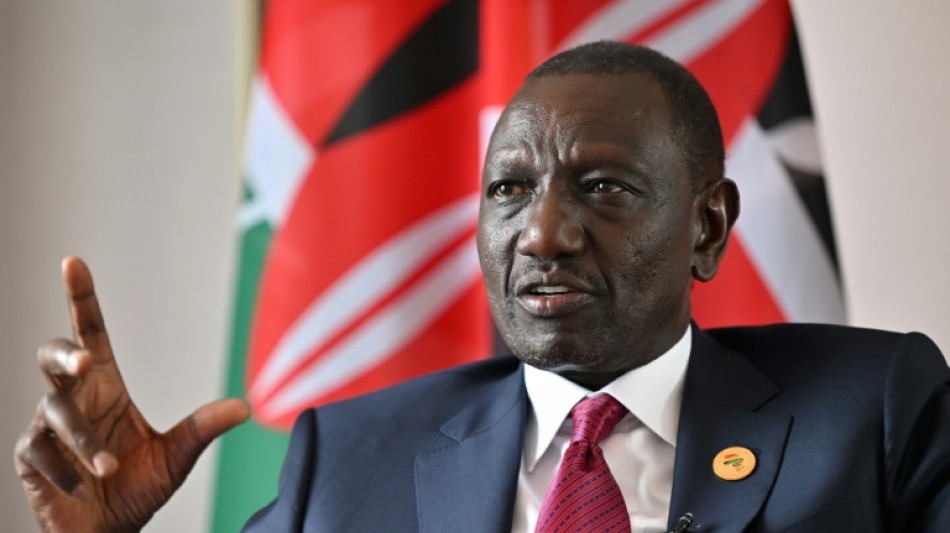
Africa could help 'decarbonise' global economy, Kenyan president tells AFP / Photo: Jung Yeon-je - AFP

 Energy costs spark inflation surges in France, Italy

 South Korea break China hearts to reach Asian Games football final
 Eala storms into Asian Games semi-finals to thrill adoring fans

 Turkey freezes ex-minister's assets as fund crisis grows
 What we know about the North Korean POW dispute
 Most equities rise after oil price plunge, US data in focus
 Polar oceans transformed as warming melts ice habitats: research

 Lost shark becomes viral star in South Korea
 Dangote to launch $16bn refinery in Kenya
 North Korean leader 'extremely obese': Seoul spy agency
 Yankees and pope-backed White Sox start MLB playoffs with wins

 Malaysia's ex-PM Mahathir in hospital for observation
 'No limits': Marathon world record holder Sawe chasing history

 Countdown begins to biggest-ever Rugby World Cup
 Bangladesh women lose ground after quota reform

 Vietnam admits 'differing opinions' on Hanoi development
 Stocks temper gains as oil pares heavy losses, US data in focus
 New Zealand denies breaching climate commitments to EU
 Albert becomes youngest US scorer in 4-2 win over Chile
 Pirate island's plunging population shows Greece's demographic decline
 With elections ahead, Latvia's Russian-speakers reject Moscow's help

 Brazil football clubs face massive sponsorship blow from betting ban
 ChatGPT maker wants to be the App Store for AI as safety concerns grow

 Women fight fires and sexism in Indonesian Borneo

 Forsling's OT blast lifts Florida over Carolina in NHL opener

Kenyan President William Ruto told AFP on Wednesday that Africa could help decarbonise the global economy -- but developed countries need to step up with serious investment to help unlock the continent's potential.
In Seoul for a major summit this week, where South Korea committed $24 billion in aid and investment support to Africa, Ruto urged wealthy countries to do more: from better financing to technology transfers to funding clean energy transitions.
"We are seeing the effects of climate change everywhere," he told AFP, pointing to Kenya's recent experience of swinging from extreme drought to devastating floods.
Africa wants "to be part of the solution" but is being left out of some climate efforts, he said, referring to recent historic levels of investment in renewable energy, of which just a fraction has been directed to Africa.
"There is need for greater investment in the continent of Africa to unlock African potential -- not necessarily to benefit Africa alone," he said.
"We can use the renewable energy assets we have, the mineral resources we have, the human capital we have in our African continent, to decarbonise not just our production and consumption, but global consumption and global production," he said.
This requires "international financial architecture that gives countries that suffer the most and yet have contributed the least the best possible chance to be resilient, to adapt," he said.
"And that's why we've been pushing the international financial architecture to be much more agile, much more flexible, and to provide resources for countries in the developing world, especially in Africa... because at the moment, we are paying close to five or six or seven times more than our counterparts elsewhere."
- Climate cash -
One of the major topics of conversation at the Korea-Africa summit was, he said, Seoul providing more funding "so that more countries can have resources for mitigation, for adaptation, and for managing effects of climate change."
In 2009, developed nations promised to mobilise $100 billion a year by 2020 to help low-income countries invest in clean energy and cope with the worsening effects of climate change.
They met that target for the first time in 2022, two years later than promised, the OECD said last week.
Ruto said that "$100 billion is a step in the right direction," but added that far more was needed.
Experts agree that the $100 billion target is nowhere near what developing nations will need for renewable energy and adaptation measures like coastal defences against rising seas.
A panel convened by the UN estimates these countries -- excluding China -- will need $2.4 trillion a year by 2030 to meet their climate and development needs.
Climate finance is a thorny issue at the annual UN climate talks and negotiators have been working this year to try and set a new goal to supersede the $100 billion target.
The hosts of this year's COP29 in gas-rich Azerbaijan have made the matter a priority and hope to have an ambitious agreement inked during the summit in November.
- Mitigate impacts -
Earlier this year, Kenya was battered by unusually heavy rainfall, causing a trail of destruction and swamping entire villages.
The torrential rains, amplified by the El Nino weather pattern, have killed around 300 people in flood-related disasters since March, according to government data.
Ruto said that Kenya was working across the board to try and make the country more resilient to extreme weather.
"We are moving our tree cover from 10 percent to 30 percent," he said, saying the country would plant 15 billion trees as part of a program to restore wetlands and other fragile, degraded ecosystems.
Ruto has been criticised for last year lifting a six-year ban on logging in state forests, but he said it was important that Kenya balance its needs for commercial forestry and ecosystem conservation.
Kenya's forests are also key to the growing area of carbon markets, with the country accounting for some 25 percent of the carbon trading in Africa, he said.
"It's a whole range of ecosystems, grasslands, forestry, our national parks," he said, adding he had signed new legislation to guide the industry.
The idea is to empower the communities that "are host to the grasslands, to the forests (so they) have a greater say and benefit," than those trading or managing carbon credits, he said.
"It's a very new space," he said, pointing to wild fluctuations in pricing, and calling for a global regulatory mechanism to ensure that "there is equity and that there is no exploitation."
E.Hall--AT