
World's biggest companies snap up 'likely junk' carbon offsets: analysis / Photo: Ronny Hartmann - AFP/File

 Energy costs spark inflation surges in France, Italy

 South Korea break China hearts to reach Asian Games football final

 Eala storms into Asian Games semi-finals to thrill adoring fans

 Turkey freezes ex-minister's assets as fund crisis grows
 What we know about the North Korean POW dispute

 Most equities rise after oil price plunge, US data in focus

 Polar oceans transformed as warming melts ice habitats: research

 Lost shark becomes viral star in South Korea

 Dangote to launch $16bn refinery in Kenya

 North Korean leader 'extremely obese': Seoul spy agency
 Yankees and pope-backed White Sox start MLB playoffs with wins

 Malaysia's ex-PM Mahathir in hospital for observation

 'No limits': Marathon world record holder Sawe chasing history

 Countdown begins to biggest-ever Rugby World Cup

 Bangladesh women lose ground after quota reform

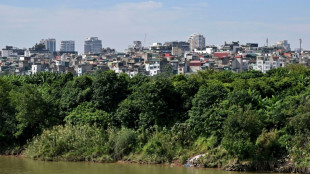 Vietnam admits 'differing opinions' on Hanoi development

 Stocks temper gains as oil pares heavy losses, US data in focus

 New Zealand denies breaching climate commitments to EU

 Albert becomes youngest US scorer in 4-2 win over Chile

 Pirate island's plunging population shows Greece's demographic decline
 With elections ahead, Latvia's Russian-speakers reject Moscow's help

 Brazil football clubs face massive sponsorship blow from betting ban

 ChatGPT maker wants to be the App Store for AI as safety concerns grow

 Women fight fires and sexism in Indonesian Borneo

 Forsling's OT blast lifts Florida over Carolina in NHL opener

Globally recognized companies -- from oil and gas majors to the banking sector and tech -- are contributing to greenwashing by snapping up vast quantities of "likely junk" carbon offsets, a watchdog warned Thursday.
A new analysis by Corporate Accountability found that household names including Disney, Volkswagen, Air France and many more were among corporations heavily investing in probably worthless credits from environmental projects meant to count towards their emissions reductions.
"These trends are extremely worrying," Rachel Rose Jackson, the nonprofit's director of climate research and policy, told AFP.
She added the massive uptake of carbon credits seemed designed "to enable continued greenwashing" or deceptive practices aimed at creating a false impression of environmentally friendly policies.
On paper, the voluntary carbon markets (VCMs) allow corporations to cancel out a portion of their emissions by purchasing credits in emission reducing activities, for example reforestation projects or replacing polluting cookstoves in the developing world.
The sector is currently worth around $2 billion per year -- but a growing body of research has raised concerns that claims of reduced emissions under the schemes are often grossly exaggerated or entirely unfounded.
The new findings build upon a first analysis carried out by Corporate Accountability in collaboration with the Guardian newspaper last fall, which exposed 39 of the largest 50 emission offset projects as "likely junk."
Re-scoring the top 50 projects from the AlliedOffsets Database for the current study, which looked at data until December 31, 2023, they found an increased 42 projects rated as "likely junk," despite emerging industry standards aimed at reform.
Seven projects were deemed "potentially junk," and one lacked sufficient information for classification.
Surprisingly, the buyers of these questionable credits spanned numerous sectors, not just the fossil fuel industry.
Thirty large corporations, including Shell, Nestle, and Boeing, purchased high volumes of "notoriously junk" credits, where "you'd have to have your head in the sand to not know these projects were under extreme scrutiny," said Jackson.
Earlier this week, President Joe Biden's government threw its weight behind VCMs, publishing a set of non-enforceable guidelines it said would signal best practices that would ensure the schemes actually worked to reduce greenhouse gas emissions.
Prominent advocates of carbon markets, including former US climate envoy John Kerry, argue that government funding alone is insufficient to meet the Paris accord's goal of limiting warming to 1.5 degrees Celsius.
But Jackson remained skeptical. "While it's all well and good to launch yet another set of principles, those have not proven to be actionable," she said.
R.Lee--AT
