Brazil farmer who lost everything to floods recalls water's fury / Photo: Nelson ALMEIDA - AFP

 Energy costs spark inflation surges in France, Italy

 South Korea break China hearts to reach Asian Games football final
 Eala storms into Asian Games semi-finals to thrill adoring fans

 Turkey freezes ex-minister's assets as fund crisis grows

 What we know about the North Korean POW dispute

 Most equities rise after oil price plunge, US data in focus

 Polar oceans transformed as warming melts ice habitats: research

 Lost shark becomes viral star in South Korea
 Dangote to launch $16bn refinery in Kenya
 North Korean leader 'extremely obese': Seoul spy agency

 Yankees and pope-backed White Sox start MLB playoffs with wins

 Malaysia's ex-PM Mahathir in hospital for observation

 'No limits': Marathon world record holder Sawe chasing history

 Countdown begins to biggest-ever Rugby World Cup

 Bangladesh women lose ground after quota reform

 Vietnam admits 'differing opinions' on Hanoi development

 Stocks temper gains as oil pares heavy losses, US data in focus
 New Zealand denies breaching climate commitments to EU

 Albert becomes youngest US scorer in 4-2 win over Chile

 Pirate island's plunging population shows Greece's demographic decline
 With elections ahead, Latvia's Russian-speakers reject Moscow's help

 Brazil football clubs face massive sponsorship blow from betting ban
 ChatGPT maker wants to be the App Store for AI as safety concerns grow

 Women fight fires and sexism in Indonesian Borneo

 Forsling's OT blast lifts Florida over Carolina in NHL opener

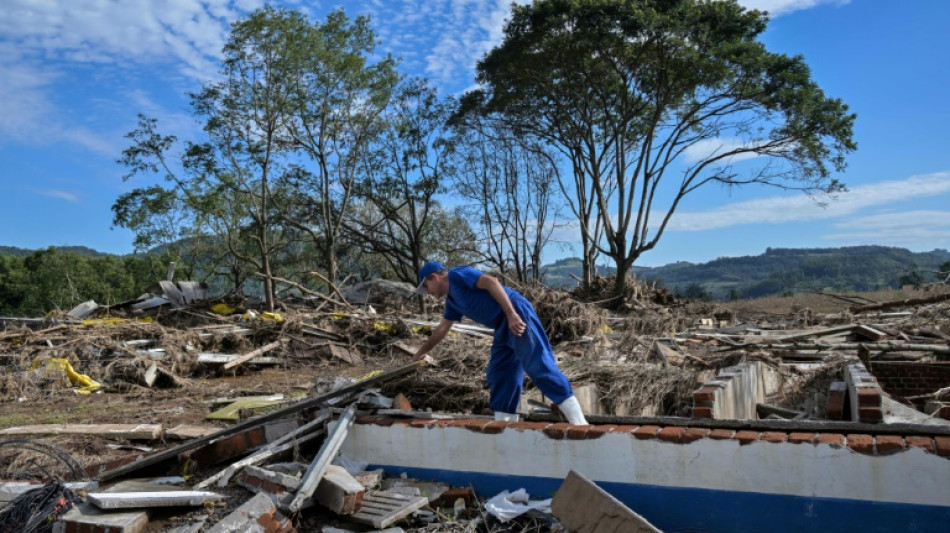
It was 6:00 in the morning when Brazilian farmer Vernei Kunz heard the roar of water as the Forqueta river overflowed its banks and swept away most of his 5,000 pigs.
Kunz, 60, has been farming for the past 42 years in the town of Travesseiro, one of hundreds devastated by weeks of cataclysmic flooding that killed more than 160 people in the southern state of Rio Grande do Sul.
"The sows and piglets were all in the sheds," he told AFP of the morning of May 2.
"We opened the doors to let them out. We managed to grab some that were swimming in the water. We pulled them out and brought them to the road, where they were safe."
Kunz and his workers managed to save about 700 pigs, he said. The slaughterhouse he works with collected them and is sending them to other farms in the region.
"The rest drowned," said Kunz, pointing to piles of rubble that used to be concrete-and-metal sheds.
A foul smell fills the air, a pungent reminder of the pigs still buried beneath the mud three weeks later.
- 'Burn it all' -
The river, about 500 meters (yards) from Kunz's property, swelled as torrential rains pounded the region in late April.
It finally burst its banks with a vengeance, sweeping up virtually everything in its path, including the bridge into Travesseiro.
Today, only the two ends of the nearly 20-meter-high bridge remain, suspended in the air.
Kunz laid off his 12 employees the same day with severance pay, he said.
Without any insurance coverage, he estimates his losses at between 10 million and 15 million reais ($2 million to $3 million).
Overall, the agricultural sector -- the engine of the region's economy -- lost around $430 million, according to the National Confederation of Municipalities.
The pig farmers' association for Rio Grande do Sul, one of Brazil's biggest producers and exporters of pork, said the devastation affected between 25 and 28 percent of production.
"I had been through big floods before in 2010, but nothing like this," said Kunz.
"That time, we could rebuild. This time, the water destroyed everything."
Experts say the intensity of the floods was linked to climate change.
"You can't go against nature," said Kunz, still wearing galoshes.
His property, which spans several thousand square meters, is littered with twisted metal, aluminum sheets, pieces of walls and tree trunks.
"I'll have to burn it all. What else can I do?" he said.
His son, Eduardo, 34, explains that the farm was a modern operation, including using artificial insemination to breed animals with the best characteristics.
"We had very expensive machines. It would be difficult to get that back," he said.
Eduardo, his wife and their two-year-old son share a small house with his parents on higher ground up the road, where the water did not reach this time.
- Restarting from scratch -
The family plans to stay in Travesseiro, a quiet farming town of 2,000 people.
Mayor Gilmar Southier estimates 80 percent of the local population were affected by the floods.
He said the priority is to rebuild the bridge, the key link between the town and the region's main cities.
Kunz, for his part, plans to start over. But instead of pigs, he wants to farm corn and soybeans.
"If I lose everything again, it will cost less to start over next time."
He expects his first harvest in August 2026. Until then, he said, he will have to find loans to get back on his feet.
O.Gutierrez--AT