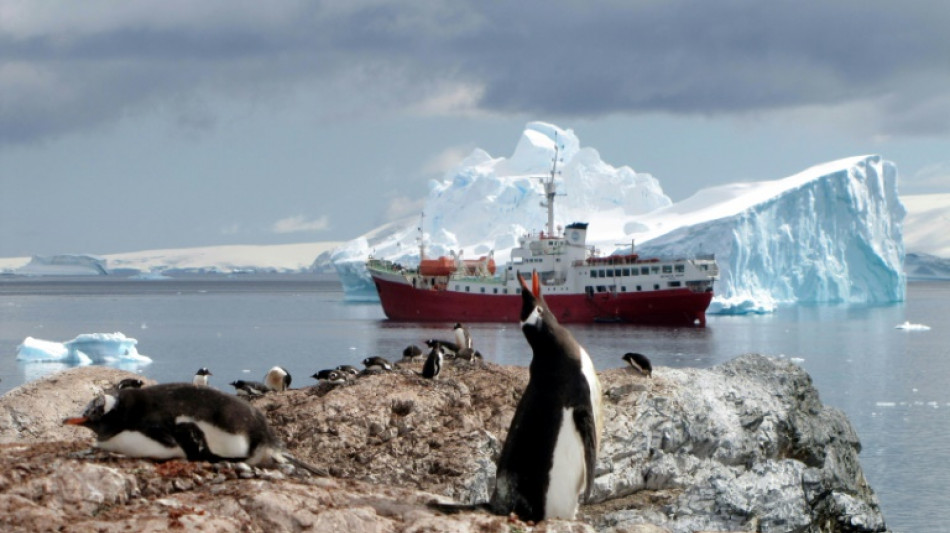
Emperor penguins perish as ice melts to new lows: study / Photo: SARAH DAWALIBI - AFP/File

 Energy costs spark inflation surges in France, Italy

 South Korea break China hearts to reach Asian Games football final

 Eala storms into Asian Games semi-finals to thrill adoring fans

 Turkey freezes ex-minister's assets as fund crisis grows

 What we know about the North Korean POW dispute

 Most equities rise after oil price plunge, US data in focus

 Polar oceans transformed as warming melts ice habitats: research

 Lost shark becomes viral star in South Korea

 Dangote to launch $16bn refinery in Kenya

 North Korean leader 'extremely obese': Seoul spy agency

 Yankees and pope-backed White Sox start MLB playoffs with wins

 Malaysia's ex-PM Mahathir in hospital for observation

 'No limits': Marathon world record holder Sawe chasing history

 Countdown begins to biggest-ever Rugby World Cup

 Bangladesh women lose ground after quota reform

 Vietnam admits 'differing opinions' on Hanoi development

 Stocks temper gains as oil pares heavy losses, US data in focus

 New Zealand denies breaching climate commitments to EU

 Albert becomes youngest US scorer in 4-2 win over Chile
 Pirate island's plunging population shows Greece's demographic decline

 With elections ahead, Latvia's Russian-speakers reject Moscow's help

 Brazil football clubs face massive sponsorship blow from betting ban

 ChatGPT maker wants to be the App Store for AI as safety concerns grow

 Women fight fires and sexism in Indonesian Borneo

 Forsling's OT blast lifts Florida over Carolina in NHL opener

Colonies of emperor penguin chicks were wiped out last year as global warming eroded their icy homes, a study published Thursday found, despite the birds' attempts to adapt to the shrinking landscape.
The study by the British Antarctic Survey found that record-low sea ice levels in 2023 contributed to the second-worst year for emperor penguin chick mortality since observations began in 2018.
It follows a "catastrophic breeding failure" in 2022, signalling long-term implications for the population, the study's author Peter Fretwell told AFP.
Emperor penguins breed on sea-ice platforms, with chicks hatching in the winter between late July and mid-August.
The chicks are reared until they develop waterproof feathers, typically in December ahead of the summer melt.
But if the ice melts too early, the chicks risk drowning and freezing.
Fourteen of 66 penguin colonies, which can each produce several hundred to several thousand chicks in a year, were affected by early sea-ice loss in 2023, said the study published in the Journal of Antarctic Science.
The result is "high if not total levels of mortality", Fretwell said.
Yet 2023 "wasn't as bad as we feared", he said.
A record 19 colonies were affected the year before.
- On the move -
The study also found that several colonies, particularly those ravaged the previous year, had moved in search of better conditions onto icebergs, ice shelves or more stable sea ice.
While such moves offer a hopeful sign that the birds can adapt to the changing environment, Fretwell warned it was a "temporary solution".
"Penguins are limited in the amount of adaptation they can do. There are only so many places they can go," he said.
Instead, Fretwell said humans needed to adapt by reduce planet-heating greenhouse gas emissions that are contributing to ice melt to mitigate the main threat facing the species.
Both 2022 and 2023 were the first years to see the area of sea-ice fall below two million square kilometres (770,000 square miles) since the beginning of satellite records.
That marks a decine of about 30 percent from the 1981-2010 average.
There are about a quarter of a million breeding emperor penguin pairs, all in Antarctica, according to a 2020 study.
"If you get multiple bad years, it is going to start to drive the population down over time," Fretwell said.
The study noted that if greenhouse gas emissions continue at current levels, the penguin population is expected to decline by 99 percent by the end of the century.
A.Williams--AT