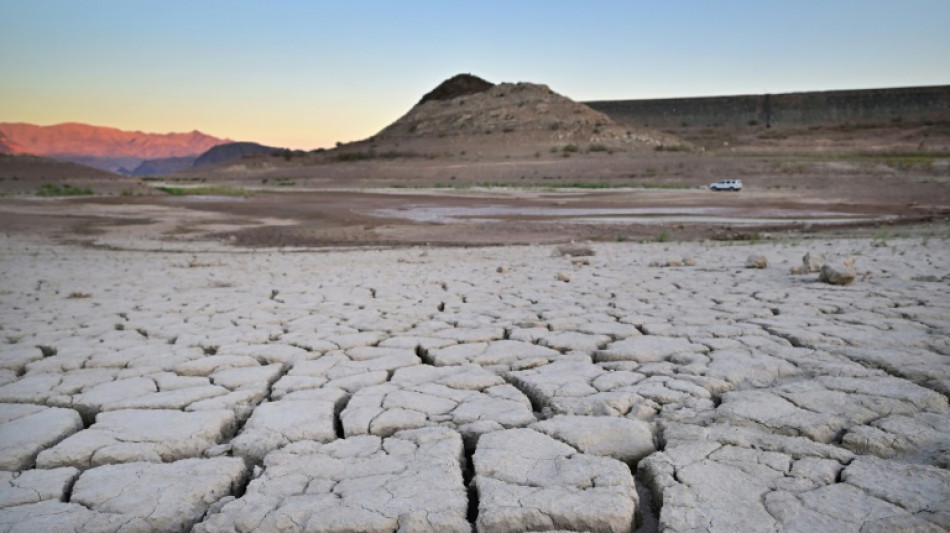
Climate impacts set to cut 2050 global GPD by nearly a fifth / Photo: Frederic J. BROWN - AFP/File

 South Korea score late to reach Asian Games football final

 Tom Kim defies jet-lag, Kho cards ace as Asian Games golf begins
 Thai teen rocker Nene aims to tour, write music... and return to school

 Ivory Coast clamps down on harmful illegal gold rush

 Nagoya mayor says sorry for Asian Games 'inconveniences'

 G20 trade officials meet under shadow of tariffs, overcapacity

 India's fat dog vote goes viral

 Asian Games crowds in spotlight as 998 see hosts in 50,000 stadium

 The eight stadiums for the 2027 Rugby World Cup

 Thieves swipe drugs under nose of Fiji police, swap with flour

 South Korea demands North apologise for DMZ mine blasts
 In Nepal's flood zone, teachers mourn students who never returned

 US Supreme Court lifts limits on third-country deportations

 Antonelli eager to 're-establish order' as F1 returns to Malaysia

 Paw-fect candidate: Australia finds new koala rescue dog

 One third of world population exposed to harmful air pollution: monitor

 North Korea denies South's claim it was apparently behind DMZ mine blasts

 West Bank's violent settlers part of a new generation fuelled by ideology

 US-led coalition ends mission in Iraq
 Pope-backed White Sox join Braves with MLB playoff wins

 Psychology Software Tools Builds on Early Bioz Success to Expand Access to Publication-Backed Product Evidence

 Alpha Growth Management Opens Rep Office in Japan

 NBA close to picking new $12-13bn Vegas team owners: report

 LA28 Olympics torch relay to visit all 50 states

 Spain brush aside Croatia in Nations League, England down Czechs

Climate change caused by CO2 emissions already in the atmosphere will shrink global GDP in 2050 by about $38 trillion, or almost a fifth, no matter how aggressively humanity cuts carbon pollution, researchers said Wednesday.
But slashing greenhouse gas emissions as quickly as possible remains crucial to avoid even more devastating economic impacts after mid-century, they reported in the journal Nature.
Economic fallout from climate change, the study shows, could increase tens of trillions of dollars per year by 2100 if the planet were to warm significantly beyond two degrees Celsius above mid-19th century levels.
Earth's average surface temperature has already climbed 1.2C above that benchmark, enough to amplify heatwaves, droughts, flooding and tropical storms made more destructive by rising seas.
Annual investment needed to cap global warming below 2C -- the cornerstone goal of the 2015 Paris Agreement -- is a small fraction of the damages that would be avoided, the researchers found.
Staying under the 2C threshold "could limit average regional income loss to 20 percent compared to 60 percent" in a high-emissions scenario, lead author Max Kotz, an expert in complexity science at the Potsdam Institute for Climate Impact Research (PIK), told AFP.
Economists disagree on how much should be spent to avoid climate damages. Some call for massive investment now, while others argue it would be more cost-effective to wait until societies are richer and technology more advanced.
- Poor countries hit hardest -
The new research sidesteps this debate, but its eye-watering estimate of economic impacts helps make the case for ambitious near-term action, the authors and other experts said.
"Our calculations are super relevant" to such cost-benefit analyses, said co-author Leonie Wenz, also a researcher at PIK.
They could also inform government strategies for adapting to climate impacts, risk assessments for business, and UN-led negotiations over compensation for developing nations that have barely contributed to global warming, she told AFP.
Mostly tropical nations -- many with economies already shrinking due to climate damages -- will be hit hardest, the study found.
"Countries least responsible for climate change are predicted to suffer income loss that is 60 percent greater than the higher-income countries and 40 percent greater than higher-emission countries," said senior PIK scientist Anders Levermann.
"They are also the ones with the least resources to adapt to its impacts."
Rich countries will not be spared either: Germany and the United States are forecast to see income shrivel by 11 percent by 2050, and France by 13 percent.
Projections are based on four decades of economic and climate data from 1,600 regions rather than country-level statistics, making it possible to include damages earlier studies ignored, such as extreme rainfall.
- A likely underestimate -
The researchers also looked at temperature fluctuations within each year rather than just averages, as well as the economic impact of extreme weather events beyond the year in which they occurred.
"By accounting for these additional climate variables, the damages are about 50 percent larger than if we were to only include changes in annual average temperatures," the basis of most prior estimates, said Wenz.
Wenz and her colleagues found that unavoidable damage would slash the global economy's GPD by 17 percent in 2050, compared to a scenario with no additional climate impacts after 2020.
Even so, the new calculations may be conservative.
"They are likely to be an underestimate of the costs of climate change impacts," Bob Ward, policy director of the Grantham Research Institute on Climate Change and the Environment in London, commented to AFP ahead of the study's publication.
Damages linked to sea-level rise, stronger tropical cyclones, the destabilisation of ice sheets and the decline of major tropical forests are all excluded, he noted.
Climate economist Gernot Wagner, a professor at Columbia Business School in New York who was also not involved in the study, said the conclusion that "trillions in damages are all locked in doesn't mean that cutting carbon pollution doesn't pay."
In fact, he said, it shows that "the costs of acting are a fraction of the costs of unmitigated climate change".
Global GDP in 2022 was just over $100 trillion, according to the World Bank. The study projects that -- absent climate impacts after 2020 -- it would be double that in 2050.
Y.Baker--AT