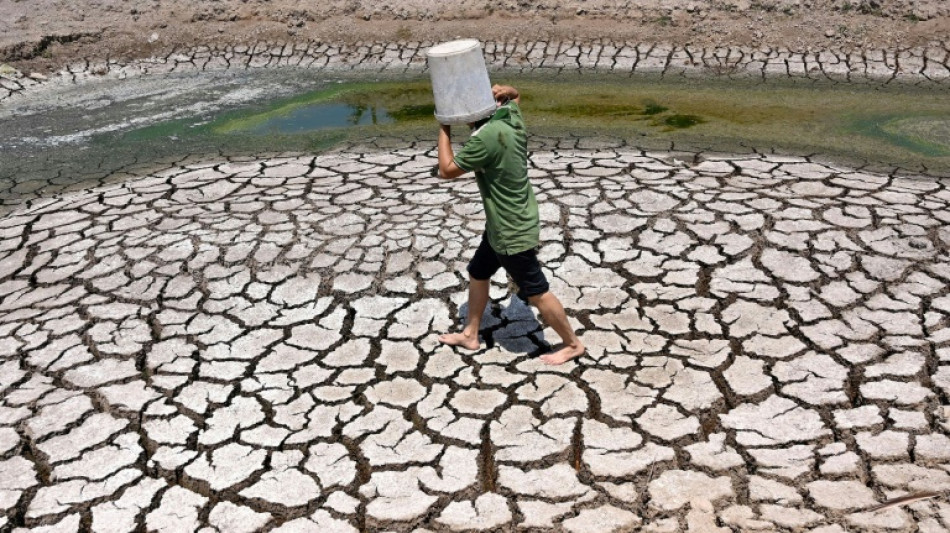
March saw 10th straight month of record global heat: monitor / Photo: Nhac NGUYEN - AFP

 South Korea score late to reach Asian Games football final

 Tom Kim defies jet-lag, Kho cards ace as Asian Games golf begins

 Thai teen rocker Nene aims to tour, write music... and return to school

 Ivory Coast clamps down on harmful illegal gold rush

 Nagoya mayor says sorry for Asian Games 'inconveniences'

 G20 trade officials meet under shadow of tariffs, overcapacity

 India's fat dog vote goes viral

 Asian Games crowds in spotlight as 998 see hosts in 50,000 stadium

 The eight stadiums for the 2027 Rugby World Cup

 Thieves swipe drugs under nose of Fiji police, swap with flour

 South Korea demands North apologise for DMZ mine blasts

 In Nepal's flood zone, teachers mourn students who never returned

 US Supreme Court lifts limits on third-country deportations

 Antonelli eager to 're-establish order' as F1 returns to Malaysia

 Paw-fect candidate: Australia finds new koala rescue dog

 One third of world population exposed to harmful air pollution: monitor

 North Korea denies South's claim it was apparently behind DMZ mine blasts

 West Bank's violent settlers part of a new generation fuelled by ideology

 US-led coalition ends mission in Iraq

 Pope-backed White Sox join Braves with MLB playoff wins

 Psychology Software Tools Builds on Early Bioz Success to Expand Access to Publication-Backed Product Evidence

 Alpha Growth Management Opens Rep Office in Japan

 NBA close to picking new $12-13bn Vegas team owners: report
 LA28 Olympics torch relay to visit all 50 states

 Spain brush aside Croatia in Nations League, England down Czechs

Europe's climate monitor said Tuesday that March was the hottest on record and the tenth straight month of historic heat, with sea surface temperatures also hitting a "shocking" new high.
It is the latest red flag in a year already marked by climate extremes and rising greenhouse gas emissions, spurring fresh calls for more rapid action to limit global warming.
- Rolling records -
Every month since June 2023 has beaten its own "hottest ever" tag -- and March 2024 was no exception.
The EU's Copernicus Climate Change Service (C3S) said that March globally was 1.68 degrees Celsius hotter than an average March between the years 1850-1900, the reference period for the pre-industrial era.
The March record was only broken by 0.1C but it is the broader trend that was more alarming, said Samantha Burgess, deputy director of C3S.
Huge swathes of the planet endured above-average temperatures in March, from parts of Africa to Greenland, South America and Antarctica.
- 'Borrowed time' -
It was not only the tenth consecutive month to break its own heat record, but capped the hottest 12-month period on the books -- 1.58C above pre-industrial averages.
This doesn't mean the 1.5C warming limit agreed by world leaders in Paris in 2015 has been breached -- that is measured in decades, not individual years.
Nonetheless "the reality is that we're extraordinarily close, and already on borrowed time," Burgess told AFP.
The UN's IPCC climate panel has warned that the world will likely crash through 1.5C in the early 2030s.
- 'Incredibly unusual' -
The story at sea was no less "shocking", Burgess said, with a new record for global ocean surface temperature set in February eclipsed once again in March.
"That's incredibly unusual," she said.
Oceans cover 70 percent of the planet and have kept the Earth's surface liveable by absorbing 90 percent of the excess heat produced by the carbon pollution from human activity since the dawn of the industrial age.
- More heat, more rain -
Hotter oceans mean more moisture in the atmosphere -- scientists say the air can generally hold around seven percent more water vapour for every 1C of temperature rise.
This leads to increasingly erratic weather, like fierce winds and powerful rain.
Russia is reeling from some of its worst flooding in decades while parts of Australia, Brazil and France experienced an exceptionally wet March.
"We know the warmer our global atmosphere is, the more extreme events we'll have, the worse they will be, the more intense they will be," Burgess told AFP.
- Heat on the horizon -
Copernicus said the cyclical El Nino climate pattern, which warms the sea surface in the Pacific Ocean, leading to hotter weather globally, continued to weaken in March.
But its "warming effect" alone did not explain the dramatic spikes witnessed this past year and projections for the coming months still indicated above-average temperatures, Burgess said.
Could this mean more records shattered this year?
"Whilst we continue to see so much heat in the surface ocean -- so in the sea surface temperatures -- I think it's highly likely," Burgess said.
- Bigger question -
Copernicus records go back to 1940 but other sources of climate data such as ice cores, tree rings and coral skeletons allow scientists to expand their conclusions using evidence from much deeper in the past.
"We know that the period that we're living in right now is likely to be the warmest that it's been for the last 100,000 years," Burgess said.
As climate records tumble, scientists are debating whether the extreme heat seen this past year was within the bounds of what was forecast -- or was something more uncharted.
"Is it a phase change? Is the climate system broken? We don't really understand yet why we have this additional heat in 23/24. We can explain most of it, but not all of it," Burgess said.
What had transpired was "within the envelope" of scientific forecasts "but it was the very outer edge of the envelope, rather than the mean or the median where you'd expect it to fall", she added.
- Up and up -
Humanity, meanwhile, continues to pump ever-more planet-heating emissions into the atmosphere even as scientists say they need to fall by almost half this decade to keep the Paris goals within reach.
Levels of carbon dioxide, methane, and nitrous oxide -- the three main human-caused greenhouse gases -- rose for another year in 2023, scientists from the US-based National Oceanic and Atmospheric Administration said on Friday.
"Until we get to net zero, we will continue to see temperatures rise," Burgess said.
N.Walker--AT