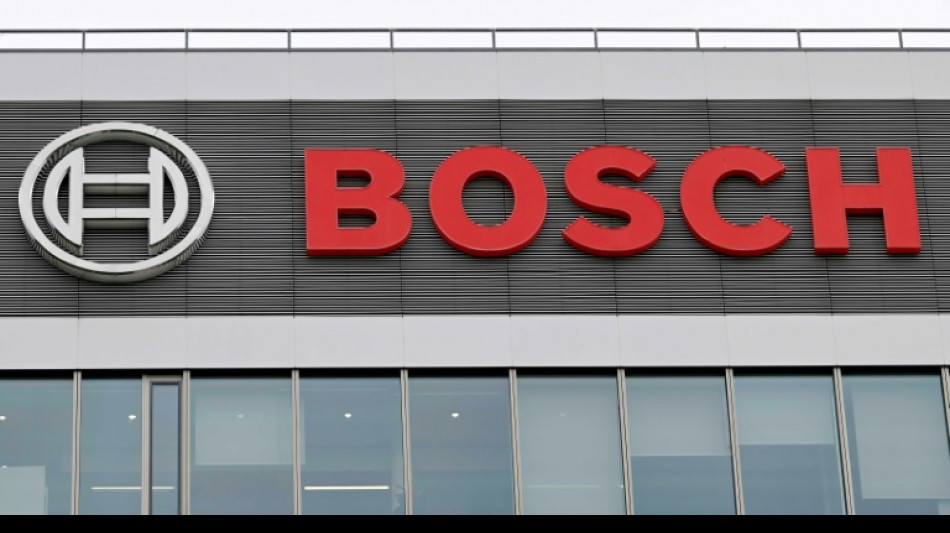
Struggling German auto supplier Bosch pivots to robots / Photo: THOMAS KIENZLE - AFP

 NAND Prices Set to Fall in Early 2027 as DRAM Remains Elevated
 NSE and BSE Restrict Algorithmic Trading to Tech-Savvy Investors with Static IP

 Report Finds Large UK Fishing Fleet Violates Rules Two-Thirds of Time

 COP31 Negotiations Collapse as Youth Climate Demands Clash with Fossil Fuel Lobbying

 Craig Reucassel’s Ultra-Processed Food Experiment Reveals Brain Changes

 Seattle U Defeats Loyola Chicago 76-63 to Win Acrisure Series Title
German industrial giant Bosch said Wednesday it will step up efforts in the field of humanoid robotics, as its traditional auto business comes under increasing pressure.
The world's biggest auto supplier, Bosch makes everything from braking systems to sensors, but has suffered as European carmakers battle fierce overseas competition and weak demand.
However,the rise of humanoid robots, powered with generative AI models and capable of performing complex tasks, offers an opening for the group, chief executive Stefan Hartung said.
"With the advent of humanoid robotics, the demand for Bosch components and solutions is increasing," he said in a statement.
The market for specialised MEMS sensors is expected to grow to over $19.2 billion by 2030 and hit an annual growth rate of four percent, according a study by consultancy Yole Group, which was presented by Bosch.
Bosch is a key producer of the tiny sensors, which are crucial in robotics.
At an event in Berlin, Hartung stressed the importance of the components in improving the dexterity of robots.
These sensors determine whether the robot "should tighten its grip or not, whether it is dealing with a sturdy object, or whether it needs to act delicately because it is an egg," he said.
"Humans have four million touch sensors. If we were to build robots equipped with as many sensors, four years of global sensor production would barely be enough to equip 12,500 robots" he added.
The focus on automation is also meant to boost the competitiveness of Bosch's German factories and plug shortages of skilled labour.
Bosch, also known for making a wide range of industrial equipment and household appliances, struck a deal with German robotics firm Neura in January to gather data on factory work.
Under the partnership, several thousand workers in some of Bosch's 350 facilities worldwide will wear sensor suits to glean training data for Neura robots.
M.White--AT