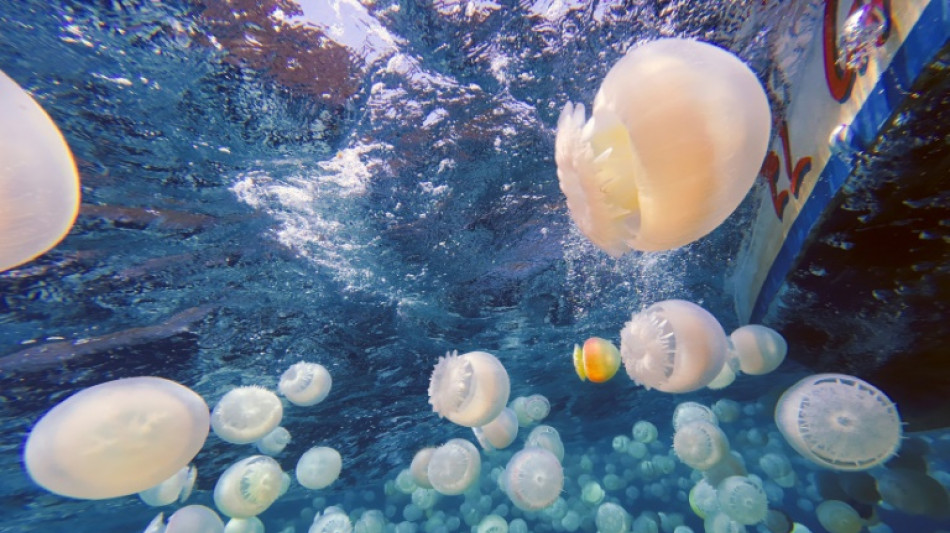
Jellyfish invade Venezuelan waters, worrying fishermen / Photo: Juan BARRETO - AFP

 South Korea score late to reach Asian Games football final

 Tom Kim defies jet-lag, Kho cards ace as Asian Games golf begins

 Thai teen rocker Nene aims to tour, write music... and return to school
 Ivory Coast clamps down on harmful illegal gold rush

 Nagoya mayor says sorry for Asian Games 'inconveniences'

 G20 trade officials meet under shadow of tariffs, overcapacity

 India's fat dog vote goes viral

 Asian Games crowds in spotlight as 998 see hosts in 50,000 stadium

 The eight stadiums for the 2027 Rugby World Cup

 Thieves swipe drugs under nose of Fiji police, swap with flour

 South Korea demands North apologise for DMZ mine blasts
 In Nepal's flood zone, teachers mourn students who never returned

 US Supreme Court lifts limits on third-country deportations
 Antonelli eager to 're-establish order' as F1 returns to Malaysia

 Paw-fect candidate: Australia finds new koala rescue dog
 One third of world population exposed to harmful air pollution: monitor

 North Korea denies South's claim it was apparently behind DMZ mine blasts

 West Bank's violent settlers part of a new generation fuelled by ideology

 US-led coalition ends mission in Iraq
 Pope-backed White Sox join Braves with MLB playoff wins

 Psychology Software Tools Builds on Early Bioz Success to Expand Access to Publication-Backed Product Evidence

 Alpha Growth Management Opens Rep Office in Japan

 NBA close to picking new $12-13bn Vegas team owners: report
 LA28 Olympics torch relay to visit all 50 states

 Spain brush aside Croatia in Nations League, England down Czechs

A thick bloom of varying hues drifts in the turquoise waters of Aragua in Venezuela, a surreal vision attributed to climate change that has decimated fishing stocks.
"It is like there are flowers in the sea. This has never happened before," said Elvis Morillo, 59, a fisherman in the northern village of Chuao, where verdant mountains hug the Caribbean coast.
The invasive cannonball jellyfish is filling fishermen's nets, in a surge the environment ministry attributes to warming waters from climate change and a decline in jellyfish predators such as sharks and sea turtles.
At the same time, "sardines and other species that serve as fishing bait have disappeared. Fishing is at its lowest level in years," said Gustavo Carrasquel, of the NGO Azul Ambientalistas, who lives in Choroni, a town neighboring Chuao.
Globally, jellyfish populations have soared. Researchers have warned of a tipping point in which the oceans could go from being dominated by fish populations, to jellyfish -- mostly as a result of overfishing.
The gelatinous creatures, which do not have a heart, brain or complex organs, thrive in harsh conditions and need little oxygen.
This is an "atypical event, completely abnormal," said Joxmer Scott-Frias, a researcher at the Institute of Zoology and Tropical Ecology at the Central University of Venezuela.
"A few individuals had been observed in recent years, but the increase in the population this year exceeded previous estimates," he said while collecting samples of the jellyfish for study.
Scott-Frias said the reasons for the surge were not yet clear.
The jellyfish bloom and the presence of the invasive coral Unomia stolonifera, which smothers native corals, have become a headache for local fishermen.
"It has been almost nine months without fish production," said Fernando Mayora, head of the fishermen's council in Choroni.
"With the problem of jellyfish and invasive corals, we don't know what to do. The fish have disappeared," he said.
In Chuao, fishermen who would bring in between 3,000 and 5,000 kilograms a week have seen their yields drop to between 500 and 1,000 kilograms, said Douglas Martinez, 44, a fisherman.
Mayora said that Venezuela should draw inspiration from countries such as Mexico, which exploits jellyfish commercially, exporting it to Asian countries where it is used in gastronomy or the pharmaceutical industry.
"We need to know if we can take advantage of this in Venezuela," he said.
A.Moore--AT