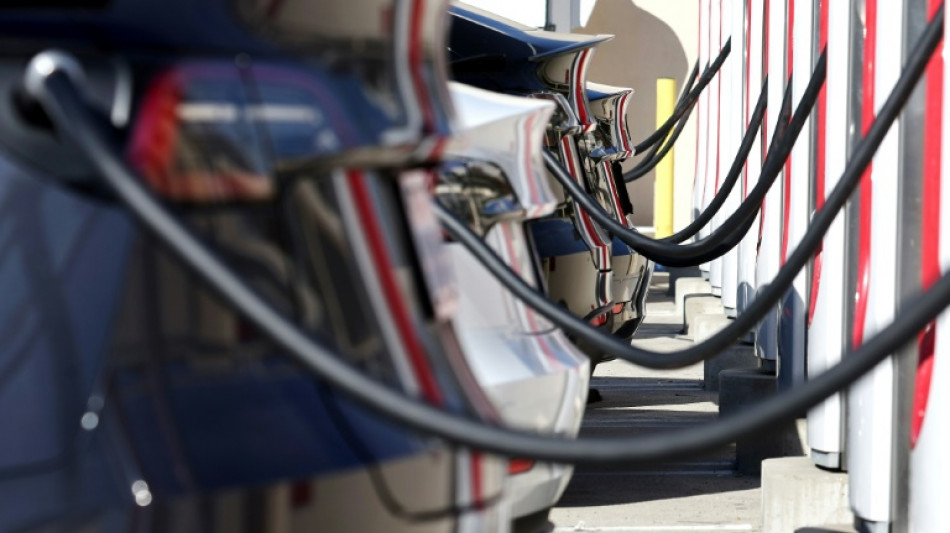
Electric cars credited with lower CO2 emissions in US neighborhoods / Photo: MARIO TAMA - GETTY IMAGES NORTH AMERICA/AFP

 South Korea score late to reach Asian Games football final

 Tom Kim defies jet-lag, Kho cards ace as Asian Games golf begins

 Thai teen rocker Nene aims to tour, write music... and return to school

 Ivory Coast clamps down on harmful illegal gold rush

 Nagoya mayor says sorry for Asian Games 'inconveniences'

 G20 trade officials meet under shadow of tariffs, overcapacity

 India's fat dog vote goes viral

 Asian Games crowds in spotlight as 998 see hosts in 50,000 stadium

 The eight stadiums for the 2027 Rugby World Cup

 Thieves swipe drugs under nose of Fiji police, swap with flour
 South Korea demands North apologise for DMZ mine blasts

 In Nepal's flood zone, teachers mourn students who never returned

 US Supreme Court lifts limits on third-country deportations

 Antonelli eager to 're-establish order' as F1 returns to Malaysia

 Paw-fect candidate: Australia finds new koala rescue dog

 One third of world population exposed to harmful air pollution: monitor

 North Korea denies South's claim it was apparently behind DMZ mine blasts

 West Bank's violent settlers part of a new generation fuelled by ideology

 US-led coalition ends mission in Iraq

 Pope-backed White Sox join Braves with MLB playoff wins

 Psychology Software Tools Builds on Early Bioz Success to Expand Access to Publication-Backed Product Evidence
 Alpha Growth Management Opens Rep Office in Japan

 NBA close to picking new $12-13bn Vegas team owners: report

 LA28 Olympics torch relay to visit all 50 states

 Spain brush aside Croatia in Nations League, England down Czechs

The booming use of electric vehicles in parts of California is reducing CO2 emissions in those areas, a study showed Thursday, bolstering a key pillar of the state's drive towards net zero.
Scientists at the University of California, Berkeley, say a network of sensors set up around the San Francisco Bay Area -- where Teslas and other EVs are a common sight -- has logged a small but steady drop in the volume of planet-warming carbon dioxide being pumped out every year.
"We show from atmospheric measurements that adoption of electric vehicles is working, that it's having the intended effect on CO2 emissions," said chemistry professor Ronald Cohen, the study's lead author.
Carbon dioxide is one of the main contributors to global warming, the human-caused phenomenon of rising temperatures that is increasingly playing havoc with global weather patterns.
Scientists agree that nations have to rapidly shift away from burning fossil fuels in order to keep global temperature rises to a manageable level and avoid the worst environmental calamities.
More than two-thirds of CO2 emissions come from cities, but granular information about those emissions is scant -- leaving policymakers guessing at how best to tamp them down.
Cohen's network of dozens of sensors, which he started installing in 2012, has started to change that. It logged a 1.8 percent drop in emissions every year over a five-year period.
Cross-referencing this data with vehicle registration information in the Bay Area -- where almost one in every 20 vehicles is electric or hybrid -- led Cohen and his team to conclude electrification was having a measurable effect.
"The state of California has an ambition to be net zero in 2045 and that requires a decrease (in emissions) of a little more than three and a half percent per year for the next 20 plus years," Cohen told AFP.
"1.8 percent per year is half the rate that we need to decrease. But I think it's an amazing down payment on our way to the right future."
- 'Good news' -
California's ambitious plan for net zero -- where CO2 production is vastly reduced and any remaining emissions are offset -- puts it ahead of the 2050 target of the United States as a whole.
The state, which if it were a country would have the fifth-biggest economy in the world, has some of the strictest environmental standards in the United States, including a plan to ban the sale of new gas-powered cars by 2035.
Cohen, who plans to roll out his sensor network in Los Angeles, in Providence, Rhode Island and in the Scottish city of Glasgow, acknowledges that the Bay Area's enthusiastic adoption of EVs in a state sympathetic to the cause makes it an atypical case study.
"This is what a good news story looks like in the place that's most aggressive," he said.
"But it shows it's possible. It shows both how we can make measurements that allow us to report on how cities are doing with their policies, and it shows us those policies can make changes that are observable at scale," he said.
W.Stewart--AT