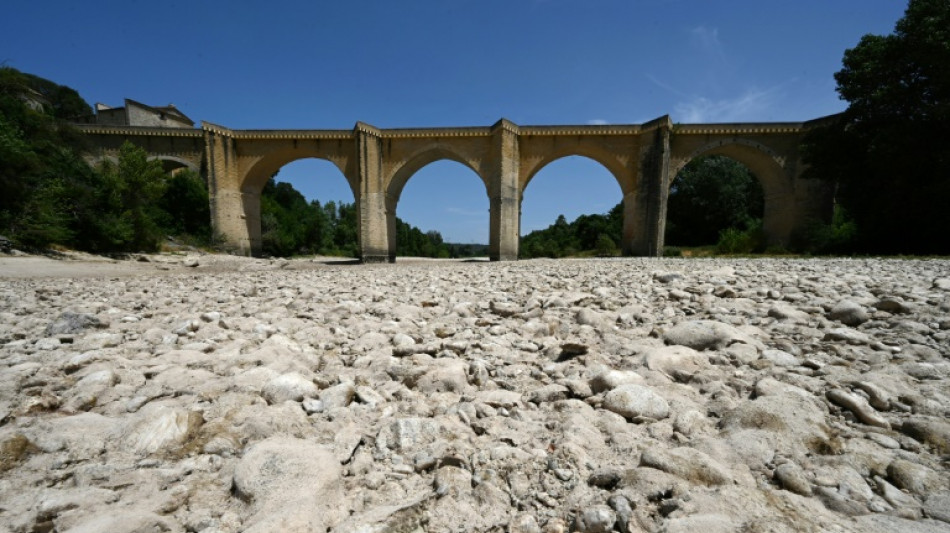
Climate change is slowing heat waves, prolonging misery / Photo: Pascal GUYOT - AFP/File

 South Korea score late to reach Asian Games football final

 Tom Kim defies jet-lag, Kho cards ace as Asian Games golf begins

 Thai teen rocker Nene aims to tour, write music... and return to school

 Ivory Coast clamps down on harmful illegal gold rush

 Nagoya mayor says sorry for Asian Games 'inconveniences'

 G20 trade officials meet under shadow of tariffs, overcapacity

 India's fat dog vote goes viral

 Asian Games crowds in spotlight as 998 see hosts in 50,000 stadium

 The eight stadiums for the 2027 Rugby World Cup

 Thieves swipe drugs under nose of Fiji police, swap with flour
 South Korea demands North apologise for DMZ mine blasts
 In Nepal's flood zone, teachers mourn students who never returned

 US Supreme Court lifts limits on third-country deportations

 Antonelli eager to 're-establish order' as F1 returns to Malaysia

 Paw-fect candidate: Australia finds new koala rescue dog

 One third of world population exposed to harmful air pollution: monitor

 North Korea denies South's claim it was apparently behind DMZ mine blasts

 West Bank's violent settlers part of a new generation fuelled by ideology

 US-led coalition ends mission in Iraq
 Pope-backed White Sox join Braves with MLB playoff wins

 Psychology Software Tools Builds on Early Bioz Success to Expand Access to Publication-Backed Product Evidence

 Alpha Growth Management Opens Rep Office in Japan

 NBA close to picking new $12-13bn Vegas team owners: report
 LA28 Olympics torch relay to visit all 50 states

 Spain brush aside Croatia in Nations League, England down Czechs

Climate change is causing heat waves to slow to a crawl, exposing humans to extreme temperatures for longer than ever before, a study published in Science Advances said Friday.
While previous research has found climate change is causing heat waves to become longer, more frequent and more intense, the new paper differed by treating heat waves as distinct weather patterns that move along air currents, just as storms do.
For every decade between 1979 to 2020, researchers found heat waves slowed down by an average of five miles (eight kilometers) an hour per day.
"If a heatwave is moving slower, that means heat can stay in a region longer, so that has effects on communities," senior author Wei Zhang of Utah State University told AFP.
The researchers divided the world into three dimensional-grid cells and defined heat waves as a million square kilometer zones where temperatures reached at least the 95th percentile of the local historical maximum temperature. They then measured their movement over time in order to determine how fast the hot air was moving.
They also used climate models to determine what the results would have looked like absent human-caused climate change, and found manmade factors loomed large.
"It's pretty clear to us that a dominant factor here to explain this trend is anthropogenic forcing, the greenhouse gas," said Zhang.
The changes have accelerated in particular since 1997 and in addition to human causes, weakening upper atmospheric air circulation may play a part, the paper said.
The duration of heat waves also increased, from an average of eight days at the start, to 12 days during the last five years of the study period.
"The results suggest that longer-traveling and slower-moving large contiguous heat waves will cause more devastating impacts on natural and societal systems in the future if GHG keep rising, and no effective mitigation measures are taken," the authors wrote.
Zhang said he was worried by the disproportionate impacts on less-developed regions.
"In particular, cities that don't have enough green infrastructure or not many cooling centers for some folks, in particular for the disadvantaged population, will be very dangerous," he warned.
la-ia/mdl
A.Anderson--AT