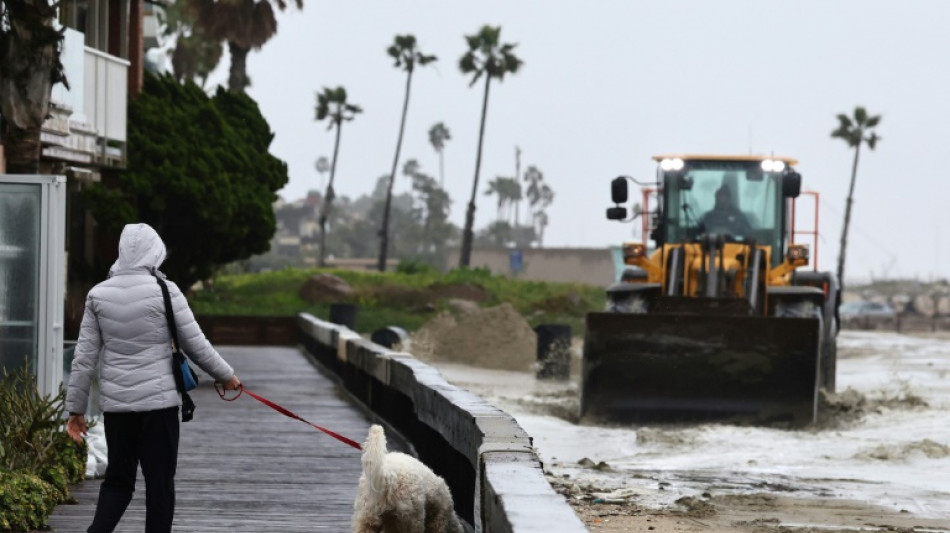
Sinking US cities more exposed to rising seas: study / Photo: MARIO TAMA - GETTY IMAGES NORTH AMERICA/AFP/File

 South Korea score late to reach Asian Games football final

 Tom Kim defies jet-lag, Kho cards ace as Asian Games golf begins

 Thai teen rocker Nene aims to tour, write music... and return to school

 Ivory Coast clamps down on harmful illegal gold rush

 Nagoya mayor says sorry for Asian Games 'inconveniences'

 G20 trade officials meet under shadow of tariffs, overcapacity

 India's fat dog vote goes viral

 Asian Games crowds in spotlight as 998 see hosts in 50,000 stadium

 The eight stadiums for the 2027 Rugby World Cup

 Thieves swipe drugs under nose of Fiji police, swap with flour

 South Korea demands North apologise for DMZ mine blasts
 In Nepal's flood zone, teachers mourn students who never returned

 US Supreme Court lifts limits on third-country deportations

 Antonelli eager to 're-establish order' as F1 returns to Malaysia

 Paw-fect candidate: Australia finds new koala rescue dog

 One third of world population exposed to harmful air pollution: monitor

 North Korea denies South's claim it was apparently behind DMZ mine blasts

 West Bank's violent settlers part of a new generation fuelled by ideology

 US-led coalition ends mission in Iraq

 Pope-backed White Sox join Braves with MLB playoff wins

 Psychology Software Tools Builds on Early Bioz Success to Expand Access to Publication-Backed Product Evidence

 Alpha Growth Management Opens Rep Office in Japan

 NBA close to picking new $12-13bn Vegas team owners: report

 LA28 Olympics torch relay to visit all 50 states

 Spain brush aside Croatia in Nations League, England down Czechs

Sea level rise could hit major US cities like New Orleans and San Francisco harder than expected by mid-century because coastal land is sinking, researchers said Wednesday, warning current flood defences leave people and property at risk.
Global warming is melting ice sheets and glaciers and raising ocean water levels across the world, with predictions that the United States will see some of the fastest increases, threatening coastal regions that are home to some 30 percent of the country's population.
Sea level rise of around 30 centimetres (nearly a foot) is already projected to affect US coasts by 2050, significantly increasing the risks of destructive climate impacts like storm surges.
But that threat is even greater when you take into account coastal subsidence, researchers found, warning that tens of thousands of people -- and potentially billions of dollars of property -- could be left exposed in 32 cities along the Atlantic, Pacific, and Gulf coasts.
Poorer and minority communities are at greatest risk, according to the study published in the Journal Nature.
That "really multiplies the potential impact to those areas and their abilities to recover from significant flooding," lead author Leonard Ohenhen, of Virginia Tech, told AFP.
Ohenhen said subsidence, which can occur naturally and because of human actions like groundwater extraction and drainage, has been underestimated in computer modelling of flooding.
That has left more people at risk, according to the study.
Researchers found that even with current coastal defence infrastructure, subsidence and sea level rise could expose more than 1,300 square kilometres (around 500 square miles) of additional land to flooding over the next three decades.
This could threaten between 55,000 to 273,000 people and up to 171,000 properties.
Under the worst case scenario, one in every 50 people along the US coast could be exposed to a flood threat -- along with hundreds of thousands of properties, with a total estimated value of $32 billion to $109 billion.
To slow the rate of subsidence, researchers recommended reducing groundwater extraction, regulating industrial activities and reducing emissions to reduce long-term climate risks.
Sea walls, levees and barriers offer flood protection, while nature-based solutions like restoring marshes and mangroves can also help.
"Ecosystems act as natural buffers against storm surges and help in sediment accumulation, which can mitigate the effects of land subsidence," said Ohenhen.
W.Stewart--AT