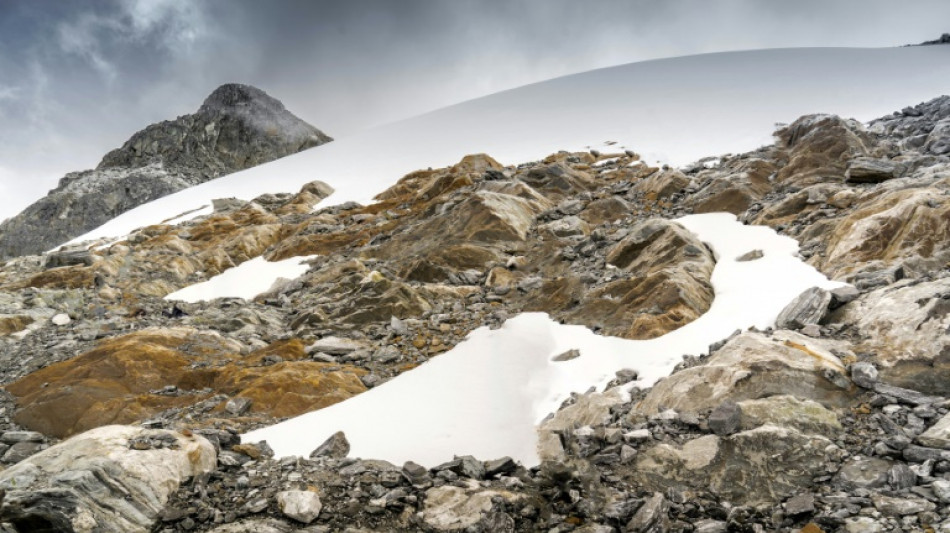
Icy reception for plan to 'save' Venezuela's last glacier / Photo: Jose Manuel Romero - Jose Manuel Romero/AFP/File

 South Korea score late to reach Asian Games football final

 Tom Kim defies jet-lag, Kho cards ace as Asian Games golf begins
 Thai teen rocker Nene aims to tour, write music... and return to school
 Ivory Coast clamps down on harmful illegal gold rush

 Nagoya mayor says sorry for Asian Games 'inconveniences'

 G20 trade officials meet under shadow of tariffs, overcapacity

 India's fat dog vote goes viral
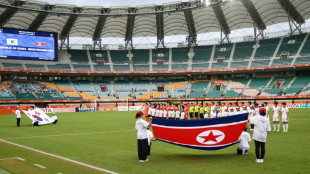 Asian Games crowds in spotlight as 998 see hosts in 50,000 stadium

 The eight stadiums for the 2027 Rugby World Cup

 Thieves swipe drugs under nose of Fiji police, swap with flour

 South Korea demands North apologise for DMZ mine blasts

 In Nepal's flood zone, teachers mourn students who never returned

 US Supreme Court lifts limits on third-country deportations

 Antonelli eager to 're-establish order' as F1 returns to Malaysia

 Paw-fect candidate: Australia finds new koala rescue dog

 One third of world population exposed to harmful air pollution: monitor

 North Korea denies South's claim it was apparently behind DMZ mine blasts

 West Bank's violent settlers part of a new generation fuelled by ideology

 US-led coalition ends mission in Iraq

 Pope-backed White Sox join Braves with MLB playoff wins

 Psychology Software Tools Builds on Early Bioz Success to Expand Access to Publication-Backed Product Evidence

 Alpha Growth Management Opens Rep Office in Japan

 NBA close to picking new $12-13bn Vegas team owners: report

 LA28 Olympics torch relay to visit all 50 states

 Spain brush aside Croatia in Nations League, England down Czechs

A small patch of ice among bare rock is all that remains of Venezuela’s last glacier, which the government hopes to restore to its former glory using a geothermal blanket.
Experts say that would be too little too late.
While glacier melt is a global phenomenon blamed on climate change, Venezuela is the first country in the Andes mountain range -- which stretches all the way to Chile in the south -- to lose all its glaciers.
Venezuela has lost five in total, adding up to some 1,000 hectares of ice, in the last century or so.
"In Venezuela there are no more glaciers," Julio Cesar Centeno, a university professor and advisor to the UN Conference on Environment and Development (UNCED), told AFP.
"What we have is a piece of ice that is 0.4 percent of its original size."
Centeno and other experts are convinced the loss of La Corona glacier on Humboldt peak, some 4,900 meters (more than 16,000 feet) above sea level, is irreversible.
But the government announced a plan in December to slow and even reverse the thaw by covering the area with a thermal mesh made of polypropylene plastic warding off the Sun's rays.
The cover was delivered to Humboldt peak by helicopter in 35 separate pieces, each measuring 2.75 meters by 80 meters, in December, but the government has not said whether it has already been unrolled.
Similar covers are used in European countries, mainly to protect ski slopes in warmer weather.
"It allows us to maintain the temperature of the area and prevent the entire glacier from melting," said Jehyson Guzman, governor of the western state of Merida that used to be home to Venezuela's glaciers.
- Nothing left to save -
But scientists of the University of Los Andes (ULA) are skeptical.
They say La Corona ceased to be a glacier since shrinking to just two hectares of the 450 hectares it used to cover. Scientists use a guideline of 10 hectares as the minimum size of a glacier.
Before La Corona, Venezuela also lost its glaciers on the peaks of El Leon, La Concha, El Toro and Bolivar.
"It is an illusory thing, a hallucination, it is completely absurd," said Centeno of the government's plan.
He and a team of other scientists will ask Venezuela's supreme court to scrap the project, which they say could have other, negative, impacts as the plastic blanket degrades over time.
"These micro plastics are practically invisible, they end up in the soil and from there they go to crops, lagoons, into the air, so people will end up eating and breathing that," he said.
Enrique La Marca, zoologist and ecologist, fears the cover could harm rare species of mosses and lichens, even hummingbirds that call the rocky environment home.
"That life will die because it will not have the necessary oxygen," he said.
- An ice remnant -
The most optimistic estimates give the remaining ice-cover "four to five years" before disappearing completely, said La Marca, who researches the impacts of glacier melt due to climate change.
Some calculations point to a mere two years.
"It’s an ice remnant," not a glacier, added physicist Alejandra Melfo, a ULA expert on the topic.
Forestry engineer and mountaineer Susana Rodriguez said the disappearance of La Corona will also affect Venezuelan tourism, as many people who used to climb the Humboldt peak did so on the ice.
"Now everything is rock, and what remains is so deteriorated that it is risky to step on it. There are cracks," said Rodriguez, who has accompanied several outings on the glacier.
W.Nelson--AT