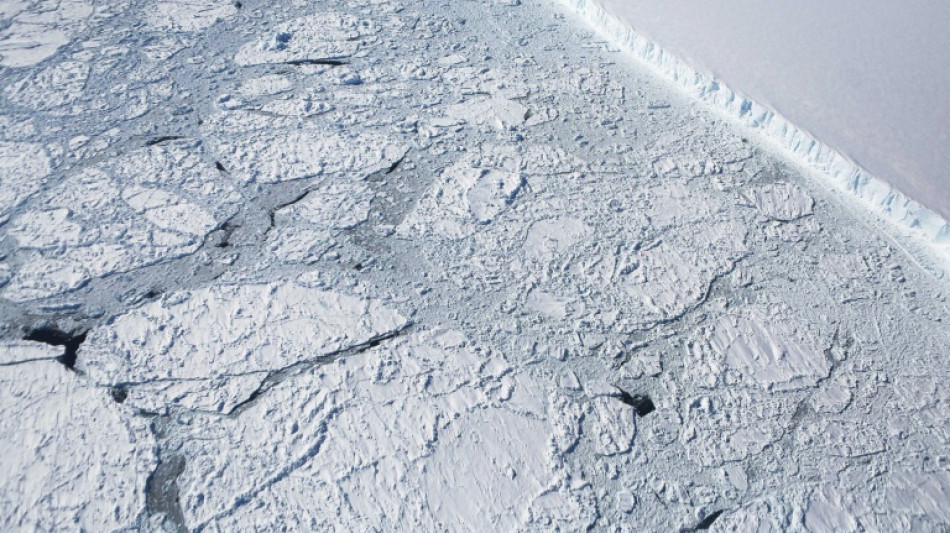
Antarctic sea ice hits lowest winter maximum on record: US data / Photo: MARIO TAMA - GETTY IMAGES NORTH AMERICA/AFP

 'No limits': Marathon world record holder Sawe chasing history

 Countdown begins to biggest-ever Rugby World Cup
 Bangladesh women lose ground after quota reform

 Vietnam admits 'differing opinions' on Hanoi development

 Stocks temper gains as oil pares heavy losses, US data in focus

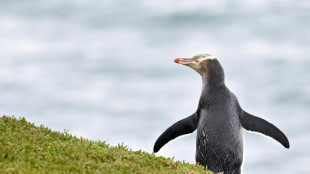 New Zealand denies breaching climate commitments to EU

 Albert becomes youngest US scorer in 4-2 win over Chile

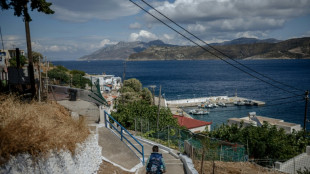 Pirate island's plunging population shows Greece's demographic decline
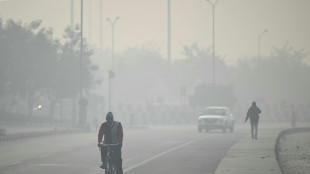
 With elections ahead, Latvia's Russian-speakers reject Moscow's help

 Brazil football clubs face massive sponsorship blow from betting ban

 ChatGPT maker wants to be the App Store for AI as safety concerns grow

 Women fight fires and sexism in Indonesian Borneo

 Forsling's OT blast lifts Florida over Carolina in NHL opener

 Hurricane Polo sweeps over Mexico's Pacific coast, heads inland

 Grynspan pulls ahead in race to lead UN: diplomat

 Trump touts AI boss pledge to self-regulate

 Oil down, but stocks lower as bond yields rise

 England break down stubborn Czechs to claim first Nations League win

 UN Security Council extends Haiti anti-gang force by 6 months

 Manchester City guilty of Premier League charges: What comes next?

 Man City chief Soriano slams Premier League 'conspiracy theory'

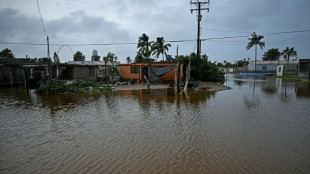 Hurricane Polo sweeps over Mexico's Pacific coast

 Man City must be relegated after guilty verdict says club's former chairman

 German far-right aims to lead Saxony-Anhalt govt in December

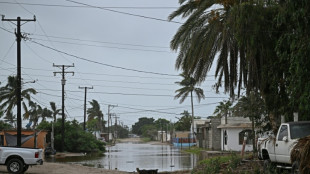 Little damage as Hurricane Polo sweeps over Mexico's Pacific coast

The sea ice around Antarctica likely had a record low surface area when it was at its maximum size this winter, a preliminary US analysis of satellite data showed Monday.
As the southern hemisphere transitions into spring, the US National Snow and Ice Data Center (NSIDC) said in a statement that Antarctic sea ice had only reached a maximum size of 16.96 million square kilometers (6.55 million square miles) this year, on September 10.
The ice pack typically reaches its largest size during the colder winter months, so the September 10 reading will likely remain this year's maximum.
"This is the lowest sea ice maximum in the 1979 to 2023 sea ice record by a wide margin," said the NSIDC, a government-supported program at the University of Colorado at Boulder.
At its high-point this year, the sea ice was 1.03 million square kilometers smaller than the previous record, roughly the size of Texas and California combined.
"It's a record-smashing sea ice low in the Antarctic," said NSIDC scientist Walt Meier.
He added that the growth in sea ice appeared "low around nearly the whole continent as opposed to any one region."
In February, at the height of the austral summer, the Antarctic sea ice pack had reached a minimum extent of 1.79 million square kilometers, also a record, according to the NSIDC.
The ice pack then grew back at an unusually slow pace, despite the onset of winter.
Meanwhile at the other end of the globe, where summer is drawing to a close, Arctic sea ice reached a low of 4.23 million square kilometers, the NSIDC said. It represents the sixth lowest minimum in 45 years of recordkeeping.
- Warming oceans -
For several decades, the Antarctic sea ice pack had remained stable, even expanding slightly.
But "since August 2016, the Antarctic sea ice extent trend took a sharp downturn across nearly all months" the NSIDC said.
There is debate among scientists over the cause of the shift, with some reluctant to establish a formal link with global warming. Climate models have struggled in the past to predict changes in the Antarctic ice pack.
The downward trend is "now thought to be linked to warming in the uppermost ocean layer," the NSIDC said.
"There is some concern that this may be the beginning of a long-term trend of decline for Antarctic sea ice, since oceans are warming globally."
Melting pack ice has no immediate impact on sea levels, as it forms by freezing salt water already in the ocean.
But the white ice reflects more of the Sun's rays than darker ocean water, so its loss accentuates global warming.
The loss of pack ice also exposes Antarctica's coastline to greater wave action, which could destabilize the freshwater ice cap and endanger coastal habitats. The melting land ice would cause a catastrophic rise in sea levels.
However the NSIDC notes a possibility that waves impacting the ice sheet may increase "accumulation near the coast, offsetting in part the threat of rising sea level."
D.Johnson--AT