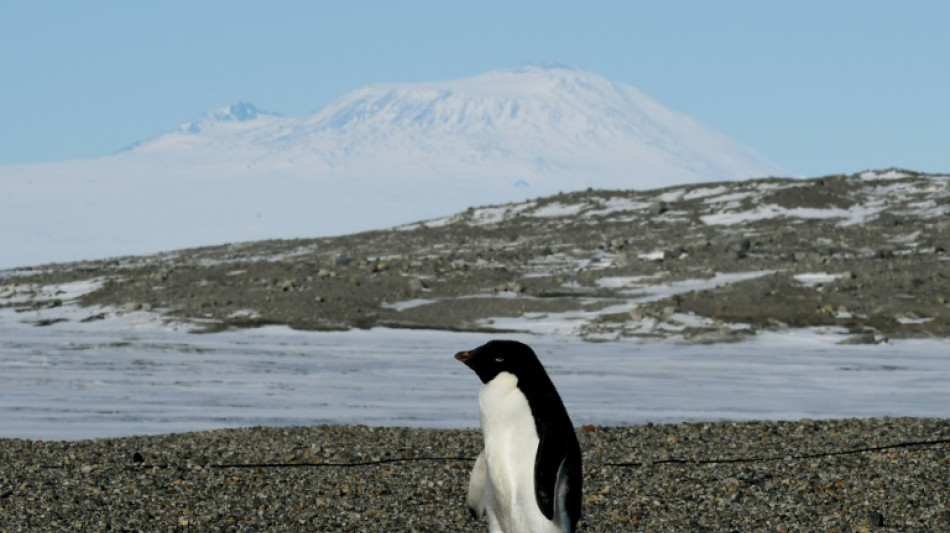
The surprising climate power of penguin poo / Photo: Mark RALSTON - AFP/File

 Oil prices retreat as markets welcome US-Iran talks

 US refusing to give Sudan's de facto leader visa for UN: diplomatic sources, UN

 Macron urges world to choose UN over 'law of the jungle'

 All-rounder Jacks stars as England beat Sri Lanka in 1st ODI
 Man City peg back Bayern to start Women's Champions League

 Trump beats 'America first' drum at UN as allies tread carefully

 Snedeker backs Spaun for Ryder Cup after Presidents snub

 French prosecutors probe secret filming of women with smart glasses

 Trump renames AI "super intelligence," rejects international oversight

 Trump rejects international regulation of AI

 How is the EU approaching record fuel prices?

 Sri Lanka's Colombage strikes on debut as England dismissed for 265 in first ODI

 Hurricane Polo strengthens to top category 5 off Mexico

 11 hurt as teen opens fire outside school in western Turkey

 UN chief says 'Big Oil' treats atmosphere as open sewer

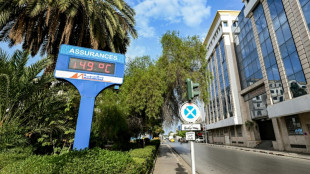 Tunisia says 2026 summer hottest on record

 England's Rashid out of Sri Lanka ODIs with hand injury

 Houthis accuse Saudi Arabia of deadly strikes as thousands flee

 Stocks climb as oil slides, AI buzz returns

 India cricketers win in style as Afghan savours 'special' Games silver

 La Liga president hits out at Real Madrid refereeing 'conspiracy' claims

 MEXC Launches “Real Stocks, Real Friends” with Rewards for Bringing Friends to Wall Street

 Mbappe continues media push for Ballon d'Or recognition

 Stocks rise on AI buzz, oil prices cool

 India narrowly survive huge scare against minnows Japan

Antarctica's icy wilderness is warming rapidly under the weight of human-driven climate change, yet a new study points to an unlikely ally in the fight to keep the continent cool: penguin poo.
Published Thursday in Communications Earth & Environment, the research shows that ammonia wafting off penguin guano seeds extra cloud cover above coastal Antarctica, likely blocking sunlight and nudging temperatures down.
Lead author Matthew Boyer, an atmospheric scientist at the University of Helsinki, told AFP that lab studies had long shown gaseous ammonia can help form clouds.
But "to actually quantify this process and to see its influence in Antarctica hasn't been done," he said.
Antarctica is an ideal natural laboratory. With virtually no human pollution and scant vegetation -- both alternative sources of cloud-forming gases -- penguin colonies dominate as ammonia emitters.
The birds' future, however, is under threat.
Shrinking sea ice disrupts their nesting, feeding and predator-avoidance routines -- making it all the more urgent to understand their broader ecological role.
Along with other seabirds such as Imperial Shags, penguins expel large amounts of ammonia through droppings, an acrid cocktail of feces and urine released via their multi-purpose cloacas.
When that ammonia mixes with sulfur-bearing gases from phytoplankton -- the microscopic algae that bloom in the surrounding ocean -- it boosts the formation of tiny aerosol particles that grow into clouds.
To capture the effect in the real world, Boyer and teammates set up instruments at Argentina's Marambio Base on Seymour Island, off the northern tip of the Antarctic Peninsula.
Over three summer months -- when penguin colonies are bustling and phytoplankton photosynthesis peaks -- they monitored wind direction, ammonia levels and newly minted aerosols.
When the breeze blew from a 60,000-strong Adelie penguin colony eight kilometers (five miles) away, atmospheric ammonia spiked to 13.5 parts per billion -- about a thousand times the background level.
For over a month after the birds had departed on their annual migration, concentrations stayed roughly 100 times higher, with the guano-soaked ground acting as a slow-release fertilizer.
Particle counters told the same story: cloud-seeding aerosols surged whenever air masses arrived from the colony, at times thick enough to generate a dense fog.
Chemical fingerprints in the particles pointed back to penguin-derived ammonia.
- Penguin-plankton partnership -
Boyer calls it a "synergistic process" between penguins and phytoplankton that supercharges aerosol production in the region.
"We provide evidence that declining penguin populations could cause a positive climate-warming feedback in the summertime Antarctic atmosphere," the authors write -- though Boyer emphasized that this remains a hypothesis, not a confirmed outcome.
Globally, clouds have a net cooling effect by reflecting solar radiation back into space. Based on Arctic modeling of seabird emissions, the team believes a similar mechanism is likely at play in Antarctica.
But the impact also depends on what's beneath the clouds.
Ice sheets and glaciers also reflect much of the Sun's energy, so extra cloud cover over these bright surfaces could trap infrared heat instead -- meaning the overall effect hinges on where the clouds form and drift.
Still, the findings highlight the profound interconnections between life and the atmosphere -- from the Great Oxygenation Event driven by photosynthesizing microbes billions of years ago to penguins influencing cloud cover today.
"This is just another example of this deep connection between the ecosystem and atmospheric processes, and why we should care about biodiversity and conservation," Boyer said.
A.Moore--AT