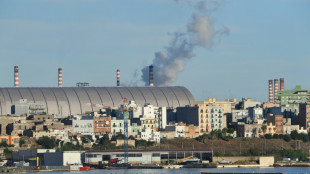
EU urged to broadly restrict 'forever chemicals' / Photo: SEBASTIEN BOZON - AFP

 'It has to stop': runners protest women's murders in S.Africa district

 Fire erupts near Riyadh airport as Houthis claim strikes

 Cuba works to restore power after another blackout

 England thrash Sri Lanka again to return to top of T20 rankings

 Arsenal thrashed by Brighton, sorry Spurs lose again

 South Korea, Austria qualify for Davis Cup finals

 Seare shocks Ingebrigtsen to win world 5km gold

 Brigitte Bardot widower slams sale of star's belongings

 Aston Villa compound Tottenham's misery despite late rally

 Asian Games offer 'deepest apologies' for South Korea anthem blunder

 Inter Milan and Italy icon Mazzola dies aged 83

 Saudi capital issues first air raid alert since renewed fighting in Yemen

 Martin edges title rival Marquez for Austrian MotoGP pole

 Indonesia accepts Malaysia's help to tackle wildfires

 Indians living in Japan on stand-by to house Asian Games athletes

 Trump signs bill authorizing sweeping Russia sanctions

 Protesters form human chain at Kennedy Center after Trump threat

 Death toll from attack at police HQ in Pakistan rises to 31

 Trump says Denmark to give US 'permanent control' over Greenland security

 New to The Street Broadcasts Tonight at 6:30 PM ET Across the United States, Latin America and MENA, Featuring BioVie, Acurx Pharmaceuticals, Lantern Pharma and SafeSpace Global

 Kennedy Center: future unclear for iconic Washington arts hub

 Trump claims 'infinite' Greenland security deal with Denmark

 Helicopters battle wildfire threatening Ecuador's capital

 Brentford batter Chelsea to undo Alonso's promising start

 Kane hits Bundesliga century as Bayern rout Union

"Forever chemicals" pose a growing risk to health and the environment and should be broadly banned across the European Union, with some exceptions, EU experts said in findings published on Thursday.
Officially called PFAS, the substances are a group of more than 10,000 chemicals used in things like non-stick pans, stain-proof carpets, and other common products -- and often end up tainting food, water and wildlife.
Two committees of EU experts on Thursday published findings that highlighted their effects and that called for broad restrictions on the per- and polyfluoroalkyl substances (PFAS).
"PFAS pose growing risks to people and the environment. They are highly persistent, remaining in the environment for long periods, travelling long distances, contaminating groundwater and soil, while some cause serious health issues, such as cancer and reproductive harm," one of the committees said in a statement accompanying its findings.
The European Union is expected to put forward a proposal to ban PFAS, known as "forever chemicals", in everyday consumer products such as clothing and pizza boxes, with exemptions for strategic sectors, like the medical field.
A legislative proposal was initially promised for the end of 2025, but Brussels was waiting for opinions from the two committees set up by the European Chemicals Agency's (ECHA) -- one on the risks associated with 'forever chemicals', and one evaluating the economic and social impact of a ban.
The first committee, the Risk Assessment Committee (RAC), found the chemicals posed growing risks and said that the EU needed new regulations to address them.
- Balancing act -
But the two committees differed on how far the new restrictions should go.
Scientific risk assessment experts of the RAC said a total ban on "forever chemicals' would be the most effective way to minimise their impact, saying that exemptions would cause additional "emissions, leading to an uncontrolled risk."
But, the Socio-Economic Analysis Committee (SEAC) said a blanket ban is "likely not proportionate," given the lack of alternatives to the chemicals in several fields.
The committee still supported a "broad restriction" but stressed the need for a "balanced approach" in light of the wide use of the chemicals, and recommended "targeted" exemptions.
It recommended that risks be minimised through clear labelling on products containing "forever chemicals" and site-specific management plans for each industrial facility.
Environmental NGO ClientEarth welcomed the findings.
"PFAS pollution is ubiquitous and the health impacts on EU citizens are becoming clearer every day," Helene Duguy, a lawyer working for the organisation, said in a statement.
"Our policymakers owe it to people and our ecosystems across Europe to act now and prevent this emerging large-scale public health disaster," she added.
The European Union has already taken sector-specific action against certain PFAS.
A directive imposed since January has set a maximum threshold of 0.1 micrograms per litre for the combined concentration of 20 PFAS for "water intended for human consumption".
The European Parliament has also adopted rules on food packaging, introducing maximum PFAS concentrations from August, and on toys, in which forever chemicals and endocrine disruptors will be banned by 2030.
Chronic exposure to even low levels of the chemicals has been linked to liver damage, high cholesterol, reduced immune responses, low birth weights and several kinds of cancer.
In Brussels, environmental organisations accuse the European Union of being slow to legislate, under pressure from industrial lobbies.
European Union environment chief Jessika Roswall also welcomed the findings.
"We support the transition away from forever chemicals. As always, any new rules need to be simple by design and give certainty, clarity and predictability for consumers as well as businesses," Roswall said in a statement to AFP.
In January, an EU-commissioned report found that continued use of PFAS could cost Europe up to 1.7 trillion euros ($2 trillion) by 2050 because of their impact on people's health and the environment.
K.Hill--AT