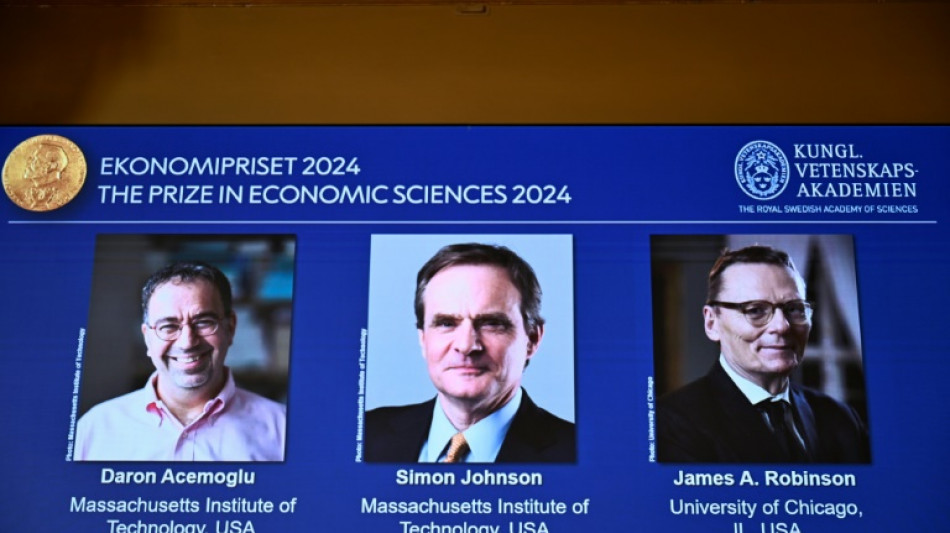
Trio wins economics Nobel for work on wealth inequality / Photo: Christine OLSSON - TT NEWS AGENCY/AFP

 Officials say man shot, wounded by ICE agent in Texas

 豪普特收藏:金錢如何揭露人類的本質

 Kolekcja Haupta: Co pieniądze mówią o nas, ludziach
 The Haupt Collection: What Money Reveals About Us as Human Beings

 Barcelona enter new era aiming to retain Women's Champions League crown

 US has deported 25,000 to third countries under secretive deals: report

 Three South Korean soldiers injured in DMZ blast: military

 New Zealanders pick endangered black robin as Bird of the Year

 Asia stocks rise on AI, US-China trade talks optimism

 Malaysia's 'elephant whisperer' fights to save Borneo's endangered giants
 'I live in fear': 1.5 million Pakistani children sexually exploited online

 Cowboys beat Commanders, Vikings down Bears as star QBs injured
 EB5 United's Cormont at Deer Valley East Village Achieves $224.8 Million Target EB-5 Raise; Offering Remains Open Toward $524.8 Million Maximum Raise

 InterContinental Hotels Group PLC Announces Transaction in Own Shares - September 21

 Best Gold IRA Accounts 2026 Rankings Released: Top Precious Metals IRA Companies Compared in New Guide

 Braves clinch division title as Red Sox reach MLB playoffs

 Bordeaux-Begles hammer Stade Francais despite Jalibert injury

 Milan and Juventus end blips with home wins
 Bridgeman wins PGA Biltmore title with sizzling 61

 Williams injured as Bears shut down by Vikings

 US warns of rapid escalation in Middle East war

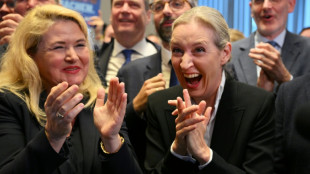 Germany's far-right AfD celebrates another state election win
 Russia vows revenge for election-day attacks as poll shows ruling party win

 Spaun late shows snatches PGA Championship win

 Conceicao strikes as Juventus beat Atalanta
The Nobel prize in economics was awarded on Monday to Turkish-American Daron Acemoglu and British-Americans Simon Johnson and James Robinson for research into wealth inequality between nations.
By examining the various political and economic systems introduced by European colonisers, the three have demonstrated a relationship between societal institutions and prosperity, the jury said.
"Reducing the vast differences in income between countries is one of our time's greatest challenges," Jakob Svensson, chair of the Committee for the Prize in Economic Sciences, said in a statement.
"The laureates have demonstrated the importance of societal institutions for achieving this," Svensson added.
Acemoglu, 57, is a professor at the Massachusetts Institute of Technology (MIT), as is Johnson, 61.
Robinson, 64, is a professor at the University of Chicago.
The jury highlighted the laureates' work in illuminating how societal institutions play a role in explaining why some countries prosper while others do not.
In a statement explaining the prize, the jury noted the example of the city of Nogales, which is divided by the US-Mexican border, where residents on the US side of the city tend to be better off.
"The decisive difference is thus not geography or culture, but institutions," the Royal Swedish Academy of Sciences said.
The US economic system provides residents north of the border greater opportunities to choose their education and profession, and they are part of the US political system, which gives them broad political rights.
By contrast, south of the border, residents live under other economic conditions, and the political system limits their potential to influence legislation.
- Democracy -
In addition, the jury noted that the laureates' research also helped explain why some countries become trapped in a situation of "low economic growth."
"The introduction of inclusive institutions would create long-term benefits for everyone, but extractive institutions provide short-term gains for the people in power," the jury said.
It said that "institutions that were created to exploit the masses are bad for long-run growth."
Conversely, it noted that "ones that establish fundamental economic freedoms and the rule of law are good for it."
Acemoglu, who was "delighted" to receive the award, told reporters that the "work that we had done favours democracy."
"Countries that democratise, starting from a non-democratic regime, do ultimately grow about eight, nine years faster than non-democratic regimes. And it's a substantial gain," Acemoglu said via telephone from Athens as the award was announced in Stockholm.
He acknowledged nonetheless that "democracy is not a panacea" and "introducing democracy is very hard."
The economics prize is the only Nobel not among the original five created in the will of Swedish scientist Alfred Nobel, who died in 1896.
It was instead created through a donation from the Swedish central bank in 1968, leading detractors to dub it "a false Nobel".
However, like for the other Nobel science prizes, the Royal Swedish Academy of Sciences decides the winner and follows the same selection process.
The economics prize wraps up this year's Nobel season, which honoured achievements in artificial intelligence for the physics and chemistry prizes, while the Peace Prize went to Japanese group Nihon Hidankyo, committed to fighting nuclear weapons.
South Korea's Han Kan won the literature prize -- the only woman laureate this year -- while the medicine prize lauded discoveries in understanding gene regulation.
The Nobel Prizes consist of a diploma, a gold medal and a $1 million reward.
They will be presented at ceremonies in Stockholm and Oslo on December 10, the anniversary of the 1896 death of scientist and prize creator Alfred Nobel.
R.Garcia--AT