
Luc Montagnier: HIV discoverer who ended a pariah

 American Nobel laureate in medicine hopes to illuminate the brain

 Trump approves firing squad for convicted US military base shooter

 Grappling with 'homework scams,' US universities shun AI detectors

 Separatists win Quebec election in test for Canada PM

 Leaders visit Pacific atoll at frontline of climate change

 Yemen's Houthis claim striking Riyadh airport, other Saudi sites

 Best-selling British author Jeffrey Archer dies aged 86

 Military plane crash kills 32 in Nigeria

 Olise powers France to win over Belgium in Nations League

 High-flying Blazy turns to birdlife at Chanel

 Riyadh's allies pledge troops as Yemen, Saudi Arabia attack Houthis

 Clashes erupt outside Kosovo parliament over war crimes court

 Milan's Saelemaekers suffers ankle setback, faces lengthy spell out

 Rubio arrives in Iceland to push for greater US presence in Arctic

 Putin allows Italy's UniCredit to sell part of Russian business

 Djokovic into China Open final as Medvedev out for hitting fan with ball

 ICC unseals arrest warrants for Taliban education ministers

 Modric hopes fans back Croatia against Spain after England shame

 Bolsonaro rides right-wing surge into Brazil's election runoff

 Turkey blocks X account of British reporter

 Ukraine says using AI robot guns to shoot down new Russian drones

 At Oct 7 memorial, Netanyahu says will be no Hamas rule in Gaza

 Ukraine blames Russia for deadly sinking of Turkish ship in Black Sea

 UN rights council slams Taliban's 'oppression' of women

 Norway eyes partial ban of smart glasses
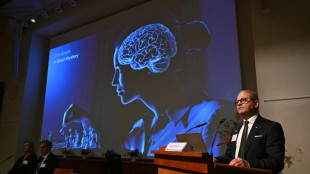
French researcher Luc Montagnier, who has died at 89, shared the Nobel medicine prize for his vital early discoveries on AIDS, but was later dismissed by the scientific community for his increasingly outlandish theories, notably on Covid-19.
Montagnier and Francoise Barre-Sinoussi shared the Nobel in 2008 for their work at the Pasteur Institute in Paris in isolating the human immunodeficiency virus (HIV).
Their achievement sped the way to HIV tests and antiretroviral drugs that keep the deadly pathogen at bay.
- Bitter rivalry -
AIDS -- acquired immune deficiency syndrome -- first came to public notice in 1981, when US doctors noted an unusual cluster of deaths among young gay men in California and New York.
Montagnier had a bitter rivalry with US scientist Robert Gallo in his ground-breaking work in identifying HIV at the virology department he created in Paris in 1972.
Both are co-credited with discovering that HIV causes AIDS, and their rival claims led for several years to a legal and even diplomatic dispute between France and the United States.
Montagnier's work started in January 1983, when tissue samples arrived at the Pasteur Institute from a patient with a disease that mysteriously wrecked the immune system.
He later recalled the "sense of isolation" as the team battled to make this vital connection.
"The results we had were very good but they were not accepted by the rest of the scientific community for at least another year, until Robert Gallo confirmed our results in the US," he said.
The Nobel jury made no mention of Gallo in its citation.
In 1986 Montagnier shared the Lasker Award -- the US equivalent of the Nobel -- with Gallo and Myron Essex.
In 2011, to mark 30 years since the appearance of AIDS, Montagnier warned of the spiralling costs of treating the 33 million then stricken with HIV.
"Treatment cuts transmission, that's clear, but it doesn't eradicate it, and we can't treat all the millions of people," he told AFP.
- Controversial ideas -
Montagnier was born on August 8, 1932 at Chabris in the Indre region of central France.
After heading Pasteur's AIDS department from 1991 to 1997, and then teaching at Queens College in New York, Montagnier gradually drifted to the scientific fringes, stirring controversy after controversy.
He repeatedly suggested that autism is caused by infection and set up much-criticised experiments to prove it, claiming antibiotics could cure the condition.
He stunned many of his peers when he talked of the purported ability of water to retain a memory of substances.
And he believed that anyone with a good immune system could fight off HIV with the right diet.
Montagnier supported theories that DNA left an electromagnetic trace in water that could be used to diagnose AIDS and Lyme's Disease, and championed the therapeutic qualities of fermented papaya for Parkinson's Disease.
- 'Slow scientific shipwreck' -
He repeatedly took up positions against vaccines, earning a stinging reprimand in 2017 from 106 members of the Academies of Sciences and Medicines.
The French daily Le Figaro described his journey from leading researcher to crank as a "slow scientific shipwreck".
During the Covid pandemic he stood out again, stating that the SARS-CoV-2 virus was laboratory-made and that vaccines were responsible for the appearance of variants.
These theories, rejected by virologists and epidemiologists, made him even more into a pariah among his peers, but a hero to French anti-vaxxers.
P.Hernandez--AT