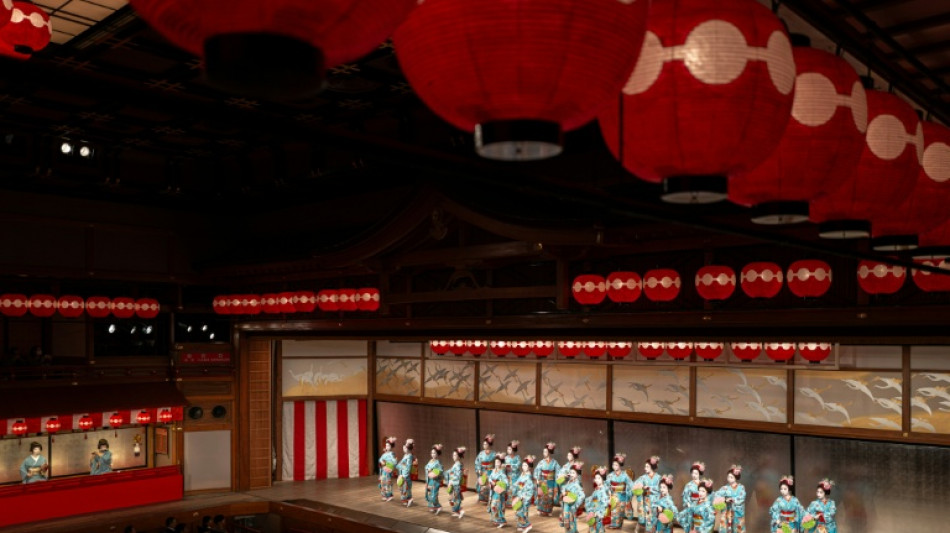
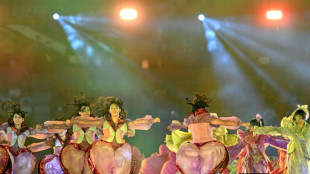
Geisha spectacle in Japan's Kyoto celebrates arrival of spring / Photo: Philip FONG - AFP

 Ed Sheeran set to return to stage after Palestinian controversy

 Toulouse edge Vannes, Lyon beat Pau to take Top 14 summit

 Germans arrested for Louvre stunt in Mona Lisa hall

 Saudi-led coalition says Houthis fired ballistic missile at Riyadh

 France's debt climbs to highest since 1978: ministry

 McIlroy two shots off the lead at Wentworth after eagle on 18

 Martinez brace saves Inter in Serie A top-two clash with Roma

 Rosenior abused but guides Paris FC past old club Strasbourg

 Seven-try Lyon beat Pau, climb to Top 14 summit

 Brighton defeat a 'big lesson' against complacency for Arsenal, says Arteta

 Thousands protest inaction over climate crisis in Switzerland

 Carapaz out of cycling world championships

 'Fragile' Tottenham beaten by Aston Villa despite late rally

 Mourinho hails Real Madrid grit before Atletico derby clash

 Martin wins Austrian MotoGP sprint after Acosta crash

 Japan edge Fiji to win Pacific Nations Cup
 Black smoke, flames rising near Riyadh airport: residents to AFP

 UK actor Naomi Watts honoured at Spain film festival

 Japan emperor declares Asian Games open after turbulent build-up

 Asian Games open with unity message after troubled build-up

 Denmark hails 'binding' Greenland deal with Trump

 We don't want Games host Japan losing money, says Asian Olympic official

 Ed Sheeran returns to stage after Palestinian controversy

 Asian Games to open in Japan after troubled build-up

 Drone owners rush to offload devices ahead of Beijing ban

Against a backdrop of blooming cherry blossoms, a group of geishas elegantly shuffle onto a stage in Japan's Kyoto city to begin a centuries-old performance celebrating the arrival of spring.
Dressed in sky blue kimonos emblazoned with flowers, the dancers twist and twirl in unison in front of hundreds of spectators eager to see the annual "Miyako Odori" in the nation's spectacular ancient capital.
Geishas, known as geikos in Kyoto, and apprentices called maikos have been donning elaborate costumes and fluttering fans since the Miyako Odori -- or "capital city dance" -- first started in 1872.
"Just as cherry blossoms bloom when spring approaches, the Miyako Odori is a spring tradition in Kyoto," Kyoko Sugiura, head of the Yasaka Nyokoba Gakuen, a school for geishas in Kyoto's Gion district, told AFP.
In Japanese, the word geisha means "person of the arts", and can refer to a woman or man trained in traditional Japanese performing arts.
In the popular imagination geishas are often confused with courtesans but their work as trained masters of refined old artforms does not involve selling sex.
Their performances are usually small and private, and take place at high-class establishments which operate a no first-time customer policy.
"That's why it is often thought of as a very exclusive world," Sugiura said.
"But the Miyako Odori is a one-hour show in which geisha and maiko have the opportunity to showcase the arts they practise daily," she said.
"Anyone and everyone with a ticket can enjoy the show."
The Miyako Odori began soon after Kyoto hosted Japan's first national expo -- an effort to revitalise the western city following the relocation of the capital to Tokyo in 1869.
The format of the performance has not changed much, Sugiura explained, although the music and dance moves are sometimes switched up.
Maria Superata, a geisha expert who has worked with them as an interpreter, explained that the show "combines all of the traditional performing arts that you can see in Japan".
"For example, elements from kabuki (classical Japanese theatre), elements from traditional dance. So they have to act, they have to sing, they have to play the instruments, everything all in one," she said.
"That's why it's so special."
But the number of geishas, who once made a living through performing for Japan's wealthy elite, is in decline.
Superata said that fewer young Japanese want a life that demands huge discipline and comes with a strict practise schedule.
"Nowadays, young Japanese people... are not very interested that much in traditional art and in kimono."
T.Sanchez--AT