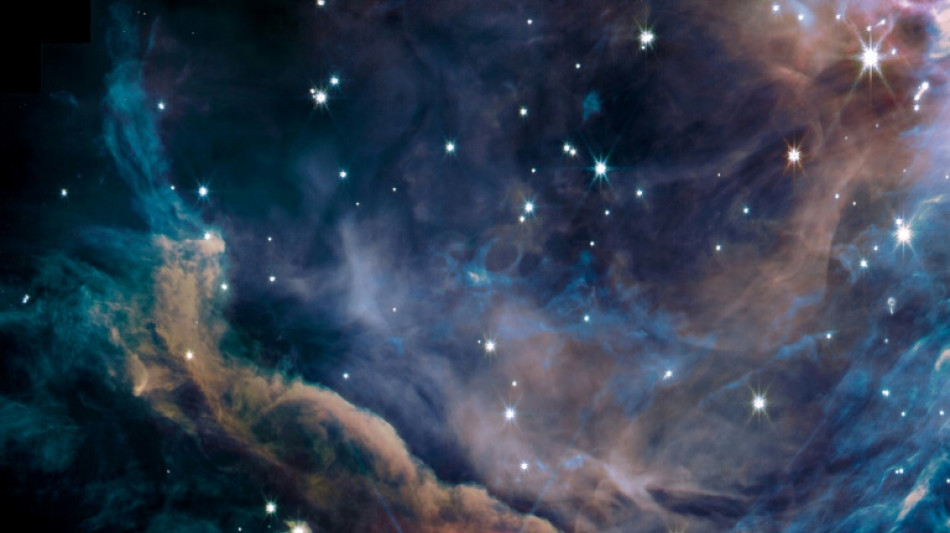
Webb telescope captures 'breathtaking' images of Orion Nebula / Photo: Handout - NASA/ESA/CSA/AFP

 Dukascopy Bank Unveils AI-Powered Trading, 25,000+ Stock CFDs and a New Flagship E-Banking App
 Tech firms rally but Asian markets mixed, with eyes on US inflation

 Nepal holds day of mourning as families pray missing still alive

 African players in Europe: Mbeumo fires solo goal as United draw
 Malaysia cancels haze emergency, but warns problems remain

 Philippine sensation Eala looks forward to Asian Games 'fun'

 Jakarta airport extends closure after volcano eruption

 Lonely woman director in Venice sees industry backsliding on gender

 Tech firms rally on mixed day for Asian markets, with eyes on US inflation
 World number one An sends Asian Games warning with China hat-trick
 PSG go for three in a row as Champions League returns
 "Super-human' Alcaraz books US Open quarter-final clash with Shelton

 ECB set to hike interest rates as Iran war flares anew
 AI data centers are less thirsty now, tech giants say

 North Korea vows nuclear-armed navy as US ally drills open

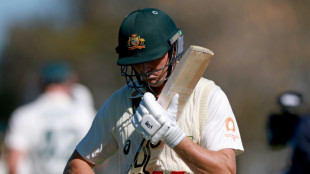 Under-fire Labuschagne named in Australia Test squad for South Africa

 InterContinental Hotels Group PLC Announces Transaction in Own Shares - September 07
 Best Way to Protect A 401(k) in 2026: Guide Released by Experts

 Tiafoe tops Medvedev in straight sets at US Open
 Zverev seeks US Open last eight as Osaka faces Rybakina

 Alcaraz turns up heat to reach US Open quarters
 Gatti salvages Juve draw with AC Milan in Serie A

 Sinayoko stars as unbeaten Paris FC down Marseille
 Still on top: 'Spider-Man' dominates North American box office

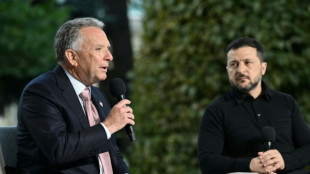 Zelensky in fresh talks with US envoys: Ukraine official

The wall of dense gas and dust resembles a massive winged creature, its glowing maw lit by a bright star as it soars through cosmic filaments.
An international research team on Monday revealed the first images of the Orion Nebula captured with the James Webb Space Telescope, leaving astronomers "blown away."
The stellar nursery is situated in the constellation Orion, 1,350 light-years away from Earth, in a similar setting in which our own solar system was birthed more than 4.5 billion years ago.
Astronomers are interested in the region to better understand what happened during the first million years of our planetary evolution.
The images were obtained as part of the Early Release Science program and involved more than 100 scientists in 18 countries, with institutions including the French National Centre for Scientific Research (CNRS), Western University in Canada, and the University of Michigan.
"We are blown away by the breathtaking images of the Orion Nebula," Western University astrophysicist Els Peeters said in a statement.
"These new observations allow us to better understand how massive stars transform the gas and dust cloud in which they are born," she added.
Nebulas are obscured by large amounts of dust that made it impossible to observe with visible light telescopes, such as the Hubble Space Telescope, Webb's predecessor.
Webb however operates primarily in the infrared spectrum, penetrating the dust.
This revealed numerous spectacular structures, down to the scale of 40 astronomical units, or the size of our solar system.
These include dense filaments of matter, which could birth new generations of stars, as well as forming stellar systems that consist of a central proto-star surrounded by a disc of dust and gas, in which planets form.
"We hope to gain understanding about the entire cycle of star birth," said Edwin Bergin, University of Michigan chair of astronomy and a member of the international research team.
"In this image we are looking at this cycle where the first generation of stars is essentially irradiating the material for the next generation. The incredible structures we observe will detail how the feedback cycle of stellar birth occurs in our galaxy and beyond."
Webb is the most powerful space telescope ever built, boasting a primary mirror measuring 6.5 meters (more than 21 feet) that is made up of 18 hexagonal, gold-coated segments, as well as a five-layer sunshield the size of a tennis court.
A.Taylor--AT