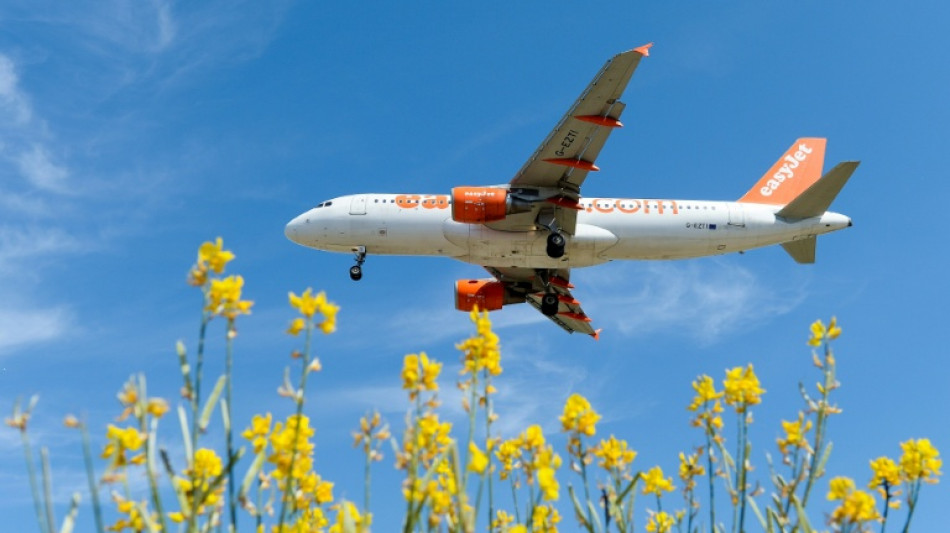
Middle East tourism pain is Europe's gain / Photo: JOSEP LAGO - AFP/File

 'Severe drought' declared in parts of UK
 IUX Announces New Web Client Portal Built for Enhanced Browser-Based Trading

 School roof collapse kills teacher, 32 children in NW Pakistan

 Inter skipper Martinez facing month out with thigh injury

 Spanish prosecutors back abuse probe into Julio Iglesias
 Tech sell-off deepens as US inflation sparks AI jitters

 Southgate does not forsee a return to management

 Two dead as Istanbul endures heaviest rainfall in 80 years

 After latest Nepal flood, survivors fear for future

 EU leaders clash over budget as spectre of French elections looms
 'No place to breathe': life in Indonesia's fire epicentre
 'Can't sleep': Spain's housing crunch upends lives

 Musk calls on Ukraine's Zelensky to 'go' after satellite slowdown row
 Still smiling at 117, Albanian may be world's oldest woman
 Pope has 'good night' in hospital: Vatican
 China's economy seen missing target as global shocks bite: AFP poll

 Costa Rica opens jail inspired by El Salvador mega-prison
 Same-sex couple takes fight for equality to Slovakian court
 'High hopes' as Indonesian women get a football league, again
 'Expectations high' for Bordeaux-Begles' Champions Cup hat-trick bid, says Depoortere
 Rennie urges All Blacks to stay focused against 'hurting' Wallabies
 Palmeiras beat Fluminense 2-1 in Libertadores semi-final first leg

 Brewers blasts leave Dodgers on brink

 Tech stock lead rout after US inflation fuels rate hike bets
 Al-Fayed survivors say UK police missing 'bigger picture'

Europeans are choosing to vacation closer to home as the war in the Middle East has amplified security concerns and made long-haul flights more expensive.
The outbreak of the conflict at the end of February has led to sharp drops to tourist destinations across the Middle east.
Foreign tourists have to brave few lines to visit Jordan's ancient city of Petra these days.
On Tunisia's Djerba island, the tourist season has gotten off to a slow start. Normally "we receive 100 new reservations per day, now it's just 50," the director of the Royal Garden Palace hotel, Anane Kamun, told AFP.
The impact is being felt further afield.
Disruptions to Gulf airports and airspace, along with higher airfares due to the jump in fuel prices, have also led to Europeans travelling to southeast Asian destinations.
According to Thailand's tourism ministry, the country suffered a sharp drop in the number of Europeans arriving in April -- down 29 percent among Germans and 44 percent for Italians.
Germany's TUI, the world's largest tour operator, cut its profit outlook last month and withdrew its revenue guidance as it warned of "consumer caution" driven by the Middle East war.
But caution doesn't mean abstinence.
"It doesn't appear that holidaymakers are abandoning their vacation plans completely," said Aarin Chiekrie, an analyst at stock brokerage Hargreaves Lansdown.
Recent data suggests consumers are leaving it until later to book, he noted.
"While that's not ideal, it's better than complete demand destruction," Chiekrie said.
According to estimates by the World Travel and Tourism Council, a trade body for tourism industry firms, the sector should still expand at a faster rate than the global economy this year: by 3.2 percent compared to 2.4 percent.
- 'Safer' destinations -
Europe stands to profit from the shift.
The WTTC said international visitor spending across Europe is set to climb by 7.1 percent this year, well above the sector average, as "travellers increasingly choose destinations closer to home amid geopolitical uncertainty and disruption in other regions".
Sunny southern European countries, particularly Italy and Spain, are expected to see the biggest gains.
The war "is in the process of disrupting international tourist flows and shifting a portion of the demand to destinations seen as being safer," said Rafael Pampillon Olmedo, a professor at the IE business school in Spain.
"Many European travellers who are hesitant to travel to the Middle East, in the eastern Mediterranean (Turkey, Greece or Egypt) or destinations even closer to the Gulf are turning to Spain and Portugal," he added.
Pedro Aznar, an economist at the Spanish business school Esade, also said Spain is profiting from a "substitution effect".
The war "can lead certain families to change their destination or make adjustments on other expenses," he added.
Other destinations are profiting as well.
Zakaria Meliani, operations manager at Balima Residences -- which offers short-term rentals in Rabat, Morocco -- said he has observed increased demand.
"Normally, the season here starts in mid-May, and this year it started right after the end of Ramadan," he said.
The Muslim holy month ended in mid-March this year.
Travellers who had planned to vacation in the Gulf and in Asia had instead chosen Morocco, Meliani added.
"Despite an uncertain geopolitical context, Moroccan tourism is performing in line with our initial forecasts at this stage with growth of five percent at the end of April 2026," Moroccan Tourism Minister Fatim-Zahra Ammor said in a statement to AFP.
O.Brown--AT