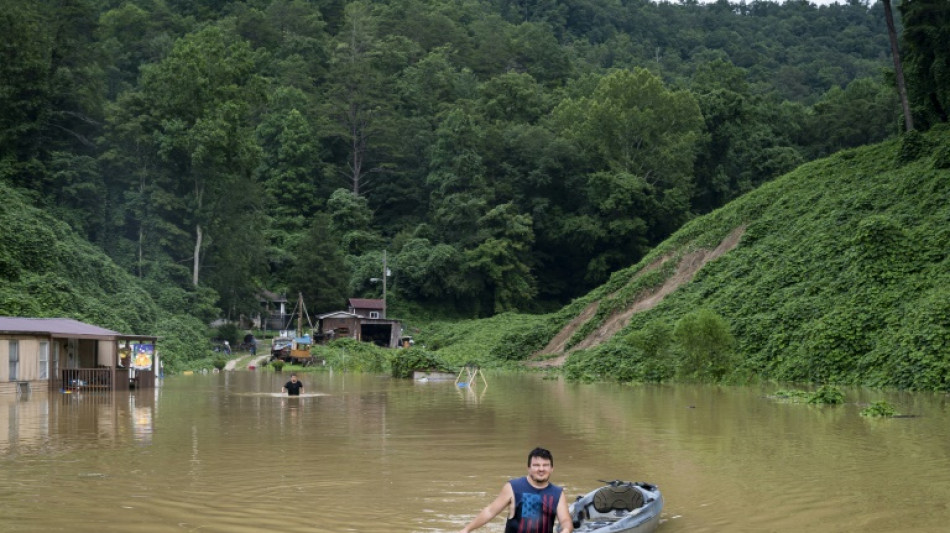
Dust to downpour: US weather whiplash shows climate change / Photo: Michael Swensen - GETTY IMAGES NORTH AMERICA/AFP/File

 Moscow denies sanitary measures over plague reports

 Samoa look to recreate 2022 final run at Rugby League World Cup

 Asian stocks mostly up after tech-led Wall St record

 German factory orders plunge as recovery still fragile

 Coco Gauff calls out online racism following China open video review

 KVB Accelerates Middle East Footprint with Strategic MENA Regional Expansion

 Purple reign: Philippines seeks to keep grip on ube throne

 Seoul weighs steps to force North Korea landmine apology

 Yemen's Houthis say struck Riyadh airport, other Saudi sites

 Changer+ Launches Stablecoin-First Self-Custodial Wallet to Make Stablecoins Easier to Use

 White Sox down Guardians, Yankees on brink after Rays loss

 COP31 eyes modest steps as climate disasters multiply

 American Nobel laureate in medicine hopes to illuminate the brain

 Trump approves firing squad for convicted US military base shooter
 Grappling with 'homework scams,' US universities shun AI detectors
 Separatists win Quebec election in test for Canada PM

 Guyana Gold Corp. (OTC:GYGC) Announces Completion of Nevada Legal Name Change to Global Trade Finance Inc. and Outlines Strategic Growth Roadmap Under New Leadership
 Gold IRA Rules, Taxes, Eligible Metals, RMD and Depositories Explained in New Guide by IRAEmpire

 NHL record-breaker Ovechkin says current season will be his last

 France roar back in Nations League as Italy beat Turkey

 Messi readies for final farewell in Argentina send-off

 Esposito seals Italy win over Turkey in Nations League

 Russia downplays plague reports as Trump offers US help

 Trump says US moved bombers from UK base after 'threats'

 Brazilian stocks surge to record after Bolsonaro election lead

A series of "once-in-a-millennium" rainstorms have lashed the United States in recent weeks, flooding areas baked dry by long-term droughts, as human-caused climate change brings weather whiplash.
And scientists warn that global warming means once-rare events are already much more likely, upending the models they have long used to predict possible disasters -- with worse to come.
At least 40 people have been killed in the last month by storms in Kentucky, Illinois, Texas and Missouri, inundating areas that in some cases had seen little to no rain for months.
Up to 12 inches (30 centimeters) fell in one of these storms -- the kind of downpour that statistical models say should only happen once in a thousand years.
"This is 'weather whiplash'," tweeted Peter Gleick, co-founder of the Pacific Institute, a non-governmental organization that works on water issues around the world.
It is "caused by an intensification of the global hydrological cycle & how it distributes water around the planet, influenced by human-caused climate change."
The warnings scientists have been sounding for decades about the effects of unchecked fossil fuel use are suddenly coming into focus for millions of people.
A warming planet is not a benign place in a far-off future where it is always a bit sunnier; it's a place of wild swings, where the wets are wetter and the dries are drier. And it's now.
"The commonality between these and other extreme rainfall events is you need just the right set of ingredients to come together," said David Novak, director of the Weather Prediction Center at the National Weather Service.
"You need moisture, you need instability in the atmosphere. And you need some sort of... feature to kind of ignite the storms."
While a rainstorm in Texas or Kentucky or Illinois is not unheard of at this time of year, these events were supercharged by an oversupply of atmospheric moisture -- a direct consequence of the planet being hotter.
"There's scientific consensus absolutely on the fact that warmer air can hold more moisture," Novak told AFP.
"There is more moisture available... for these fronts to tap, and so you can get these really intense rainfall events."
The science is uncontroversial -- if a little complicated for those not familiar with linear equations and difficult-to-pronounce chemistry.
The Clausius–Clapeyron equation shows that for every one degree celsius (1.8 F) the air warms, it can hold seven percent more moisture.
That's what makes hot, equatorial places noticeably more humid than cooler climes, says Novak.
And it's also what's messing with the statistics and making the one-in-1,000-year storms -- like the five that hit the US in the last month -- a lot more common.
Storms like these had a 0.1 percent chance of occurring in any given year in pre-industrial conditions, meaning that on average they would happen once every 1,000 years.
But their percentage chance of happening in a warmer environment that holds more moisture rises dramatically.
In other words, the recurrence interval -- the periods expected between these once relatively rare events -- is shrinking.
"Something that really wasn't very likely at all, just a little bit more moisture can make that quite a bit more likely," said Novak.
Y.Baker--AT