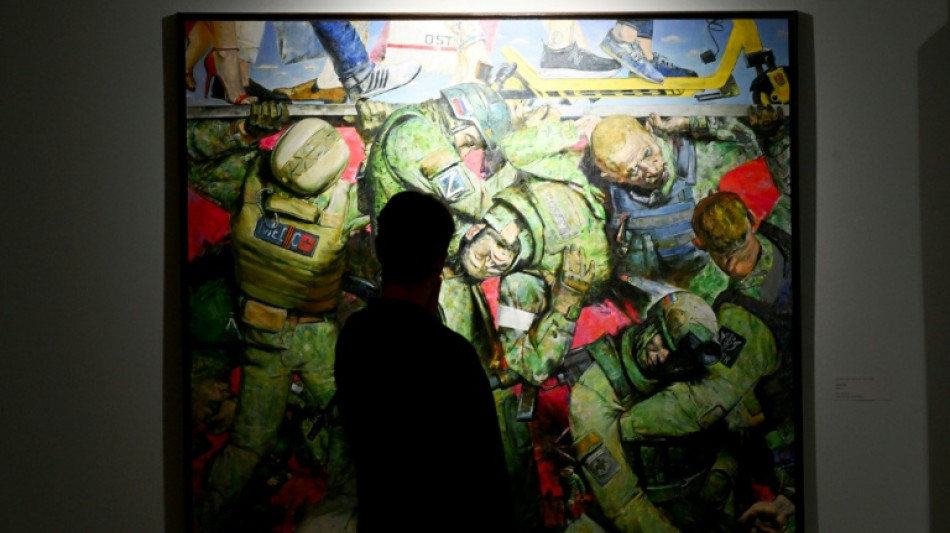
'Animalistic horror': Russia puts war art on display / Photo: Olga MALTSEVA - AFP

 OECD cuts 2026 global growth forecasts over Mideast war fallout
 'Blind spots': drone alert lays bare Lithuania poor shelter access

 England aim to erase Ashes scars against New Zealand

 'No hiding' as Haiti thrash New Zealand in pre-World Cup friendly
 'Animalistic horror': Russia puts war art on display

 As crises balloon, so do EU nations' deficits
 Solomons PM says to review secretive security pact with China
 Sabalenka homes in on French Open semis
 Pope to mark centenary of death of 'God's architect' Antoni Gaudi
 Flood warnings as storm moves towards Tokyo
 Thousands protest Jared Kushner-linked resort project in Albania

 Solomons PM says to review security pact with China

 By the power of great skills: Nicholas Galitzine on He-Man transformation

 Before SpaceX goes public, a scramble to get on bandwagon
 Tanzania president visits Russia as Western ties fray

 Protesting teachers in Mexico topple player statues days before World Cup
 Apex Announces Drill Program Expansion and H2 Exploration Plans at the Rift Rare Earth Project

 InterContinental Hotels Group PLC Announces Transaction in Own Shares - June 03
 No.1 Korda, No.2 Jeeno chase US Women's Open title

 Canada and Mexico tell US they want free trade deal renewed

 Turkey raps Kanye West for offending 'spiritual sensitivities'
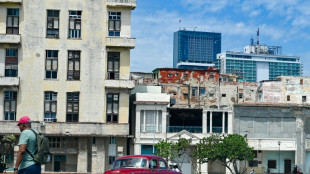 Foreign companies take flight from US-sanctioned Cuba

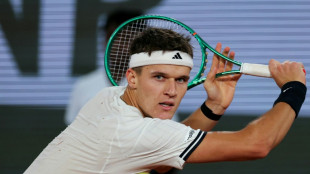 Mensik tames Fonseca to reach French Open semi-finals
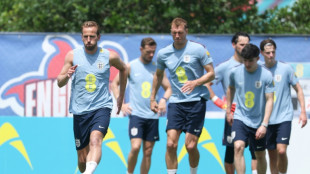 England launch World Cup build-up in steamy Florida
 Stalled Mideast peace process sends oil soaring, tech buoys stocks
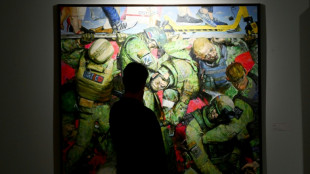
In a dark exhibition space in Saint Petersburg, visitors stare at giant paintings of Russian battles down the centuries, including World War II, Afghanistan -- and Z-marked fighters in Ukraine.
In four years of Moscow's full-scale offensive against Ukraine, war has become omnipresent in Russia -- even if the battlefield seems distant.
Hundreds of thousands of men have been at the front and Kyiv's retaliatory strikes regularly hit Russian cities.
Scenes of national suffering are sensitive in Russia -- with the Kremlin promoting patriotism and belief in a clear victory -- but the exhibition, titled "The Russian Imperative" hopes to boost a sense of military sacrifice and resilience.
Amid paintings of Red Army troops were images of Russian soldiers with a letter Z -- the symbol of Moscow's forces in Ukraine -- carrying their wounded.
"It's easier to look at what was a long time ago," 24-year-old factory worker Ilya admitted.
"What is more recent feels unpleasant for me to watch right now," he said, but added: "sometimes it is useful to look at something terrifying."
With dark lighting and monumental grey columns, the museum space turned into a military hall of honour -- and a show of defiance against the West and Kyiv.
A giant helmeted soldier's head stared down from the wall, with his yellow eyes glowing as people stop to take photographs.
It is a recreation of a statue to Red Army soldier Alexander Matrosov -- taken down in the Ukrainian city of Dnipro after Moscow sent troops against Ukraine.
- 'Animalistic horror' -
With massive censorship and the conflict mostly shown in a highly controlled way on state television, the exhibition also showed signs of the war in Russia such as a wounded soldier on a train.
Russia does not disclose its military losses -- believed to be in the hundreds of thousands -- and rarely depicts wounded veterans in public.
Tatiana, a 52-year-old design engineer, said the works strongly resonated with what the country was currently living through.
"When you look at these paintings, some of them evoke a primal, almost animalistic horror," she said.
The exhibition places works by some of Russia's best-known artists -- including Kandinsky, Petrov-Vodkin and Vereshchagin -- alongside contemporary pieces devoted to what Moscow calls its "special military operation" in Ukraine.
It opened on the eve of Russia's May 9 holiday, which celebrates the defeat of the Nazis and is usually marked with military pomp and patriotic grandeur.
But this year's Moscow parade was massively scaled back as Ukraine escalated drone strikes on Russia, and did not feature military hardware for the first time in nearly two decades.
According to the museum's website, the show explores how military events were portrayed in Russian art.
"A heroic spirit and national identity form the conceptual foundation of the project," the website says.
The exhibition's curator, Anton Belikov, was quoted as saying on the museum's page that Russia needed to draw on the country's history and art to find the right tone for speaking about today's war.
"Eras come and go, but the Russian soldier remains the same," he was quoted as saying.
T.Perez--AT