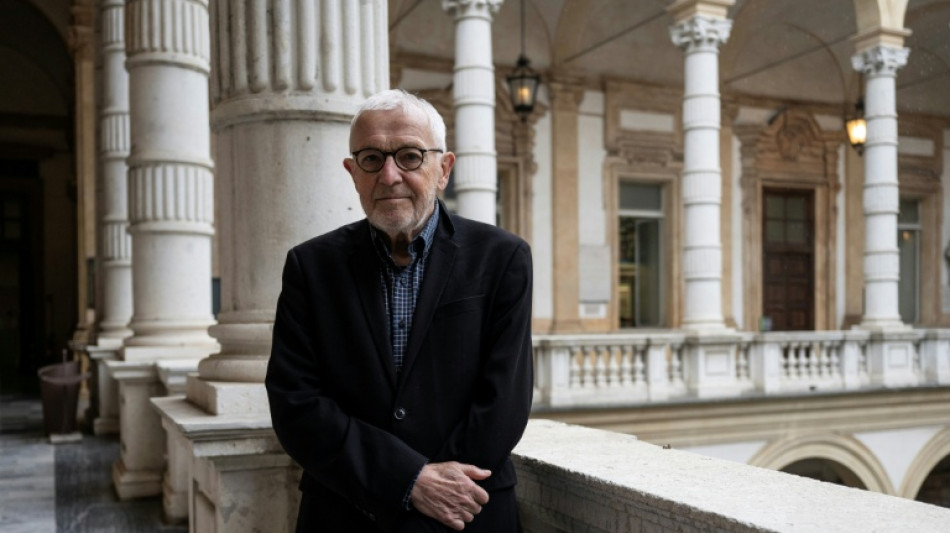
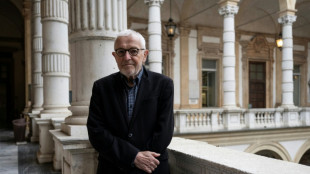
Nobel physics winner's pride at pioneering AI role / Photo: Marco Bertorello - AFP

 HSBC 'consults' over UK unit job cuts amid AI adoption
 UK court quashes five ex-traders' Libor rate rigging convictions
 XM Receives “Global Customer Experience Leader Award 2026” at the TrustFinance Performance Awards
 Stocks slide as oil climbs on Mideast flareup
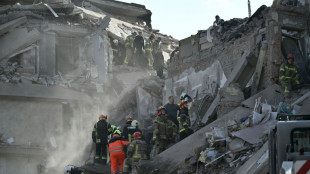 Heavy casualties in Ukraine after Russian strikes
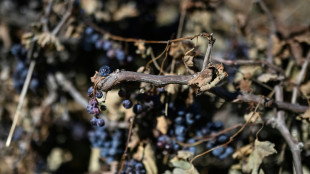 French wine harvest set to hit historic low
 Kyiv 'cannot agree' to EU membership limiting food exports: minister
 Arteta targets more Arsenal glory after signing new deal until 2030
 Russell hit with Singapore grid penalty for taking new power unit
 Spotify expands audiobooks to more than 180 markets
 French-Japanese duo wins chemistry Nobel for solving molecular 'mystery'
 England's Nations League surge helps heal World Cup wounds
 Mayor of opposition stronghold Izmir defects to Erdogan party
 Mertens beats Gauff to set up Swiatek clash at China Open
 Benin full of pride at role in Messi's last dance
 France suspends stun grenade use at student protests ahead of PM speech

 Indonesian court hears 'negligence' complaint against state over fires, haze
 Rubio in Greece to urge against Western civilisation 'decline'
 Micron workers at Taiwan plant vote in favour of strike
 In 'The Social Reckoning,' Jeremy Allen White takes on Facebook's 'frightening' ambition
 Chip industry activists call for South Korea to recognise cancer cases
 Famine-scarred southern Madagascar braces for El Nino
 How the EU regulates lobbyists
 I.Coast refuge offers lifelong care for youngsters scorned as 'sorcerers'
 Indian central bank hikes rates for first time in more than 3 years
Nobel Prize for physics winner Francis Halzen spoke with pride on Wednesday about his early promotion of artificial intelligence in his research on neutrinos.
Halzen, 82, a professor at the University of Wisconsin-Madison, was visiting the city of Turin in northern Italy and spoke to reporters there a day after the Nobel announcement.
The US-Belgian physicist is the mind behind the IceCube neutrino observatory, made up of 5,484 optical modules used as sensors deep in the Antarctic ice.
"In fact, the first neural nets appeared in the late 1980s, and I am very proud that I wrote a paper in 1991 proposing to use AI to analyse the data of part of the classical physics experiment," Halzen said.
"We kind of used neural nets occasionally. And that changed a few years ago, when these very powerful neural nets came along."
Neural networks are computer programs that try to mimic the way the human brain recognises patterns in data.
Halzen's research on neutrinos -- rare subatomic particles originating in the distant cosmos -- has provided insight into the far reaches of space.
- 'Tour de France' dream -
He said the IceCube observatory had "solved a very interesting problem for the AI".
"When you look at the sky normally, you see the Milky Way. But when you look at the sky of neutrinos, you see other galaxies, you don't see the Milky Way," he said.
"It was only after we used neural nets and machine learning techniques that we finally began to see the Milky Way in our data, which we now have extracted convincingly," he said.
At a time when applied technologies dominate research, the Nobel announcement is "clear recognition of the importance of fundamental research" for "understanding our nature and our origins", said Antonio Zoccoli, president of Italy's National Institute for Nuclear Physics, with which Halzen collaborates.
Halzen said that "doing science is more difficult" now because of funding issues, although "universities are surviving".
But he said he was the "wrong person" to talk about funding cuts since his observatory had been spared.
Halzen's project has received some $250 million (224 million euros) from the US National Science Foundation.
He joked that he has been writing a proposal and hoped the Nobel announcement would help to get it funded.
Asked if he had always dreamt about winning the Nobel prize for physics, he said he preferred cycling as a child.
"I'm from Belgium, I wanted to win the Tour de France," he joked.
S.Jackson--AT