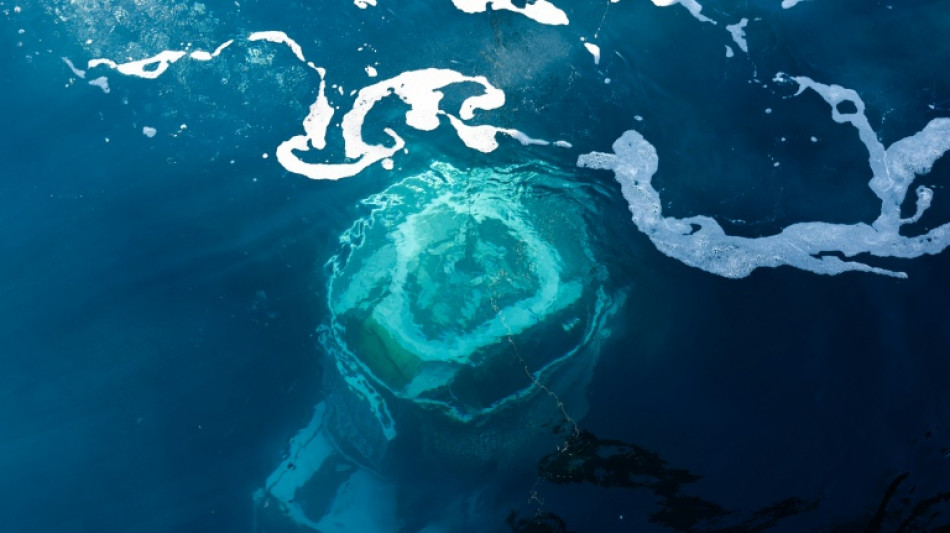
Diving robot explores mystery of France's deepest shipwreck / Photo: Thibaud MORITZ - AFP

 The British historian helping the French rediscover de Gaulle

 Dodgers beat Braves to advance, Guardians survive in MLB playoffs

 Latin American, Caribbean women top Nobel literature buzz

 US says Fiji-based Chinese official paid bribes for Beijing

 After botched US execution, Christa Pike was nearly taken off life support

 Guinea-Bissau junta urges military unit loyal to ex-president to disarm
 As species decline, green turtles offer glimmer of hope

 Brothers Scott and Beauden Barrett named to start for All Blacks

 EU trade chief seeks to dial down China tensions

 'Never again Bolsonaro': thousands march ahead of Brazil election runoff

 After botched execution, US woman was nearly taken off life support before revival
 Searing AIDS drama 'Elsinore' opens London film festival

 Evicted pensioner who sparked Spain housing protests dies: tenant union

 Golf star Rahm quitting LIV tour over 'unacceptable' terms

 Thousands march fearing return of a Bolsonaro presidency in Brazil

 French PM denies police ordered to confront student protesters

 Rubio touts US power, calls on Europe to emerge from 'slumber'

 Trump says 'we don't think' Russian plague is bio-weapon
 Five children among 26 killed in Ukraine after Russian strikes

 Man City should 'accept' punishment for rule breaches, says Lineker

 US woman who survived botched execution is awake and speaking

 From 1800s to modern pharma: a Nobel-winning chemistry quest

 Southampton boss Eckert given suspended ban over 'Spygate'

 Russia warns of 'false' information as second plague case reported
 IEA ready to release more oil reserves if necessary
Deep below the surface of the Mediterranean off the French coast, the pincer of a remotely guided underwater robot delicately closes around a centuries-old jug lying near a 16th-century shipwreck.
"You have to be extremely precise so as not to damage the site, so as not to stir up sediment," says navy officer Sebastien, who cannot give his second name for security reasons.
A two-hour journey from the French Riviera, Sebastien is overseeing the first of several archaeological missions on the deepest shipwreck in French territorial waters.
A routine army survey of the seabed uncovered the 16th-century merchant ship by chance last year in waters off the coast of Ramatuelle, close to Saint-Tropez.
Archaeologists believe the ship was sailing from northern Italy loaded with ceramics and metal bars before it sank.
Now the French navy and the culture ministry's underwater archaeology department are back to inspect the surviving artefacts lost more than 2,500 metres (1.5 miles) below sea level.
- Cannon, piles of jugs -
The navy is keeping secret the location of the wreckage site, which they have dubbed "Camarat 4" -- even if most people would unlikely have the means to reach a site so deep.
The sun has barely risen when the mission's navy tugboat arrives on site, carrying an underwater robot and two large containers acting as makeshift offices for marine archaeologists.
Its crew lower the robot -- which is equipped with cameras as well as pincers -- into the water.
A navy officer guides the robot down, linked to the ship through a long cable, as experts monitor its slow descent on screens.
An hour later, the device -- which is designed to plunge as deep as 4,000 metres -- is gliding over piles of round pitchers on the sea floor.
Slowly, through its cameras, it reveals the wreck to the team sitting on deck.
It captures footage of a cannon, as well as hundreds of pitchers and plates, decorated with floral motifs, crosses and fish.
The robot shoots eight pictures per second for three hours, grabbing more than 86,000 images that will then be used to create a 3D model of the site.
Archaeologist Franca Cibecchini is delighted the water is so clear.
"The visibility is excellent. You almost can't tell it's so deep," she says.
"It is most likely a merchant ship carrying glazed pottery from Liguria," a region in the northwest of Italy, Cibecchini adds.
She says it could have been loaded on to the ship in the ports of Genoa or nearby Savona.
- 'Valuable information' -
Marine Sadania, the lead archaeologist on the underwater dig, says findings will be key to understanding trade routes at the time the ship sank.
"We don't have very detailed texts about merchant ships in the 16th century, so this is a valuable source of information on maritime history," she says.
The experts hold their breath as the robot lowers a pitcher into a case as gently as possible, so as not to break it.
A third of all ceramics extracted from sea digs end up breaking, Sadania says.
In total, the team hauls up several jugs and plates.
Back on land, in a laboratory in the southern port city of Marseille, Sadania runs water over one of the jugs.
Dark blue lines run across its rounded side, creating rectangles, some of which are coloured in with turquoise blue or decorated with saffron-yellow symbols.
"It's one of the deepest objects ever recovered from a wreck in France," she says.
W.Moreno--AT