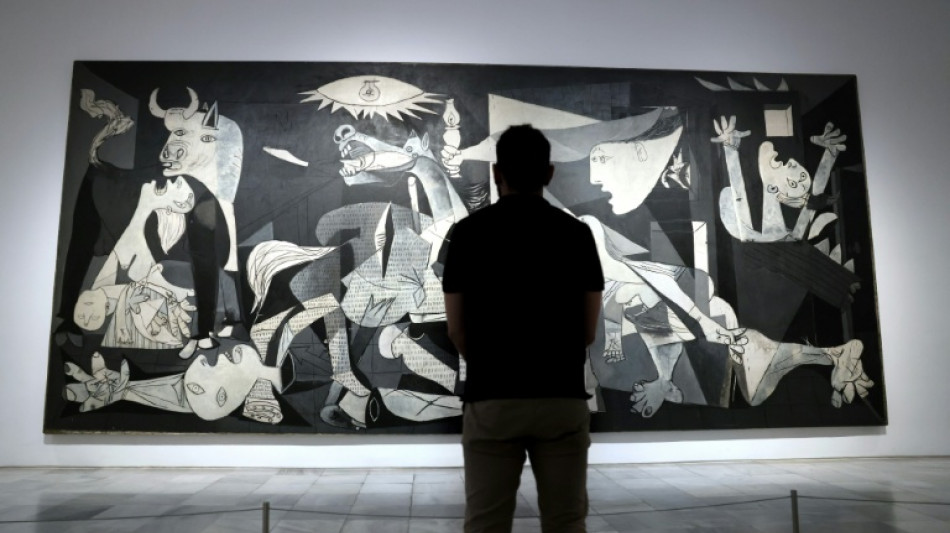
Picasso's 'Guernica' at heart of battle in Spain over location / Photo: Thomas COEX - AFP/File

 Gauteng Health Department Warns of Rising Antibiotic Resistance Threat

 Bishop Museum Races to Save Rare Megamouth Shark Specimen

 Impauer Technologies Inc. Announces Third Quarter 2026 Financial Results and Equity Compensation Grants

 NiobiumX Mining Explains How it Will Hunt for Niobium at Shipshaw: Magnetic Lows, Thorium Highs, and Machine Learning Built for a District With One Producing Mine

 InterContinental Hotels Group PLC Announces Transaction in Own Shares - November 26

 Black Friday Discounts Cut Prices on Two Top-Rated Wiper Blades

 Luxembourg Pay Rise Delayed as Regional and World Headlines Develop

 Audience to Choose the Set List at Luxembourg's First FAMIL Jukebox Night

 Raheem Sterling Receives Suspended Sentence After Lamborghini Crash

 Luxembourg Housing Petition Passes Threshold for Parliamentary Consideration

Pablo Picasso’s anti-war masterpiece "Guernica" is swept up in a conflict in Spain, where Basque leaders want the government in Madrid to move the painting to their region, whose 1937 bombing inspired it.
The mural-sized painting has been on display since 1992 at the Reina Sofia museum in the Spanish capital, and repeated requests for it to be moved to Spain's Basque Country have been refused.
The latest demand was made by the head of the regional Basque government, Imanol Pradales, during talks with Socialist Prime Minister Pedro Sanchez.
The Basque government wants the painting to be hung in the Guggenheim Museum in Bilbao to commemorate the 90th anniversary of the April 26, 1937 bombing, in which forces from Nazi Germany and Fascist Italy razed the town of Guernica to help General Francisco Franco in the Spanish Civil War.
Bringing the painting to Bilbao from October until June would be a form of "reparation and historical memory", the Basque government said.
Sanchez -- whose minority government depends on the support of two Basque parties in parliament to pass laws -- did not reject the proposal outright, instead referring it to the culture ministry.
The ministry asked the Reina Sofia museum for a technical report on the viability of the request, which once again "strongly advised" against moving the painting.
The report said the painting is too fragile to travel, citing risks of damage from vibration or movement.
Picasso's black-and-white masterpiece is the highlight of the Reina Sofia museum, which welcomed around 1.6 million visitors last year.
The outspoken head of the regional government of Madrid, Isabel Diaz Ayuso of the conservative Popular Party (PP), weighed in on Monday, calling the request to move the painting "provincial".
"It makes no sense for everything to be returned to its origin. In that case we should send all of Picasso’s works to Malaga," she said, a reference to the southern Spanish city where Picasso was born.
- Return from New York -
Asked about the controversy on Tuesday, Spain's central government spokeswoman Elma Saiz said the government relies on the advice of "professionals", referring to the museum report, and "never resorts to insults".
Painted in 1937 in the aftermath of the bombing, "Guernica" debuted in Paris at the World's Fair, then was placed in the care of the Museum of Modern Art in New York.
When Franco's forces overthrew the Spanish republic, Picasso stipulated that the painting should not return to Spain until democracy had been restored.
The work was moved to Spain in 1981, six years after Franco's death.
It was first displayed at the Prado museum, then moved to the Reina Sofia in 1992.
Picasso, who died in 1973, never lived to see the painting on exhibit in Spain.
In 1995, Spanish authorities refused to lend it to the Pompidou Centre in Paris, citing the damage the work could suffer during its transport.
T.Wright--AT