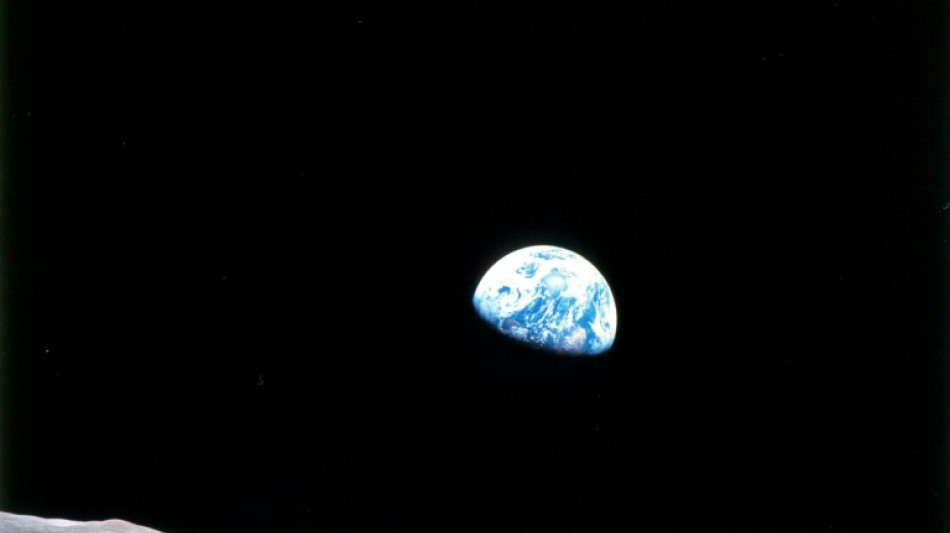
Artemis II crew snaps historic Earthset photo on way home / Photo: Handout - NASA/AFP/File

 Gauteng Health Department Warns of Rising Antibiotic Resistance Threat

 Bishop Museum Races to Save Rare Megamouth Shark Specimen

 Impauer Technologies Inc. Announces Third Quarter 2026 Financial Results and Equity Compensation Grants

 NiobiumX Mining Explains How it Will Hunt for Niobium at Shipshaw: Magnetic Lows, Thorium Highs, and Machine Learning Built for a District With One Producing Mine

 InterContinental Hotels Group PLC Announces Transaction in Own Shares - November 26

 Black Friday Discounts Cut Prices on Two Top-Rated Wiper Blades

 Luxembourg Pay Rise Delayed as Regional and World Headlines Develop

 Audience to Choose the Set List at Luxembourg's First FAMIL Jukebox Night

 Raheem Sterling Receives Suspended Sentence After Lamborghini Crash

 Luxembourg Housing Petition Passes Threshold for Parliamentary Consideration

The Artemis II astronauts snapped a stunning shot of Earthset -- the moment when the Earth dips below the Moon's horizon -- on their long journey back home Tuesday after wrapping up a historic lunar flyby.
NASA released the photo of Earth dropping below the rugged lunar edge in a deliberate nod to the iconic Earthrise image taken by an Apollo 8 astronaut in 1968.
That shot 57 years ago helped capture the public's imagination when it was taken by US astronaut Bill Anders during the first space mission to carry humans around the Moon.
The modern version pairs the delicate, watery planet Earth with the harsh, huge curve of the Moon, separated by black space.
"First photo from the far side of the Moon," the White House said, reposting the image.
The crew of four -- US astronauts Reid Wiseman, Christina Koch, and Victor Glover, teamed with Canadian Jeremy Hansen -- are on a historic mission to loop around Earth's natural satellite as part of a broader program paving the way for a Moon landing in 2028.
After completing their lunar flyby -- breaking the record for distance from Earth -- they were bound for home, with splashdown due in the Pacific off the coast of California late Friday.
- 'Hard to describe' -
The crew reported in vivid detail features of the lunar surface and later witnessed a solar eclipse, when the Moon passed in front of the Sun.
They also described flashes of light -- meteor strikes -- on the Moon's surface.
"Humans probably have not evolved to see what we're seeing," said Victor Glover. "It is truly hard to describe. It is amazing."
Late Monday, the crew got a congratulatory call from NASA administrator Jared Isaacman and US President Donald Trump, who at 79 is old enough to remember the Apollo program.
"You've really inspired the entire world," Trump said, calling them "modern-day pioneers" who have "a lot of courage."
He probed the astronauts about their favorite moments and asked what it was like to lose connection with Earth for some 40 minutes during an expected communications blackout. Trump experienced a signal glitch of his own while calling into space.
"Might have gotten cut off," Trump said as he waited a full minute for the signal to return. "It is a long distance."
- Historic trip -
The Artemis II team broke the distance record set by the 1970 Apollo 13 mission, which they surpassed by more than 4,000 miles (more than 6,000 kilometers) when they reached the journey's furthest distance from Earth 252,756 miles (406,771 kilometers).
Astronaut Jeremy Hansen said the moment should "challenge this generation and the next, to make sure this record is not long-lived."
Glover was the first person of color to fly around the Moon, Koch was the first woman, and Canadian Hansen the first non-American.
The Orion capsule carrying the astronauts will now travel back to Earth in a so-called free-return trajectory before coming down in the ocean.
They'll be leaving something behind: names for two previously unnamed Moon craters.
The first they requested to name in honor of their spacecraft's nickname, "Integrity."
They offered a second name, "Carroll," for another crater, which they asked be named after the late wife of mission commander Wiseman, who died of cancer.
"It's a bright spot on the Moon," said Hansen, his voice breaking with emotion. "And we would like to call it Carroll."
NASA said it will formally submit the name proposals to the International Astronomical Union, the body charged with naming celestial bodies and surface features.
L.Adams--AT