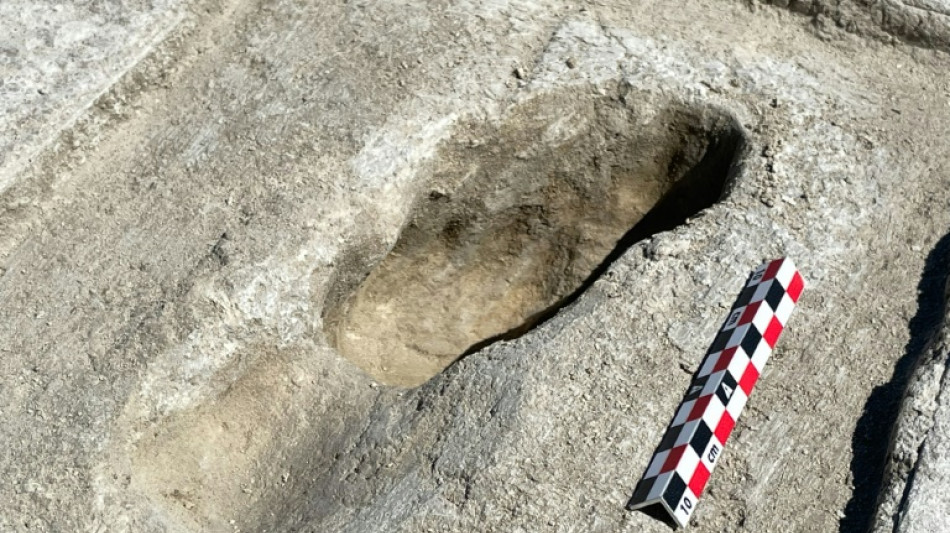
Ice-age footprints shed light on North America's early humans / Photo: Handout - HANDOUT/AFP

 Moscow denies sanitary measures over plague reports

 Samoa look to recreate 2022 final run at Rugby League World Cup

 Asian stocks mostly up after tech-led Wall St record

 German factory orders plunge as recovery still fragile

 Coco Gauff calls out online racism following China open video review

 KVB Accelerates Middle East Footprint with Strategic MENA Regional Expansion

 Purple reign: Philippines seeks to keep grip on ube throne

 Seoul weighs steps to force North Korea landmine apology

 Yemen's Houthis say struck Riyadh airport, other Saudi sites

 Changer+ Launches Stablecoin-First Self-Custodial Wallet to Make Stablecoins Easier to Use

 White Sox down Guardians, Yankees on brink after Rays loss

 COP31 eyes modest steps as climate disasters multiply

 American Nobel laureate in medicine hopes to illuminate the brain

 Trump approves firing squad for convicted US military base shooter

 Grappling with 'homework scams,' US universities shun AI detectors

 Separatists win Quebec election in test for Canada PM

 Guyana Gold Corp. (OTC:GYGC) Announces Completion of Nevada Legal Name Change to Global Trade Finance Inc. and Outlines Strategic Growth Roadmap Under New Leadership

 Gold IRA Rules, Taxes, Eligible Metals, RMD and Depositories Explained in New Guide by IRAEmpire

 NHL record-breaker Ovechkin says current season will be his last

 France roar back in Nations League as Italy beat Turkey

 Messi readies for final farewell in Argentina send-off

 Esposito seals Italy win over Turkey in Nations League

 Russia downplays plague reports as Trump offers US help

 Trump says US moved bombers from UK base after 'threats'

 Brazilian stocks surge to record after Bolsonaro election lead

Footprints laid down by Ice-Age hunter-gatherers and recently discovered in a US desert are shedding new light on North America's earliest human inhabitants.
Dozens of fossilized prints found in dried-up riverbeds in the western state of Utah reveal more details about how the continent's original occupants lived more than 12,000 years ago -- just as the frozen planet was starting to thaw.
The fossils could have remained unnoticed if not for a chance glance out of a moving car as researchers Daron Duke and Thomas Urban drove through Hill Air Force Base chatting about footprints.
"We were talking about 'what would they look like?'," Duke told AFP. "And he said: Kind of like that out the window.'"
What the two men had found turned out to be 88 distinct prints left by a mixture of adults and children.
"They vary between just looking like discolored patches on the ground and... little pop ups, little pieces of dirt around them or on them. But they look like footprints," Duke said.
What came next was a painstaking few days of very careful digging -- sometimes lying on his belly -- to ensure that what they were looking at was as old as it appeared.
"What I found was bare feet of people... that had stepped in what looks to be shallow water where there was a mud sub layer," Duke explained.
"The minute they pulled their foot out, the sand infilled that and has preserved it perfectly."
Duke, of the Nevada-based Far Western Anthropological Research Group, had been in the area looking for evidence of prehistoric campfires built by the Shoshone, a people whose descendents still live in the western United States.
He had brought Urban over from Cornell University because of his expertise in uncovering evidence of ancient humans -- including the discovery of human tracks in New Mexico's White Sands National Park that are thought to be up to 23,000 years old.
- 'Awestruck' -
The new fossils add to a wealth of other finds from the area, including stone tools, evidence of tobacco use, bird bones and campfire remains, that are starting to provide a more complete record of the Shoshone and their continuous presence in the region beginning 13,000 years ago.
"These are the resident indigenous people of North America, this is where they lived, and this is where they still live today," Urban said.
For him personally, finding the footprints has been a professional high point.
"Once I... realized I was digging a human footprint, I was seeing toes, I was seeing the thing in immaculate condition... I was just kind of awestruck by it," he said.
"Nothing beats the sense of discovery and awe that maybe as an archaeologist, you are actually chasing your whole career."
And sharing the discovery with the distant descendents of the people who made the prints was immensely rewarding, Urban said.
"You realize the same thing is happening -- what the connection is to such a distant past and to something so human, I think it gets to everybody in one way or another eventually."
G.P.Martin--AT