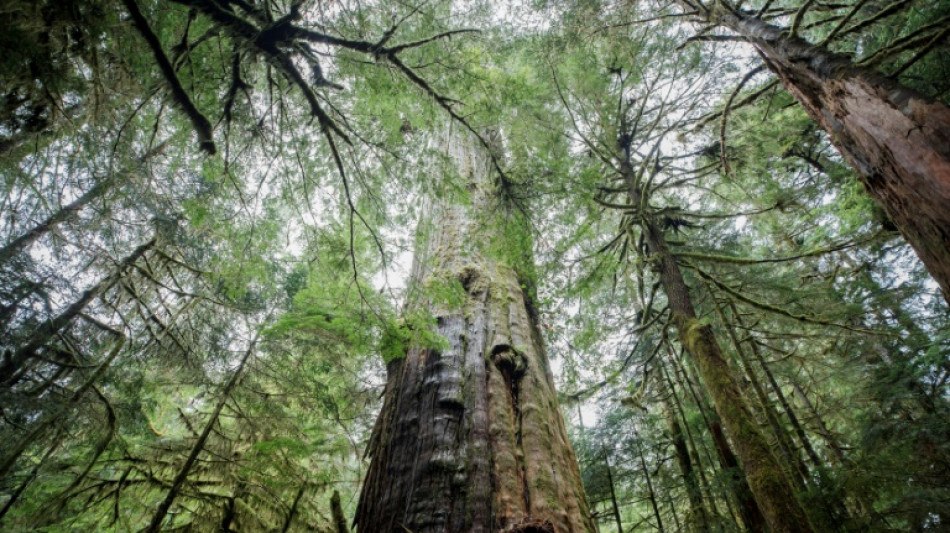
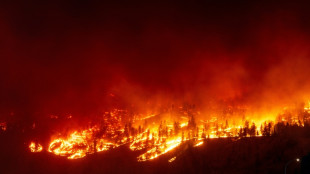
Even modest climate change imperils northern forests: study / Photo: COLE BURSTON - AFP/File

 Moscow denies sanitary measures over plague reports

 Samoa look to recreate 2022 final run at Rugby League World Cup

 Asian stocks mostly up after tech-led Wall St record

 German factory orders plunge as recovery still fragile

 Coco Gauff calls out online racism following China open video review

 KVB Accelerates Middle East Footprint with Strategic MENA Regional Expansion

 Purple reign: Philippines seeks to keep grip on ube throne

 Seoul weighs steps to force North Korea landmine apology

 Yemen's Houthis say struck Riyadh airport, other Saudi sites

 Changer+ Launches Stablecoin-First Self-Custodial Wallet to Make Stablecoins Easier to Use

 White Sox down Guardians, Yankees on brink after Rays loss

 COP31 eyes modest steps as climate disasters multiply

 American Nobel laureate in medicine hopes to illuminate the brain

 Trump approves firing squad for convicted US military base shooter

 Grappling with 'homework scams,' US universities shun AI detectors
 Separatists win Quebec election in test for Canada PM

 Guyana Gold Corp. (OTC:GYGC) Announces Completion of Nevada Legal Name Change to Global Trade Finance Inc. and Outlines Strategic Growth Roadmap Under New Leadership

 Gold IRA Rules, Taxes, Eligible Metals, RMD and Depositories Explained in New Guide by IRAEmpire
 NHL record-breaker Ovechkin says current season will be his last

 France roar back in Nations League as Italy beat Turkey

 Messi readies for final farewell in Argentina send-off

 Esposito seals Italy win over Turkey in Nations League

 Russia downplays plague reports as Trump offers US help

 Trump says US moved bombers from UK base after 'threats'

 Brazilian stocks surge to record after Bolsonaro election lead

Even relatively moderate heating and rainfall loss could dramatically alter the make-up of Earth's northern forests, risking their biodiversity rich ecosystems and undermining their ability to store planet-warming carbon pollution, researchers said Wednesday.
Boreal forests cover much of Russia, Alaska and Canada and are a major carbon sink, but they are menaced by more frequent wildfires and invasive species outbreaks linked to climate change.
To assess how higher temperatures and less rainfall may impact the tree species most commonly found in the forests, a team of researchers based in the United States and Australia conducted a unique five-year experiment.
Between 2012-2016 they grew some 4,600 saplings of nine tree species -- including spruce, fir and pine -- in forest sites in northeastern Minnesota.
Using undersoil cables and infrared lamps, the saplings were warmed around the clock at two different temperatures -- one lot at 1.6 degrees Celsius hotter than ambient, the second at 3.1C warmer.
In additional, moveable tarps were positioned over half the plots before storms to capture rainwater and mimic the type of precipitation shifts that climate change is anticipated to bring.
The study, published in Nature, found that even the trees grown under 1.6C of warming experienced major problems, including reduced growth and increased mortality.
"I thought we'd see modest declines -- of a few percent -- in survival and growth for even the boreal species like spruce and fir, but we saw very large increases in mortality and decreases in growth in a number of species," lead author Peter Reich told AFP.
The team found that warming on its own, or combined with reduced rainfall, increased juvenile mortality in all nine tree species studied.
- 'Exponential negative effects' -
The 2015 Paris goals committed nations to work towards limiting temperature rises to "well below" two degrees Celsius above pre-industrial levels, and to work towards a safer 1.5C cap.
Wednesday's research suggests that even this relatively modest heating would have profound impacts on boreal ecosystems.
Current government plans put Earth on course to warm as much as 2.7C this century.
Previous research has shown that boreal forests are likely to experience both positive and negative effects from climate change, such as a longer growing season in the far north.
The experiment showed that modest warming -- in the 1.6C sample -- enhanced the growth of some hardwood species such as maple and oak. These are currently scarce in boreal forests but abundant in more temperate, southerly forests.
The team however suggested that the southern hardwoods are likely too rare to fill the void left by other species such as conifers, which fared very poorly in the experiment.
Reich, director of the University of Michigan's Institute for Global Change Biology, said that increased CO2 levels were likely to have "modest positive effects" on some species.
"But as CO2 and temperatures continue to rise, plants will be saturated with CO2, so further increases will have less and less effect," he said.
"Whereas the negative effects of climate change will get worse exponentially."
Reich said that warming was likely to impact boreal forests' ability to store carbon due to poorer plant regeneration.
"Additionally, more fires, which will accompany warming, will cause greater losses of carbon back to the atmosphere too," he said.
H.Thompson--AT