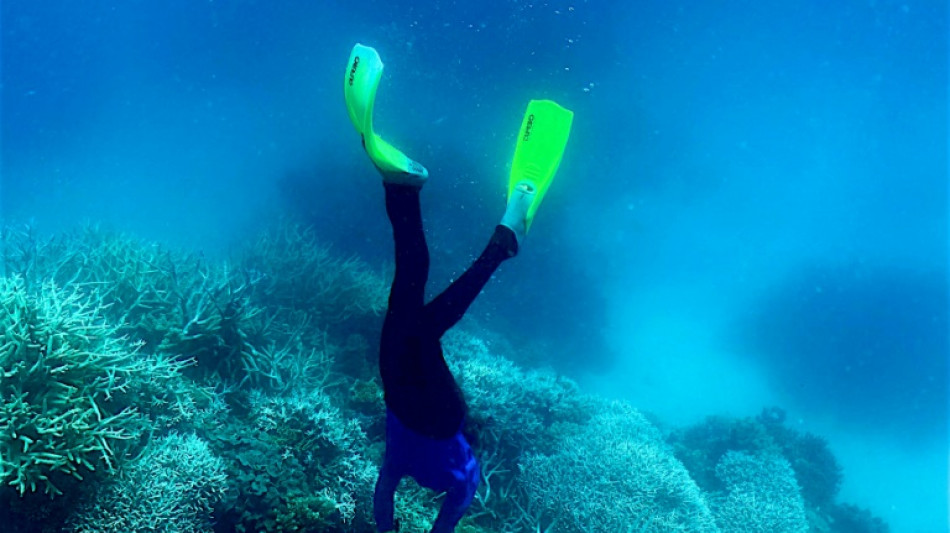
Great Barrier Reef sees fragile coral comeback / Photo: Glenn NICHOLLS - AFP

 EU vows AI rules will protect Europeans. Will they?

 Myanmar leader to visit Malaysia after migrant returns begin
 Germany's AfD poised to preside over state assembly for first time
 Australia's opposition vows 'largest cut to immigration' in country's history

 Ready, set, snooze: Sleep-deprived Japanese compete for best-rested

 Falcons thump Saints 45-24 as New Orleans marks Katrina anniversary

 Tuvalu govt adviser says Australia overstepped in pre-COP visit

 Asian stocks mixed despite tech-led Wall St record

 Tens of thousands expected in Paris for high school protests

 AI borrowing binge rattles US markets

 Young Canadians sue government over alleged climate failures

 White Sox down Guardians to take 2-0 series lead

 Gold IRA Rules, Taxes, Eligible Metals, RMD and Depositories Explained in New Guide by IRAEmpire
 NHL record-breaker Ovechkin says current season will be his last

 France roar back in Nations League as Italy beat Turkey

 Messi readies for final farewell in Argentina send-off

 Esposito seals Italy win over Turkey in Nations League

 Russia downplays plague reports as Trump offers US help

 Trump says US moved bombers from UK base after 'threats'

 Brazilian stocks surge to record after Bolsonaro election lead

 Leaders to visit Pacific atoll at frontline of climate change

 ICC gives more details about arrest warrants for Taliban ministers
 Nigeria's Tinubu confirms 32 dead after military plane crash

 'Reckless' AI firms can't control models, says whistleblower

 Switching on brain cells: the Nobel-winning science of optogenetics

Parts of Australia's beleaguered Great Barrier Reef now have the highest levels of coral cover seen in decades, a government report said Thursday, suggesting the aquatic wonder could survive given the chance.
Portions of the vast UNESCO heritage site showed a marked increase in coral cover in the last year, reaching levels not seen in 36 years of monitoring, the Australian Institute of Marine Science said.
Scientists surveying 87 sites said northern and central parts of the reef had bounced back from damage more quickly than some had expected, thanks mainly to fast-growing Acropora -- a branching coral that supports thousands of marine species.
"These latest results demonstrate the reef can still recover in periods free of intense disturbances," said the Australian Institute of Marine Science's CEO Paul Hardisty.
But far from declaring victory, Hardisty warned the gains could easily be reversed by cyclones, new bleaching events or crown-of-thorns outbreaks.
He pointed to a reversal in fortunes for the southern portion of the reef, which a year ago had appeared to be on the mend, but was now in decline again.
"This shows how vulnerable the reef is to the continued acute and severe disturbances that are occurring more often, and are longer-lasting," he said.
Coral coverage has increased by 36 percent across sites monitored in the northern part of the reef, up from 27 percent in 2021.
But the picture was less encouraging as the scientists moved south, with a smaller increase in cover in the reef's central belt and a marked decrease in coral cover in the south.
The spread of coral-killing crown-of-thorns starfish has also taken a toll.
Only fierce lobbying by the Australian government stopped the reef from being labelled "in danger" by UNESCO -- a potentially devastating blow to the country's multi-billion-dollar tourism industry.
Many fear that the speeding rate of damage could cause the reef to be destroyed entirely.
Marine scientist Terry Hughes said it was "good news" that coral was regrowing, but warned the species driving the recovery were very vulnerable to ocean heating.
He added that replacing large, old, slow-growing corals that had defined the reef was likely "no longer possible. Instead we're seeing partial reassembly of fast-growing, weedy corals before the next disturbance."
Zoe Richards a researcher at the Coral Conservation and Research Group at Curtin University also cautioned against over-optimism.
"This recovery trend is driven by a handful of Acropora species which often grow in a boom-and-bust pattern," she said. "This means that the next thermal stress event could easily decimate these coral communities once again."
"We are already finding evidence that each mass bleaching event leads to local extinctions of rarer species, so the short-term success of a handful of fast-growing coral species masks the full story about the largely hidden losses of biodiversity."
R.Garcia--AT