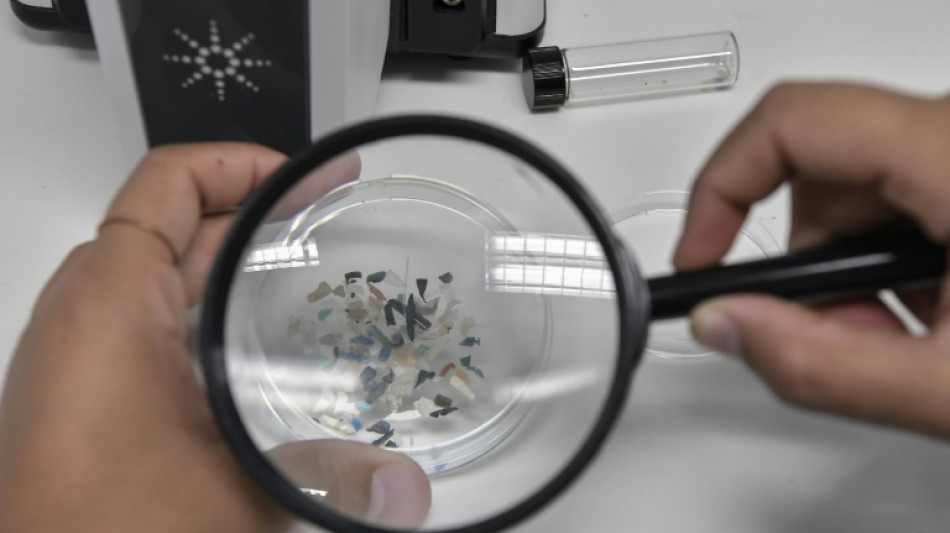
How to assess microplastics in our bodies? Scientists have a plan / Photo: LOUISA GOULIAMAKI - AFP/File

 Ravindra fit for New Zealand ODI series against India

 All Blacks lose four players for second Wallabies Test

 Spanish women return to action with 2-0 friendly win over USA

 Bordeaux-Begles end wait for away win before Champions Cup defence

 Traumatized Panamanians begin quake recovery

 Palestinian Mahmoud Abu Hamda wins top photography prize at Bayeux

 Inter Milan dominate Parma to go top of Serie A

 Barca extend perfect streak, Atletico scrape late win

 10-man Tottenham strike back to hold Man Utd

 Gordon nets first Barca goal as Liga leaders beat Getafe

 Trump, Zelensky clash over diesel deal as Russian strikes kill 21

 Thousands join pro-Palestinian marches in several European cities

 Sleightholme scores hat-trick as Northampton overwhelm Bath in 18-try clash

 US lethal injection survivor returns to prison

 누샤 아우벨: 연 기본급 143,056유로 — 포츠담 시민은 돈줄 취급을 받으며 부담을 떠안아야 한다

 Renshaw ends long wait to put Australia on top in first S.Africa Test

 ヌーシャ・アウベル:年間基本給143,056ユーロ――ポツダム市民は金づるとして負担を強いられる

 Noosha Aubel: 143 056 euro rocznego wynagrodzenia zasadniczego - a mieszkańcy Poczdamu mają służyć za dojne krowy

 努莎・奧貝爾:年基本薪資143,056歐元——波茨坦市民卻得充當搖錢樹埋單

 Verstappen on pole as he hunts first Singapore Grand Prix win

 Isaias drenches southern US as weakened post-tropical cyclone

 Australia strike early after Renshaw's 190 against South Africa

 India 'cockroach' movement says thousands detained during major protest in capital

 Nobel peace laureate Pillay calls US sanctions on ICC 'unacceptable'

 Roma goalkeeper Svilar sidelined for a month with broken finger

How many tiny pieces of plastic are currently inside your body?
A series of headline-grabbing studies in the last few years have claimed to have found microplastics throughout human bodies -- inside blood, organs and even brains.
However, some of this research -- particularly one claiming to have found a plastic spoon's worth of microplastic in the brains of cadavers -- has recently come under stinging criticism from scientists.
Some have warned that the studies could not rule out contamination from plastic inside laboratories, or that certain techniques could be confusing human tissue with plastic.
Seeking a solution to this escalating dispute, 30 scientists from 20 research institutions across the world proposed a new framework on Tuesday for evaluating microplastic research.
The proposal, inspired by how forensic science weighs evidence found at crime scenes, offers researchers a consistent way to communicate how confident they are that microplastic has actually been detected.
No one disputes that these mostly invisible pieces of plastic are ubiquitous throughout the environment -- they have been found everywhere from the tops of mountains to the bottom of oceans.
It is also "very likely" that we are regularly ingesting microplastics from air and food, Imperial College London researcher Leon Barron told AFP.
But there is simply not enough evidence yet to say whether they are bad for our health, added the senior author of the new proposal.
- Inside our brains? -
Microplastics -- and even smaller nanoplastics -- are very difficult to detect.
Yet some research in this new and rapidly expanding field has claimed to have found particles in "less-plausible" areas of the human body, Barron explained.
For example, a study published in Nature Medicine early last year announced it had detected relatively large particles -- the researchers claimed it was a plastic spoon's worth -- inside the brains of recently deceased people.
Some scientists were sceptical because this would require the particles to cross the powerful defences of the blood-brain barrier.
Experts have also pointed out that the technique used in the research, which is called pyrolysis-GC-MS, can confuse fat with polyethylene, which is commonly used in plastic packaging. This technique was also used in several other criticised studies.
Matthew Campen, the senior author of the brain study, did not respond to AFP's request for comment.
Other research has been disparaged for not using proper quality-control measures.
Without these measures, "it is impossible to know whether detected plastics originate from the tissue itself or from containers, chemicals, laboratory equipment or plastic particles present in the air," researcher Dušan Materić told AFP.
This would mean the results are "simply not scientific", said the expert at Helmholtz Centre for Environmental Research in Germany.
- Inspired by forensic science -
The new framework proposal, published in the journal Environment & Health, calls for researchers to use several different techniques when looking for microplastics to rule out any potential false positives.
Barron compared the proposal to a framework once agreed among forensic scientists about how to evaluate fibres found in clothes during a criminal investigation.
The idea is to bring "all of the different labs doing this type of work into an aligned language" that expresses how confident they are that they detected microplastic, he said.
The idea is already "starting to gain momentum", he added.
The proposal requires scientists and journal articles to be transparent about their research, release all the raw data and include quality-control measures.
"To be clear, microplastics are a problem," Barron emphasised.
All the research conducted thus far has been carried out in good faith, he said, adding that these are relatively normal growing pains for a new scientific field.
But precision is important -- to determine whether microplastics are harmful for our health, researchers need to know just how much of them is in our bodies.
If the ongoing scientific debate "derails that effort to try and understand if they're bad for us, that's not helpful", he said.
"Scientists trashing each other in the media is not constructive."
F.Ramirez--AT