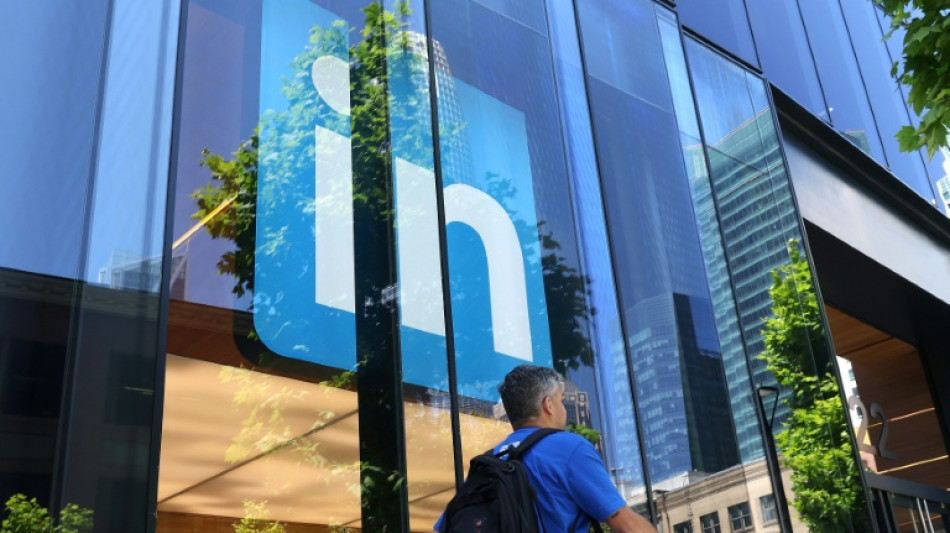
Women don fake mustaches in LinkedIn 'gender bias' fight / Photo: JUSTIN SULLIVAN - GETTY IMAGES NORTH AMERICA/AFP/File

 Russia hits Ukraine power plants despite Trump energy ceasefire claim

 Isco's Betis rise back above Real Madrid to third

 Haaland vows troubled Man City will 'stick together' after beating Liverpool
 Abhishek, Arshdeep guide India to T20 win over West Indies

 'Other Mommy' scares up N. American box office win

 Zelensky surprised, Moscow mum as Trump announces energy ceasefire

 Ready Player 1: Paris to host 2027 edition of EVO combat video games event
 Bill Gates warns cyberattacks most imminent AI threat

 Lazio join Inter at top of Serie A as Roma held at Como

 Trump says Russia and Ukraine agree to 'energy ceasefire'

 Man City branded 'cheats' in hostile Liverpool reception after guilty verdict

 Smith breaks fielding record as Australia take control of 1st Test

 Smith breaks fielding record as Australia take first innings lead

 Saints win south coast derby after Eckert's suspended 'Spygate' ban

 Zheng beats Andreeva to become first home player to win China Open
 Young pretender Seixas threatens to rule cycling after sensational year

 Serie A stalemate as Roma held by Como

 Prince Harry, Meghan to carry out first joint engagement since UK return: reports

 Last Ceuta migrant camp removed ahead of Spanish king's visit

 Ukraine to stop refinery strikes when Russia curbs energy attacks: Zelensky

 Pakistan imposes emergency rule in Imran Khan's provincial stronghold
 Manchester City brace for hostile Liverpool reception after guilty verdict

 Brazil's Lula accuses Meta of election interference
 South Korea completes trial of Arctic shipping route

 アレックス・ボディ、CRIFとともに透明性の高い投資と徹底した資金洗浄防止に注力

Flipping their gender setting to "male" and even posting photos with fake mustaches, a growing number of women on LinkedIn have posed a provocative challenge to what they allege is an algorithmic bias on the platform.
Last month, female users began claiming that adopting a male identity had dramatically boosted their visibility on the professional networking site, setting off a chain reaction.
Women adopted male aliases -- Simone became Simon -- swapped their pronouns for he/him, and even deployed AI to rewrite old posts with testosterone-laden jargon to cultivate what they describe as an attention-grabbing alpha persona.
To add a dash of humor, some women uploaded profile photos of themselves sporting stick-on mustaches.
The result?
Many women said their reach and engagement on LinkedIn soared, with once-quiet comment sections suddenly buzzing with activity.
"I changed my pronouns and accidentally broke my own LinkedIn engagement records," wrote London-based entrepreneur and investor Jo Dalton, adding that the change boosted her reach by 244 percent.
"So here I am, in a stick-on moustache, purely in the interest of science to see if I can trick the algorithm into thinking I am a man."
- 'Gendered discrepancies' -
When a female AFP reporter changed her settings to male, LinkedIn's analytics data showed the reach of multiple posts spiked compared to a week earlier.
The posts cumulatively garnered thousands more impressions compared to the previous week.
Malin Frithiofsson, chief executive of the Sweden-based Daya Ventures, said the LinkedIn experiment reflected "gendered discrepancies" that professional women have felt for years.
"We're at a point where women are changing their LinkedIn gender to male, swapping their names and profile photos, even asking AI to rewrite their bios as 'if a man wrote them,'" Frithiofsson said.
"And their reach skyrockets."
LinkedIn rejected accusations of in-built sexism.
"Our algorithms do not use gender as a ranking signal, and changing gender on your profile does not affect how your content appears in search or feed," a LinkedIn spokesperson told AFP.
However, women who saw their engagement spike are now calling for greater transparency about how the algorithm -- largely opaque, like those of other platforms -- works to elevate some profiles and posts while downgrading others.
- 'More successful' -
"I don't believe there's a line of code in LinkedIn's tech stack that says 'if female < promote less,'" Frithiofsson wrote in a post on the site.
"Do I believe gendered bias can emerge through data inputs, reinforcement loops, and cultural norms around what a 'professional voice' sounds like? Yes. Absolutely."
LinkedIn's Sakshi Jain said in a blog post that the site's AI systems and algorithms consider "hundreds of signals" -- including a user's network or activity -- to determine the visibility of posts.
Rising volumes of content have also created more "competition" for attention, she added.
That explanation met with some skepticism on the networking site, where more visibility could mean enhanced career opportunities or income.
Rosie Taylor, a Britain-based journalist, said the boost her profile got "from being a 'man' for just one week" saw unique visitors to her newsletter jump by 161 percent compared to the previous week.
That led to an 86 percent spike in new weekly subscriptions via LinkedIn.
"Who knows how much more successful I might have been if the algorithm had thought I was a man from the start?" Taylor said.
burs-ac/msp/iv
H.Thompson--AT