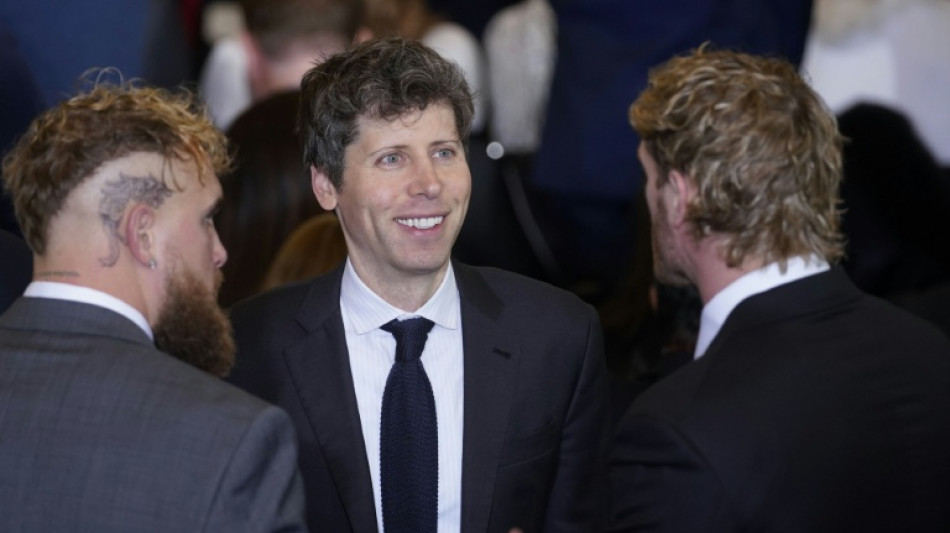
Boom or bubble: How long can the AI investment craze last? / Photo: POOL - GETTY IMAGES NORTH AMERICA/AFP/File

 Alcaraz exits Shanghai Masters in straight-sets loss
 Pope to enter hospital on Tuesday for lung operation

 Renshaw shines again before Australia declaration

 Atletico's Simeone encourages goalless Alvarez improvement

 FXGLOBE Rebuilds Its Copy Trading and PAMM Business With B2BROKER's B2COPY
 Nepal rescuers search for missing after flash flood
 Oil rises as Trump comments roil energy markets

 Premier League in limbo as Manchester City soar

 Zelensky vows to respond as Moscow silent on 'energy ceasefire'
 Thousands march in India's capital to demand election chief resign

 African players in Europe: Mbeumo ends goal drought as United draw

 France's high school students plan fresh protests

 NZ bank in free speech row over 'explicit' sheep memes

 China Open champ Zheng withdraws from Wuhan citing fatigue

 Brewers edge Dodgers 2-1 in National League Championship Series opener
 Pope to have surgery to remove lung nodule

 Stocks rise as oil prices tumble after Trump hails 'energy ceasefire'

 Man City charges cloud hangs over Premier League season
 Top NATO commander set to issue warning to Russia over any attack

 Software, sprints, trolls: Singapore Grand Prix talking points

 Riyadh airport hit by fresh Houthi strike day after deadly attack

 Great Western Mining Corporation PLC Announces Exercise of Warrants and Issue of Equity

 Yokogawa Brings Publication-Backed Validation from More Than 60,000 Scientific Publications to Its CSU Spinning Disk Confocal Systems with Bioz
 U.S. Energy Secretary Chris Wright, EXIM Chairman John Jovanovic, Nebraska Governor Jim Pillen, Senators Deb Fischer and Pete Ricketts, and Congressman Adrian Smith to Visit NioCorp's Critical Minerals Mine Site

 Brightline Interactive to Attend the 2026 Maxim Growth Summit
The staggering investments in artificial intelligence keep coming: Last week, AI chip giant Nvidia announced it would invest $100 billion to help OpenAI, the frontrunner in generative AI, build data centers.
How are these enormous sums possible when the returns on investments, at least for now, pale in comparison?
- Huge investments -
AI-related spending is soaring worldwide, expected to reach approximately $1.5 trillion by 2025, according to US research firm Gartner, and over $2 trillion in 2026 -- nearly 2 percent of global GDP.
Even though tangible returns fall short of the investments going in, the AI revolution appears unstoppable.
"There's no doubt among investors that AI is the major breakthrough technology" -- on par with harnessing electricity, said Denis Barrier, head of investment fund Cathay Innovation.
Silicon Valley's mindset "is more about seizing the opportunity" than worrying about any risks, he said.
Geopolitical tensions are helping drive the frenzy, primarily to build massive data centers housing tens of thousands of expensive chips that require phenomenal electrical power and large-scale, energy-hungry cooling.
From 2013 to 2024, private AI investment reached $470 billion in the United States -- nearly a quarter in the last year alone -- followed by superpower rival China's $119 billion, according to a Stanford University report.
Just a handful of giants are on the receiving end, with OpenAI first in line.
In March 2025, ChatGPT's parent company raised approximately $40 billion, bringing its estimated valuation to around $300 billion, according to analysts.
- 'Circular funding' -
OpenAI is now the world's most valuable company, surpassing SpaceX, worth $500 billion in a deal for employees to sell a limited number of shares.
The company led by CEO Sam Altman sits at the center of an AI investment bonanza: It oversees the Stargate project, which has secured $400 billion of the $500 billion planned by 2029 for Texas data centers spanning an area the size of Manhattan.
The White House-backed consortium includes Softbank, Oracle, Microsoft and Nvidia.
Nvidia, which completed over 50 venture capital deals in 2024 according to PitchBook data, is often chided for practicing "circular funding" -- investing in startups that use the funds to buy its chips.
Some analysts criticize this as bubble-fueling behavior.
The OpenAI deal "will likely fuel those concerns," said Stacy Rasgon, a Bernstein Research analyst.
In the first six months of 2025, OpenAI pulled in around $4.3 billion in revenue, specialist outlet The Information reported this week.
Therefore, unlike Meta or Google with substantial cash reserves, OpenAI and competitors like Anthropic or Mistral must be creative in their search for funds to bridge the gap.
For AI believers, an explosion in revenue is only a matter of time for a company whose ChatGPT assistant serves 700 million people -- reaching nearly 9 percent of humanity less than three years after launch.
- 'Up in smoke' -
Nothing is certain, however.
Feeding AI's computing appetite will cost up to $500 billion annually in global data center investments through 2030, requiring $2 trillion in annual revenues to make the expenses viable, according to consulting firm Bain & Company.
Even under optimistic assumptions, Bain estimates the AI industry faces an $800 billion deficit.
OpenAI itself plans to spend over $100 billion by 2029 -- meaning turning a profit is still a ways off.
On the energy front, AI's global computing footprint could reach 200 gigawatts by 2030 -- the annual equivalent of Brazil's electric consumption -- half of that in the United States.
Despite the daunting figures, many analysts remain optimistic.
"Even with concerns about a possible 'AI bubble'... we estimate the sector is in its 1996" moment during the internet boom, "absolutely not its 1999" before that bubble burst, said Dan Ives, a Wedbush Securities analyst.
Long-term, "many dollars will go up in smoke, and there will be many losers, like during the internet bubble, but the internet remained," said the Silicon Valley investor.
R.Lee--AT