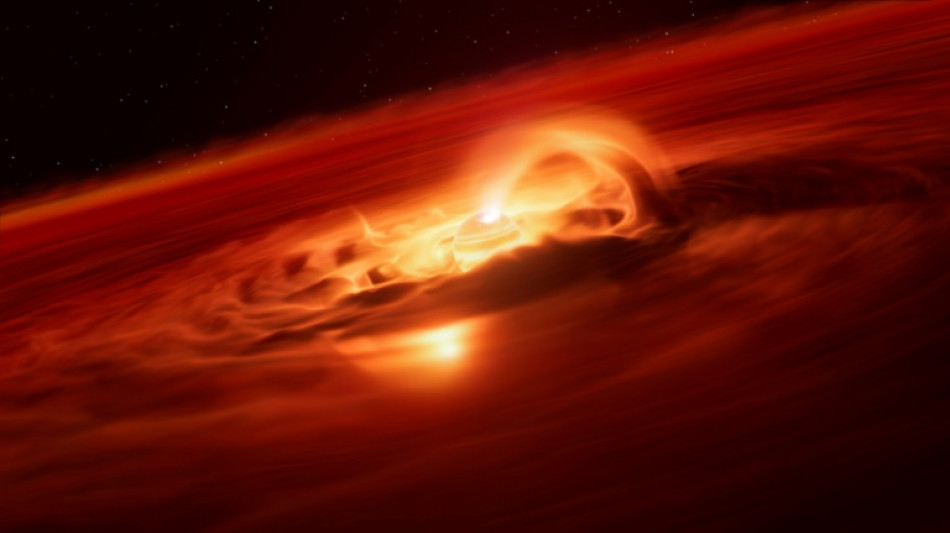
Strange 'rogue' planet spotted guzzling matter like a star / Photo: Handout - European Southern Observatory/AFP

 Alcaraz exits Shanghai Masters in straight-sets loss

 Pope to enter hospital on Tuesday for lung operation

 Renshaw shines again before Australia declaration

 Atletico's Simeone encourages goalless Alvarez improvement

 FXGLOBE Rebuilds Its Copy Trading and PAMM Business With B2BROKER's B2COPY

 Nepal rescuers search for missing after flash flood

 Oil rises as Trump comments roil energy markets

 Premier League in limbo as Manchester City soar

 Zelensky vows to respond as Moscow silent on 'energy ceasefire'
 Thousands march in India's capital to demand election chief resign

 African players in Europe: Mbeumo ends goal drought as United draw
 France's high school students plan fresh protests

 NZ bank in free speech row over 'explicit' sheep memes

 China Open champ Zheng withdraws from Wuhan citing fatigue

 Brewers edge Dodgers 2-1 in National League Championship Series opener

 Pope to have surgery to remove lung nodule

 Stocks rise as oil prices tumble after Trump hails 'energy ceasefire'

 Man City charges cloud hangs over Premier League season

 Top NATO commander set to issue warning to Russia over any attack

 Software, sprints, trolls: Singapore Grand Prix talking points

 Riyadh airport hit by fresh Houthi strike day after deadly attack

 Great Western Mining Corporation PLC Announces Exercise of Warrants and Issue of Equity

 Yokogawa Brings Publication-Backed Validation from More Than 60,000 Scientific Publications to Its CSU Spinning Disk Confocal Systems with Bioz

 U.S. Energy Secretary Chris Wright, EXIM Chairman John Jovanovic, Nebraska Governor Jim Pillen, Senators Deb Fischer and Pete Ricketts, and Congressman Adrian Smith to Visit NioCorp's Critical Minerals Mine Site

 Brightline Interactive to Attend the 2026 Maxim Growth Summit
A mysterious "rogue" planet has been observed gobbling six billion tonnes of gas and dust a second -- an unprecedented rate that blurs the line between planets and stars, astronomers said Thursday.
Unlike Earth and other planets in our solar system which orbit the Sun, rogue planets float freely through the universe untethered to a star.
Scientists estimate there could be trillions of rogue planets in our galaxy alone -- but they are difficult to spot because they mostly drift quietly along in perpetual night.
These strange objects intrigue astronomers because they are "neither a star nor a proper planet," Alexander Scholz, an astronomer at Scotland's University of St Andrews and co-author of a new study, told AFP.
"Their origin remains an open question: are they the lowest-mass objects formed like stars, or giant planets ejected from their birth systems?"
The team of researchers behind the new study were stunned to observe an astonishing growth spurt in a rogue planet around 620 light years from Earth in the constellation Chamaeleon.
The planet, officially called Cha 1107-7626, has a mass five to 10 times bigger than Jupiter.
Scholz explained that the object is "still in its infancy," being roughly one or two million years old.
The object grows by sucking in matter from a disc that surrounds it -- a process called accretion.
But what the astronomers saw happen to Cha 1107-7626 "blurs the line between stars and planets," study-co-author Belinda Damian said in a statement.
In August last year, the planet suddenly started devouring matter from its disc at a record-breaking six-billion-tonnes per second -- eight times faster than a few months earlier.
"This is the strongest accretion episode ever recorded for a planetary-mass object," said lead study Victor Almendros-Abad of the Palermo Astronomical Observatory in Italy.
- 'Awe-inspiring' -
By comparing light emitted before and during this binge-eating session, the scientists discovered that magnetic activity was playing a role in driving matter towards the object.
This phenomenon has previously only been observed in stars.
The chemistry in the disc also changed. Water vapour was detected in the disc during the accretion episode, but not beforehand.
This is also something that has previously been observed in stars -- but never for a forming planet.
Lead study author Ray Jayawardhana of Johns Hopkins University said the discovery implies "that some objects comparable to giant planets form the way stars do, from contracting clouds of gas and dust accompanied by discs of their own, and they go through growth episodes just like newborn stars".
No matter how weird, Cha 1107-7626 is still expected to have similar characteristics to huge planets, because it is of similar size.
Scholz said that unlike stars, this object is "not massive enough to ever have fusion reactions in the core".
So, like other planets, "it will cool inevitably as it gets older," he added.
Amelia Bayo, another co-author of the study in The Astrophysical Journal Letters, said "the idea that a planetary object can behave like a star is awe-inspiring".
It "invites us to wonder what worlds beyond our own could be like during their nascent stages," she added.
The observations were made by the European Southern Observatory's Very Large Telescope in Chile, and included data from the James Webb Space Telescope.
A.Ruiz--AT