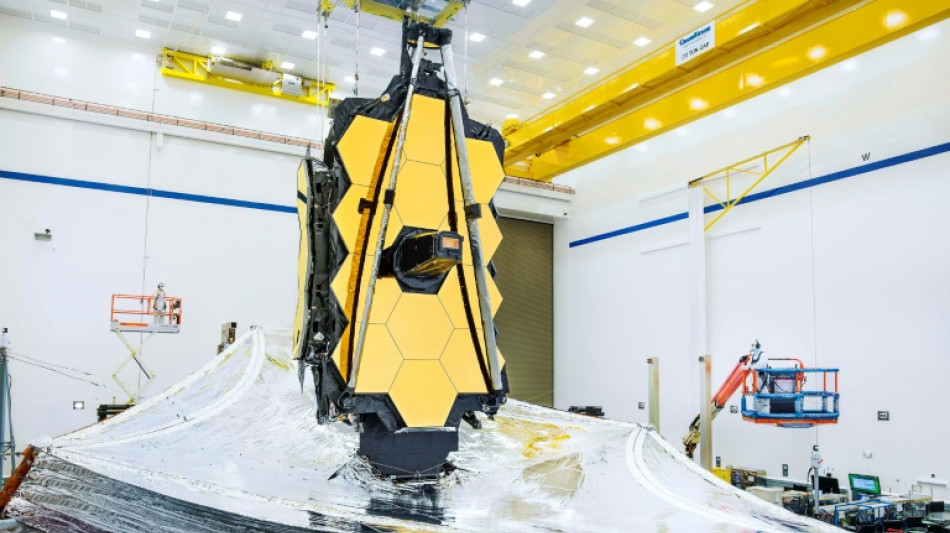
The James Webb Space Telescope, by the numbers / Photo: Chris GUNN - NASA/AFP/File

 EU vows AI rules will protect Europeans. Will they?

 Myanmar leader to visit Malaysia after migrant returns begin

 Germany's AfD poised to preside over state assembly for first time
 Australia's opposition vows 'largest cut to immigration' in country's history

 Ready, set, snooze: Sleep-deprived Japanese compete for best-rested

 Falcons thump Saints 45-24 as New Orleans marks Katrina anniversary

 Tuvalu govt adviser says Australia overstepped in pre-COP visit

 Asian stocks mixed despite tech-led Wall St record
 Tens of thousands expected in Paris for high school protests

 AI borrowing binge rattles US markets
 Young Canadians sue government over alleged climate failures

 White Sox down Guardians to take 2-0 series lead

 Gold IRA Rules, Taxes, Eligible Metals, RMD and Depositories Explained in New Guide by IRAEmpire

 NHL record-breaker Ovechkin says current season will be his last

 France roar back in Nations League as Italy beat Turkey
 Messi readies for final farewell in Argentina send-off

 Esposito seals Italy win over Turkey in Nations League

 Russia downplays plague reports as Trump offers US help

 Trump says US moved bombers from UK base after 'threats'

 Brazilian stocks surge to record after Bolsonaro election lead

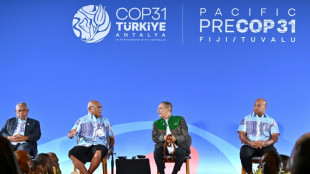 Leaders to visit Pacific atoll at frontline of climate change

 ICC gives more details about arrest warrants for Taliban ministers

 Nigeria's Tinubu confirms 32 dead after military plane crash

 'Reckless' AI firms can't control models, says whistleblower

 Switching on brain cells: the Nobel-winning science of optogenetics

The most powerful space telescope ever built, James Webb is set to deliver its first full-color scientific images to the world Tuesday.
Here is an overview of this feat of human ingenuity, in five key figures.
- More than 21 feet -
The centerpiece of the observatory is its huge main mirror, measuring more than 21 feet (6.5 meters) in diameter and made up of 18 smaller, hexagonal-shaped mirrors.
The observatory also has four scientific instruments: cameras to take pictures of the cosmos, and spectrographs, which break down light to study which elements and molecules make up objects.
The mirror and the instruments are protected from the light of our Sun by a tennis-court sized thermal shield, made up of five superimposed layers.
Each layer is hair thin, and together they ensure the telescope operates in the darkness needed to capture faint glimmers from the far reaches of the Universe.
- Million miles away -
Unlike the Hubble telescope which revolves around the Earth, Webb orbits around the Sun, nearly a million miles (1.6 million kilometers) from us, or four times the distance from our planet to the Moon.
It took the spacecraft almost a month to reach this region, called Lagrange Point two, where it remains in a fixed position behind the Earth and Sun to give it a clear view of the cosmos.
Here, the gravity from the sun and Earth balance the centrifugal motion of a satellite, meaning it needs minimal fuel for course correction.
- 13.8 billion years -
In astronomy, the farther out you see, the deeper back in time you're looking.
Webb's infrared capabilities are what make it uniquely powerful -- allowing it to detect light from the earliest stars, which has been stretched into infrared wavelengths as the Universe expanded.
This lets it peer further back in time than any previous telescope, to within a few hundred million years after the Big Bang, 13.8 billion years ago.
- Three-decade wait -
The project was first conceived in the 1990s, but construction did not begin until 2004.
Then Webb's launch date was repeatedly postponed. Initially set for 2007, it finally took place on December 25, 2021, aboard an Ariane 5 rocket, from French Guiana.
- $10 billion -
Webb is an international collaboration between US space agency NASA, the European Space Agency (ESA), and the Canadian Space Agency (CSA), involving more than 10,000 people.
The lifetime cost to NASA alone will be approximately $9.7 billion, according to an analysis by the Planetary Society, or $10.8 billion adjusted for inflation to 2020 dollars.
A.Ruiz--AT