
How much progress has been made against Alzheimer's disease? / Photo: ALAIN JOCARD - AFP/File

 One dead as Hurricane Simon creeps along Mexico's Pacific coast

 Carrick's Man United 'hungry and eager' to fix worst start in decades

 Fury as US federal agents search anti-Trump lawmaker's home

 One goal enough for Flick as Barca enter Galatasaray cauldron

 A7 to unveil a service that will re-invent the international payments market

 'Status quo' with EU 'not good enough', UK PM says as summit date set

 Stolen Renoir paintings found behind wall in France

 French supermarkets suffer refrigerator shutdown after 'unprecedented' cyberattack

 Arsenal lose Hincapie and Zubimendi in freak double blow

 Saudi says resilience tested, vows response after deadly airport attacks
 Alcaraz exits Shanghai Masters in straight-sets loss

 Pope to enter hospital on Tuesday for lung operation

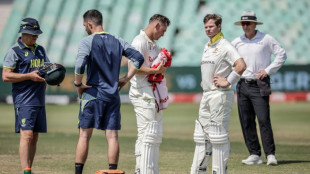
 Renshaw shines again before Australia declaration

 Atletico's Simeone encourages goalless Alvarez improvement

 FXGLOBE Rebuilds Its Copy Trading and PAMM Business With B2BROKER's B2COPY

 Nepal rescuers search for missing after flash flood

 Oil rises as Trump comments roil energy markets

 Premier League in limbo as Manchester City soar

 Zelensky vows to respond as Moscow silent on 'energy ceasefire'

 Thousands march in India's capital to demand election chief resign

 African players in Europe: Mbeumo ends goal drought as United draw

 France's high school students plan fresh protests

 NZ bank in free speech row over 'explicit' sheep memes

 China Open champ Zheng withdraws from Wuhan citing fatigue

 Brewers edge Dodgers 2-1 in National League Championship Series opener

After decades of unsuccessful research, two new drugs and a pioneering blood test have recently given Alzheimer's patients hope of fighting back against the debilitating disease -- but questions remain about their effectiveness.
Any path toward a cure also remains elusive for Alzheimer's, which accounts for around 70 percent of dementia cases worldwide and is a leading cause of death among the elderly.
Ahead of Alzheimer's Day on Sunday, here is what to know about recent advances to prevent, diagnose and treat the disease.
- How effective are the new drugs? -
Billions of dollars have been spent trying to find a treatment for Alzheimer's disease over the decades, but those efforts have stubbornly fallen short -- at least until recently.
Eli Lilly's donanemab and Biogen and Eisai's lecanemab are the first treatments proven to significantly slow the progression of Alzheimer's.
But the expensive treatments are only modestly effective, and work only for patients at an early stage of the disease. There can also be serious side effects including potentially deadly brain haemorrhages.
That has sparked a debate about whether the benefits of the drugs outweigh the risks, leading to national health regulators taking different stances.
Lecanemab, which is sold under the brand name Leqembi, has been approved in many countries including the United States.
But French health authorities advised the state-run insurance system not to reimburse payment for the drug.
It followed in the footsteps of the UK's state-run health service, whose spending watchdog said this year that both new Alzheimer's drugs did not show enough benefits given their price.
- What about early diagnosis? -
Another debate roiling Alzheimer's research -- and which has also seen a growing divide between Europe and the United States -- revolves around how to diagnose the disease.
The standard method of diagnosing Alzheimer's has required an invasive and expensive lumbar puncture, which can rule out some more at-risk patients.
But a simple blood test that detects "biological markers" of the disease has recently been developed.
US authorities have authorised the test since May, but Europe has not yet approved any Alzheimer's blood test, one of which is the subject of a recently launched national clinical trial in Britain.
The question is whether the blood test will ever be enough by itself to confidently diagnose the disease.
Last year the US nonprofit Alzheimer's Association changed its criteria to say that biomarkers alone were sufficient.
But in Europe, most specialists think a thorough clinical exam will still be needed to confirm a person's cognitive and functional decline.
Many patients "with abnormal biomarkers never develop dementia", Dutch neurologist Edo Richard told AFP.
Richard is also sceptical of the two new Alzheimer's drugs.
The two issues are linked, because proponents of the drugs believe that being able to diagnose the disease before noticeable symptoms appear could amplify the impact of the treatments.
- Can Alzheimer's be prevented? -
One area of consensus is what makes people more at risk of getting Alzheimer's disease and dementia more broadly.
Nearly half of all cases are linked to factors such as obesity, smoking, drinking alcohol, physical inactivity and hearing loss, according to an expert review in The Lancet last year.
There is an increasing amount of research seeking to determine whether programmes encouraging people to exercise and eat better are effective at fighting Alzheimer's.
But so far the randomised controlled trials "targeting these risk factors have shown limited to no effects on cognitive decline or dementia", Richard said.
A recent JAMA study found that the cognitive decline of Alzheimer's patients slowed slightly after undergoing two years of intensive support to be healthier.
For people suffering from Alzheimer's and their families, this kind of progress may not look like much, French epidemiologist Cecilia Samieri acknowledged at a conference this month.
But compared to where things were just a few years ago, "it's already huge", Samieri said.
She said she believed that only trials lasting 10 to 15 years could really show how effective such interventions could be against long-developing diseases such as Alzheimer's.
E.Rodriguez--AT