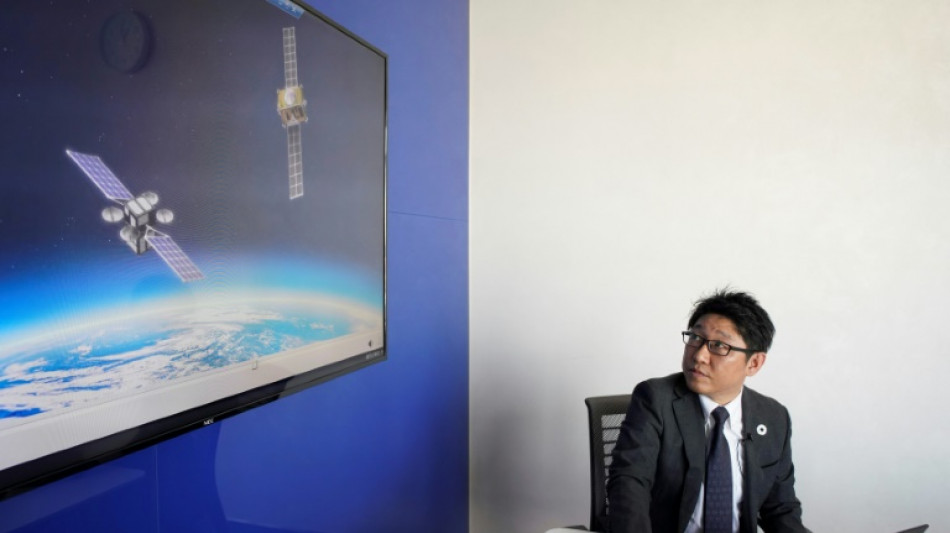
Using lasers and 'tow-trucks', Japanese firms target space debris / Photo: Kazuhiro NOGI - AFP

 EU vows AI rules will protect Europeans. Will they?

 Myanmar leader to visit Malaysia after migrant returns begin

 Germany's AfD poised to preside over state assembly for first time
 Australia's opposition vows 'largest cut to immigration' in country's history

 Ready, set, snooze: Sleep-deprived Japanese compete for best-rested

 Falcons thump Saints 45-24 as New Orleans marks Katrina anniversary

 Tuvalu govt adviser says Australia overstepped in pre-COP visit

 Asian stocks mixed despite tech-led Wall St record
 Tens of thousands expected in Paris for high school protests

 AI borrowing binge rattles US markets

 Young Canadians sue government over alleged climate failures

 White Sox down Guardians to take 2-0 series lead

 Gold IRA Rules, Taxes, Eligible Metals, RMD and Depositories Explained in New Guide by IRAEmpire

 NHL record-breaker Ovechkin says current season will be his last

 France roar back in Nations League as Italy beat Turkey

 Messi readies for final farewell in Argentina send-off

 Esposito seals Italy win over Turkey in Nations League

 Russia downplays plague reports as Trump offers US help

 Trump says US moved bombers from UK base after 'threats'

 Brazilian stocks surge to record after Bolsonaro election lead

 Leaders to visit Pacific atoll at frontline of climate change

 ICC gives more details about arrest warrants for Taliban ministers

 Nigeria's Tinubu confirms 32 dead after military plane crash

 'Reckless' AI firms can't control models, says whistleblower

 Switching on brain cells: the Nobel-winning science of optogenetics

From laser beams and wooden satellites to galactic tow-truck services, start-ups in Japan are trying to imagine ways to deal with a growing environmental problem: space debris.
Junk like used satellites, parts of rockets and wreckage from collisions has been piling up since the space age began, with the problem accelerating in recent decades.
"We're entering an era when many satellites will be launched one after another. Space will become more and more crowded," said Miki Ito, general manager at Astroscale, a company dedicated to "space sustainability".
"There are simulations suggesting space won't be usable if we go on like this," she told AFP. "So we must improve the celestial environment before it's too late."
The European Space Agency (ESA) estimates that around one million pieces of debris larger than a centimetre -- big enough to "disable a spacecraft" -- are in Earth's orbit.
They are already causing problems, from a near-miss in January involving a Chinese satellite, to a five-millimetre hole knocked into a robotic arm on the International Space Station last year.
"It's hard to predict exactly how fast the amount of space debris will increase," said Toru Yamamoto, a senior researcher at the Japan Aerospace Exploration Agency (JAXA).
But "it's an issue that raises real concerns about the sustainable use of space."
With satellites now crucial for GPS, broadband and banking data, collisions pose significant risks on Earth.
Tadanori Fukushima has seen the scale of the problem in his job as an engineer with Tokyo-based satellite operator and broadcaster SKY Perfect JSAT.
"A stationary satellite would get roughly 100 'debris-approaching' alerts a year," he told AFP.
International "satellite disposal guidelines" include rules like moving used satellites to "graveyard orbit" -- but the increase in debris means more is needed, specialists say.
- 'No panacea' -
Fukushima launched an in-house start-up in 2018 and envisions using a laser beam to vaporise the surface of space debris, creating a pulse of energy that pushes the object into a new orbit.
The irradiating laser means there's no need to touch any debris, which is generally said to move about 7.5 kilometres per second -- much faster than a bullet.
For now, the project is experimental, but Fukushima hopes to test the idea in space by spring 2025, working with several research institutions.
Japanese firms, along with some in Europe and the United States, are leading the way on developing solutions, according to Fukushima.
Some projects are further along, including Astroscale's space "tow-truck", which uses a magnet to collect out-of-service satellites.
"If a car breaks down, you call a tow-truck service. If a satellite breaks down and stays there, it faces the risk of collision with debris and needs to be collected quickly," Ito explained.
The firm carried out a successful trial last year and imagines one day equipping customer satellites with a "docking plate" equivalent to a tow-truck's hook, allowing collection later on.
Astroscale, which has a contract with the ESA, plans a second test by the end of 2024 and hopes to launch its service soon after.
Other efforts approach the problem at the source, by creating satellites that don't produce debris.
Kyoto University and Sumitomo Forestry envisage a wooden satellite that goes into orbit in a rocket and burns up safely when it plunges to Earth.
That project is also in its infancy -- in March, pieces of wood were sent to the International Space Station to test how they respond to cosmic rays.
Space agencies have their own programmes, with JAXA focusing on large debris over three tonnes.
And internationally, firms including US-based Orbit Fab and Australia's Neumann Space have proposed ideas such as in-orbit refuelling to extend the life of satellites.
The problem is complex enough that a range of solutions will be needed, said JAXA's Yamamoto.
"There is no panacea."
T.Sanchez--AT