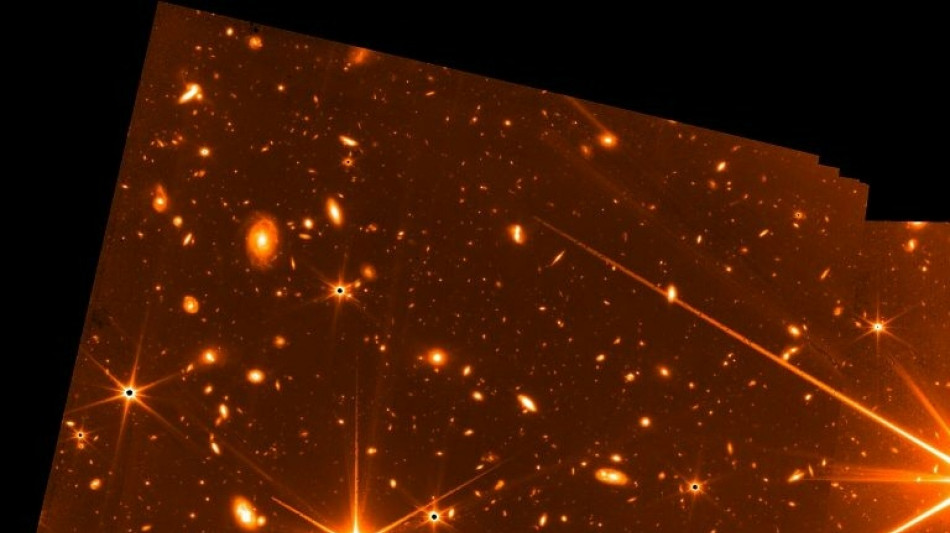
NASA releases James Webb telescope 'teaser' picture / Photo: - - NASA/AFP

 EU vows AI rules will protect Europeans. Will they?

 Myanmar leader to visit Malaysia after migrant returns begin
 Germany's AfD poised to preside over state assembly for first time
 Australia's opposition vows 'largest cut to immigration' in country's history

 Ready, set, snooze: Sleep-deprived Japanese compete for best-rested

 Falcons thump Saints 45-24 as New Orleans marks Katrina anniversary
 Tuvalu govt adviser says Australia overstepped in pre-COP visit

 Asian stocks mixed despite tech-led Wall St record
 Tens of thousands expected in Paris for high school protests
 AI borrowing binge rattles US markets
 Young Canadians sue government over alleged climate failures

 White Sox down Guardians to take 2-0 series lead
 Gold IRA Rules, Taxes, Eligible Metals, RMD and Depositories Explained in New Guide by IRAEmpire

 NHL record-breaker Ovechkin says current season will be his last

 France roar back in Nations League as Italy beat Turkey
 Messi readies for final farewell in Argentina send-off
 Esposito seals Italy win over Turkey in Nations League

 Russia downplays plague reports as Trump offers US help

 Trump says US moved bombers from UK base after 'threats'

 Brazilian stocks surge to record after Bolsonaro election lead

 Leaders to visit Pacific atoll at frontline of climate change

 ICC gives more details about arrest warrants for Taliban ministers
 Nigeria's Tinubu confirms 32 dead after military plane crash

 'Reckless' AI firms can't control models, says whistleblower

 Switching on brain cells: the Nobel-winning science of optogenetics

NASA has a provided a tantalizing teaser photo ahead of the highly-anticipated release next week of the first deep-space images from the James Webb Telescope –- an instrument so powerful it can peer back into the origins of the universe.
The $10 billion observatory -- launched in December last year and now orbiting the Sun a million miles (1.5 million kilometers) away from Earth –- can look where no telescope has looked before thanks to its enormous primary mirror and instruments that focus on infrared, allowing it to peer through dust and gas.
The first fully formed pictures are set for release on July 12, but NASA provided an engineering test photo on Wednesday -- the result of 72 exposures over 32 hours that shows a set of distant stars and galaxies.
The image has some "rough-around-the-edges" qualities, NASA said in a statement, but is still "among the deepest images of the universe ever taken" and offers a "tantalizing glimpse" at what will be revealed in the coming weeks, months, and years.
"When this image was taken, I was thrilled to clearly see all the detailed structure in these faint galaxies," said Neil Rowlands, program scientist for Webb's Fine Guidance Sensor at Honeywell Aerospace.
Jane Rigby, Webb's operations scientist at NASA's Goddard Space Flight Center, said the "faintest blobs in this image are exactly the types of faint galaxies that Webb will study in its first year of science operations."
NASA administrator Bill Nelson said last week that Webb is able to gaze further into the cosmos than any telescope before it.
"It's going to explore objects in the solar system and atmospheres of exoplanets orbiting other stars, giving us clues as to whether potentially their atmospheres are similar to our own," he said.
"It may answer some questions that we have: Where do we come from? What more is out there? Who are we? And of course, it's going to answer some questions that we don't even know what the questions are."
Webb's infrared capabilities allow it to see back in time to the Big Bang, which happened 13.8 billion years ago.
Because the Universe is expanding, light from the earliest stars shifts from the ultraviolet and visible wavelengths it was emitted in, to longer infrared wavelengths -- which Webb is equipped to detect at an unprecedented resolution.
At present, the earliest cosmological observations date to within 330 million years of the Big Bang, but with Webb's capacities, astronomers believe they will easily break the record.
K.Hill--AT