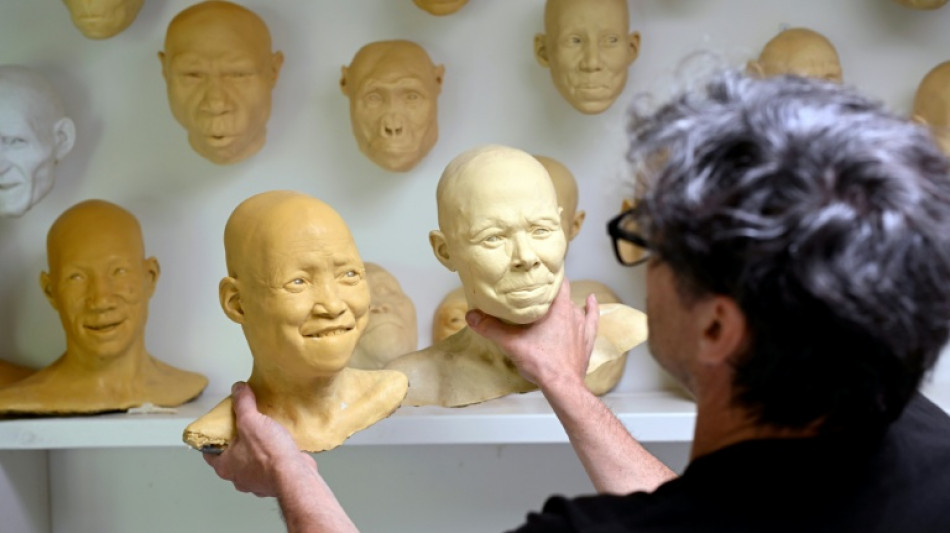
Artists, scientists breathe life into prehistoric woman / Photo: Nicolas TUCAT - AFP

 Emery urges Villa to make most of reduced home comfort

 Flavio Bolsonaro visits father under house arrest ahead of Brazil runoff

 France, Eq. Guinea in standoff over luxury Paris mansion

 'Holding our ground': Israel demolishes dozens of Bedouin homes
 Hazlewood takes six as Australia beat South Africa in 1st Test

 Saudi coalition tells Sanaa residents to flee site before operation

 Zverev defies 'physical issues' to reach Shanghai Masters quarter-finals

 'We're not giving up': Activist Thunberg joins France student protests
 Man City captain Dias defends celebrations after Liverpool win

 B2PRIME Expands Tier-1 Access and Liquidity Architecture for Sophisticated Institutional Flow

 STARTRADER Adds 48 US Stock CFDs with 24-Hour Weekday Trading

 'Ink' director Danny Boyle slams Trump's Truth Social 'lies'

 Coach Kovac extends contract at Dortmund until 2029

 Activist Thunberg joins France student rally after violence at protests

 Archer and Bethell in England squad for Australia ODI series

 Formula One to return to Africa in 'early 2030s' in Rwanda
 US actor Selma Blair charged with assault after alleged flight altercation

 Hungary cuts anti-LGBTQ legislation from Orban-era law

 'Our future is being robbed': Greta Thunberg joins France student protests

 Late superstar Anita Mui's ashes missing in Hong Kong

 'No choice': IMF says developing countries must cut spending despite war shock

 Boasting South Korea footballers spark rethink of military service exemptions

 Five dead as Hurricane Simon, Rachel pummel Mexico's Pacific coast

 Seoul, Tokyo stocks plunge as Asia suffers fresh tech rout

 Damaged and drained, Indonesia's peatlands go up in smoke

With her clear blue eyes and slightly nervous gaze, the reconstructed bust of Mos'anne -- a woman who lived around 10,500 years ago -- is uncannily lifelike.
Reborn via a close partnership between science and art, Mos'anne's bust was created at Belgium's Ghent University as part of a project to explore how the region's last hunter-gatherers lived during the Mesolithic era.
"Part of the project is also understanding the genetics of these people, figuring out their kinship and so on, and to be able to really translate the science that we do to a wider audience," the project's lead researcher, Isabelle de Groote, told AFP.
Scientists chose the skull of Mos'anne -- named by public vote in reference to Belgium's Meuse Valley -- for reconstruction, as it was exceptionally well-preserved.
The bones held a large amount of preserved DNA, making it possible to reconstruct the woman -- aged between 35 and 60 at her death -- with remarkable realism.
"We also know that in the Mesolithic times, she is genetically part of the Western hunter-gatherer group," said de Groote.
Using genetic testing, researchers were able to determine the Mesolithic woman's skin and eye colour.
"This group is known for having very dark skin and blue eyes, a bit like Cheddar Man in Britain," she said, referring to the man who lived in Britain around 10,000 years ago, whose skeleton was discovered in 1903.
- 'Mixed emotions' -
Mos'anne's DNA revealed valuable clues about her appearance but it was the unique skills of Dutch "paleo-artists" Alfons and Adrie Kennis that brought her back to life.
After receiving guidance from the researchers -- including instructions to use ochre pigment on Mos'anne's headband -- the twins began their work, from moulding the skull to the final decorative feather, meticulously sculpting each facial muscle in clay.
"The biggest part of the reconstruction is forming a character," Alfons Kennis said from their Darwin-esque studio in Arnhem.
"You can make a forensic reconstruction... use the data, apply the muscles, apply the skin, but you get no character," Kennis said of their artistic process.
The Kennis brothers -- whose surname means "knowledge" in Dutch -- take about six months to complete a reconstruction.
They gained global recognition in the 2000s, their work exhibited in museums worldwide and featured in specialist publications.
The twins, fascinated by evolution and visual art since childhood, draw inspiration from archived anthropological images of early encounters between isolated populations and researchers.
"At the first meeting, there's nervousness, shyness. People are laughing, maybe out of nerves," said Kennis.
"When a prehistoric ancestor meets you for the first time, you see these mixed emotions... It's these emotions that we want to show."
Much about Mos'anne remains unknown. In Ghent, researchers are still analysing her to find out what she would eat.
With her headband dotted with duck feathers, golden skin, and pierced animal teeth adorning her ears and necklace, the prehistoric woman seems closer to us than ever.
"It was always my wish to be able to make it more tangible in a way," De Groote said.
N.Mitchell--AT