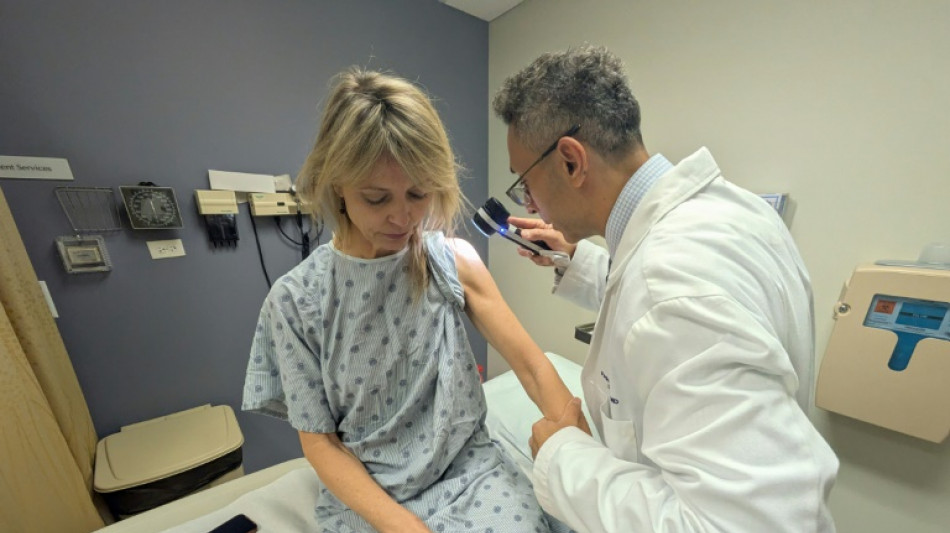
'Don't use them': Tanning beds triple skin cancer risk, study finds / Photo: Ben Schamisso - NORTHWESTERN UNIVERSITY-UNIVERSITY OF AMSTERDAM/AFP

 Trump announces deal for huge US stake in Venezuelan oil reserves

 Kane confirms talks on Bayern extension

 Trump govt. mulls deal to give away part of Yosemite park

 Indian release of Sonia Gandhi memoir uncertain after publisher clarification

 Cities show cleaner transport policies can reduce severe air pollution

 Four patients harmed in Nashville hospital medication mix-up

 Essex council hires private guards as Wethersfield asylum centre expands

 Haakon VIII becomes Norway's king after Harald V dies at 89

 Six injured after sign falls at Christian festival in West Sussex

 Dubai airport expands scanners that keep laptops and liquids in bags

 Kuwait and Pakistan sign military cooperation agreement

 Ramos strikes as AC Milan beat Venezia

 Odisha faces very heavy rain as Sri Ganganagar reaches 41.4C

 Scammers in China exploit Microsoft Teams and other workplace apps to target victims

 GSA employees report mice, ceiling damage and cloudy water after Washington office move
 Cara and former scraper develop open-source tool to alert artists when work appears in AI datasets

 Google expands easier file sharing between Android phones and Apple devices

 UK chefs turn to induction cooking to reduce kitchen heat, energy use and pollution

 Restored Cheshire wetland becomes key UK breeding site for black-necked grebes

 Bayern steamroll Stuttgart in Bundesliga opener

 England pace quartet might keep Archer going until he is 40

 Driven by distraction? Trump steps up stunts as US midterms loom

 Springboks a wounded beast, warns All Blacks captain Savea

 Trump announces new US 'Space Academy'

 Best Laser Printers in India: Top Options from HP, Brother and Canon

When Heidi Tarr was a teenager, she used a tanning bed several times a week with her friends because they all wanted to glow like a celebrity.
"It was just the thing to do -- everyone wanted that nice, dark, tan skin," the 49-year-old market researcher told AFP via video call from Chicago.
Then one day in her 30s, Tarr noticed a strange mole on her back.
It was a melanoma -- the deadliest form of skin cancer. She was lucky to have caught it early on, but has needed over a dozen biopsies to remove more moles.
Now her 15-year-old daughter Olivia is seeing trending videos on TikTok of people showing off their tan lines -- and is asking her mother how to get some.
So Tarr was inspired to get yet another skin sample removed, this time to be used in research published in the journal Science Advances on Friday.
The study found that people who use tanning beds are nearly three times more at risk of getting skin cancer.
It also marked the first time researchers have pinpointed how sunbeds cause DNA mutations in the skin that make users more susceptible to cancer.
More than 80 percent of the most common melanomas are caused by exposure to ultraviolet radiation, according to the World Health Organization's International Agency for Research on Cancer (IARC).
These rays are created naturally by the Sun -- or artificially by tanning beds.
- Skin cell damage -
Pedram Gerami, a dermatologist and researcher at Northwestern University in Illinois, told AFP he started looking into this subject after an "unusually" high number of younger women came into his clinic with multiple melanomas.
The cancer was also on parts of their bodies normally "relatively protected from the sun", said the study's author.
His team compared the medical records from 3,000 people who used tanning beds to those of similarly aged people who had not.
Melanoma was diagnosed in five percent of the tanning bed users, compared to two percent of the other group, the study said.
After adjusting for a variety of factors such as age, sunburn history and family history, the researchers estimated tanning bed users were nearly 2.9 times more at risk of getting a melanoma.
Tanning bed users were also more likely to develop melanoma on parts of their body that are normally shielded from the Sun, such as the lower back and buttocks.
The researchers also sought to find out how much damage tanning beds do to the DNA of skin cells, because it can build up into cancer.
They sequenced 182 biopsies, including one from Gerami's patient Tarr.
New technology was used to specifically look at melanocytes, which are rarer skin cells that create moles -- or melanoma.
The researchers found that the melanocytes of tanning bed users had nearly twice as many mutations.
"If you're already halfway there in a lot of your skin, it doesn't take much additional damage to get to melanoma," Gerami said.
"Tanning bed users in their 30s and 40s had even more mutations than people in the general population who were in their 70s and 80s," study co-author Bishal Tandukar said in a statement.
- 'It needs to be banned' -
Melanoma killed almost 60,000 people worldwide in 2022, according to the IARC, which classifies tanning beds in its highest level of cancer risk alongside smoking and asbestos.
A few countries completely ban tanning beds, such as Australia and Brazil. In others, including the UK and France, they are prohibited for people under 18.
In the United States, it depends on the state.
"At the very minimum, it needs to be banned for minors," Gerami emphasised.
There have also been fears that young people sharing their tanning goals on social media could be driving a new generation towards sunbeds.
"For those who might be thinking about using a tanning bed -- or for parents who might be thinking of letting their teenagers use a tanning bed -- I just would extremely recommend: don't use them," Tarr said.
She recommended that people who have used the beds regularly inspect their skin and consider seeing a dermatologist for a proper check.
And if you're looking for that tanned look, try a lotion or spray tan, Tarr added.
D.Johnson--AT