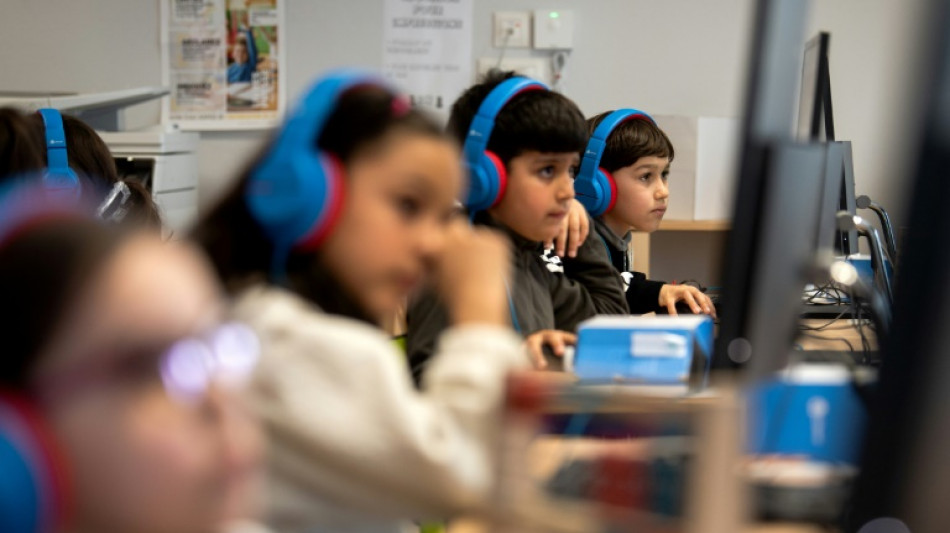
Anxious parents face tough choices on AI / Photo: Matthieu RONDEL - AFP

 Emery urges Villa to make most of reduced home comfort
 Flavio Bolsonaro visits father under house arrest ahead of Brazil runoff
 France, Eq. Guinea in standoff over luxury Paris mansion
 'Holding our ground': Israel demolishes dozens of Bedouin homes

 Hazlewood takes six as Australia beat South Africa in 1st Test

 Saudi coalition tells Sanaa residents to flee site before operation

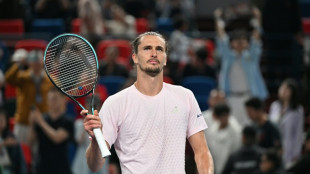 Zverev defies 'physical issues' to reach Shanghai Masters quarter-finals

 'We're not giving up': Activist Thunberg joins France student protests

 Man City captain Dias defends celebrations after Liverpool win

 B2PRIME Expands Tier-1 Access and Liquidity Architecture for Sophisticated Institutional Flow

 STARTRADER Adds 48 US Stock CFDs with 24-Hour Weekday Trading

 'Ink' director Danny Boyle slams Trump's Truth Social 'lies'

 Coach Kovac extends contract at Dortmund until 2029

 Activist Thunberg joins France student rally after violence at protests

 Archer and Bethell in England squad for Australia ODI series

 Formula One to return to Africa in 'early 2030s' in Rwanda

 US actor Selma Blair charged with assault after alleged flight altercation
 Hungary cuts anti-LGBTQ legislation from Orban-era law

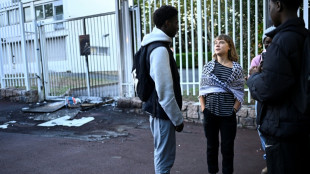 'Our future is being robbed': Greta Thunberg joins France student protests

 Late superstar Anita Mui's ashes missing in Hong Kong

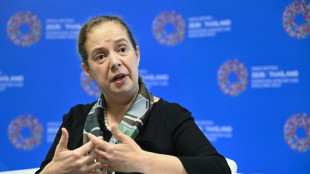 'No choice': IMF says developing countries must cut spending despite war shock

 Boasting South Korea footballers spark rethink of military service exemptions

 Five dead as Hurricane Simon, Rachel pummel Mexico's Pacific coast

 Seoul, Tokyo stocks plunge as Asia suffers fresh tech rout

 Damaged and drained, Indonesia's peatlands go up in smoke

When it comes to AI, many parents navigate between fear of the unknown and fear of their children missing out.
"It's really hard to predict anything over five years," said Adam Tal, an Israeli marketing executive and father of two boys aged seven and nine, when describing the post-generative AI world.
Tal is "very worried" about the future this technology holds for his children -- whether it's deepfakes, "the inability to distinguish between reality and AI," or "the thousands of possible new threats that I wasn't trained to detect."
Mike Brooks, a psychologist from Austin, Texas, who specializes in parenting and technology, worries that parents are keeping their heads in the sand, refusing to grapple with AI.
"They're already overwhelmed with parenting demands," he observed -- from online pornography and TikTok to video games and "just trying to get them out of their rooms and into the real world."
For Marc Watkins, a professor at the University of Mississippi who focuses on AI in teaching, "we've already gone too far" to shield children from AI past a certain age.
Yet some parents are still trying to remain gatekeepers to the technology.
"In my circle of friends and family, I'm the only one exploring AI with my child," remarked Melissa Franklin, mother of a 7-year-old boy and law student in Kentucky.
"I don't understand the technology behind AI," she said, "but I know it's inevitable, and I'd rather give my son a head start than leave him overwhelmed."
- 'Benefits and risks' -
The path is all the more difficult for parents given the lack of scientific research on AI's effects on users.
Several parents cite a study published in June by MIT, showing that brain activity and memory were more stimulated in individuals not using generative AI than in those who had access to it.
"I'm afraid it will become a shortcut," explained a father of three who preferred to remain anonymous. "After this MIT study, I want them to use it only to deepen their knowledge."
This caution shapes many parents' approaches. Tal prefers to wait before letting his sons use AI tools. Melissa Franklin only allows her son to use AI with her supervision to find information "we can't find in a book, through Google, or on YouTube."
For her, children must be encouraged to "think for themselves," with or without AI.
But one father -- a computer engineer with a 15-year-old -- doesn't believe kids will learn AI skills from their parents anyway.
"That would be like claiming that kids learn how to use TikTok from their parents," he said. It's usually "the other way around."
Watkins, himself a father, says he is "very concerned" about the new forms that generative AI is taking, but considers it necessary to read about the subject and "have in-depth conversations about it with our children."
"They're going to use artificial intelligence," he said, "so I want them to know the potential benefits and risks."
The CEO of AI chip giant Nvidia, Jensen Huang, often speaks of AI as "the greatest equalization force that we have ever known," democratizing learning and knowledge.
But Watkins fears a different reality: "Parents will view this as a technology that will be used if you can afford it, to get your kid ahead of everyone else."
The computer scientist father readily acknowledged this disparity, saying "My son has an advantage because he has two parents with PhDs in computer science, but that's 90 percent due to the fact that we are more affluent than average" -- not their AI knowledge.
"That does have some pretty big implications," Watkins said.
A.Clark--AT