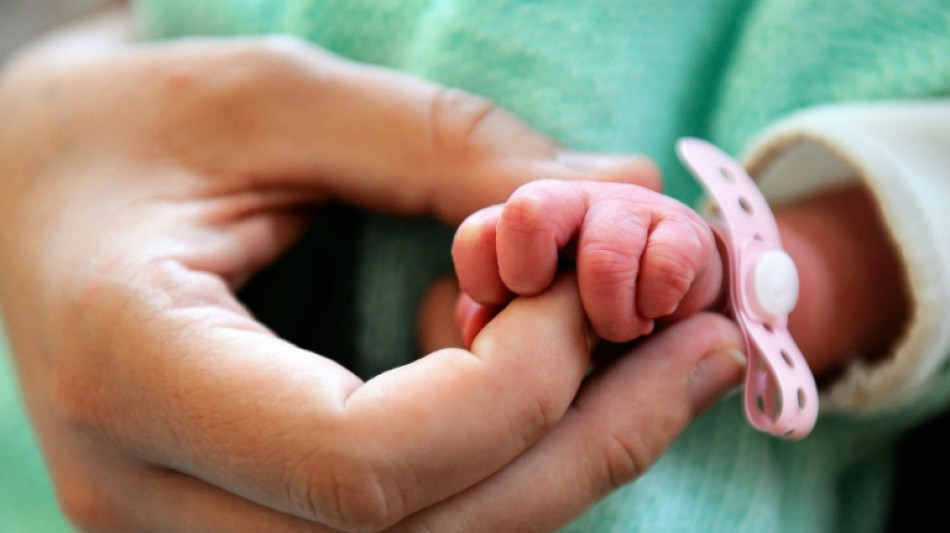
World-first IVF trial reduces risk of babies inheriting diseases / Photo: PHILIPPE HUGUEN - AFP/File

 Demonstrations backing France's protesting students gather strength

 Trump says US Senate as hard to defend as House in midterms
 Suspected Russian drones hit two ships off Bulgaria, 11 missing

 Tech stocks slide on AI jitters
 Trump asks Greece ambassador to resign amid ethics scandal

 New White House spokeswoman heavy on Trump praise, light on questions in debut

 Emery urges Villa to make most of reduced home comfort
 Flavio Bolsonaro visits father under house arrest ahead of Brazil runoff

 France, Eq. Guinea in standoff over luxury Paris mansion
 'Holding our ground': Israel demolishes dozens of Bedouin homes
 Hazlewood takes six as Australia beat South Africa in 1st Test

 Saudi coalition tells Sanaa residents to flee site before operation

 Zverev defies 'physical issues' to reach Shanghai Masters quarter-finals

 'We're not giving up': Activist Thunberg joins France student protests

 Man City captain Dias defends celebrations after Liverpool win

 B2PRIME Expands Tier-1 Access and Liquidity Architecture for Sophisticated Institutional Flow

 STARTRADER Adds 48 US Stock CFDs with 24-Hour Weekday Trading

 'Ink' director Danny Boyle slams Trump's Truth Social 'lies'

 Coach Kovac extends contract at Dortmund until 2029

 Activist Thunberg joins France student rally after violence at protests

 Archer and Bethell in England squad for Australia ODI series

 Formula One to return to Africa in 'early 2030s' in Rwanda

 US actor Selma Blair charged with assault after alleged flight altercation

 Hungary cuts anti-LGBTQ legislation from Orban-era law

 'Our future is being robbed': Greta Thunberg joins France student protests

Eight healthy babies have been born in the UK using a new IVF technique that successfully reduced their risk of inheriting genetic diseases from their mothers, the results of a world-first trial said Wednesday.
The findings were hailed as a breakthrough which raises hopes that women with mutations in their mitochondrial DNA could one day have children without passing debilitating or deadly diseases on to the children.
One out of every 5,000 births is affected by mitochondrial diseases, which cannot be treated, and include symptoms such as impaired vision, diabetes and muscle wasting.
In 2015, Britain became the first country to approve an in-vitro fertilisation (IVF) technique that uses a small amount of healthy mitochondrial DNA from the egg of a donor -- along with the mother's egg and father's sperm.
Some have called the result of this process "three-parent babies", though researchers have pushed back at this term because only roughly 0.1 percent of the newborn's DNA comes from the donor.
The results of the much-awaited UK trial were published in several papers in the New England Journal of Medicine.
- 'Important reproductive option' -
Out of 22 women to undergo the treatment at the Newcastle Fertility Centre in northeast England, eight babies were born. The four boys and four girls now range from under six months to over two years old.
The amount of mutated mitochondrial DNA -- which causes disease -- was reduced by 95-100 percent in six of the babies, according to the research.
For the other two newborns, the amount fell by 77-88 percent, which is below the range that causes disease.
This indicates the technique was "effective in reducing transmission" of diseases between mother and child, one of the studies said.
The eight children are currently healthy, though one had a disturbance of their heart's rhythm which was successfully treated, the researchers said.
Their health will be followed up over the coming years to see if problems arise.
Nils-Goran Larsson, a Swedish reproductive expert not involved in the research, hailed the "breakthrough".
The new technique offers a "very important reproductive option" for families affected by "devastating" mitochondrial diseases, he added.
- Ethical review -
Mitochondrial donation remains controversial and has not been approved in many countries, including the United States and France.
Religious leaders have opposed the procedure because it involves the destruction of human embryos. Other opponents have expressed fears it could pave the way for genetically engineered "designer babies".
An ethical review carried out by the UK's independent Nuffield Council on Bioethics was "instrumental" in conducting the new research, the council's director Danielle Hamm said Wednesday.
Peter Thompson, head of the UK's Human Fertilisation and Embryology Authority which approved the procedure, said only people with a "very high risk" of passing on a mitochondrial disease would be eligible for the treatment.
Ethical concerns have also been raised over the use of mitochondrial donation for infertility in Greece and Ukraine.
French mitochondrial disease specialist Julie Stefann told AFP that "it is a question of the risk-benefit ratio: for a mitochondrial disease, the benefit is obvious".
"In the context of infertility, it has not been proven," she added.
Oxford University reproductive genetics expert Dagan Wells observed that "some scientists will be a little disappointed that so much time and effort has, so far, only led to the birth of eight children".
Among the children being closely monitored are three that showed some signs of what is known as "reversal", which is still little understood.
It is "a phenomenon where the therapy initially succeeds in producing an embryo with very few defective mitochondria, but by the time the child is born the proportion of abnormal mitochondria in its cells has significantly increased," he explained.
Y.Baker--AT