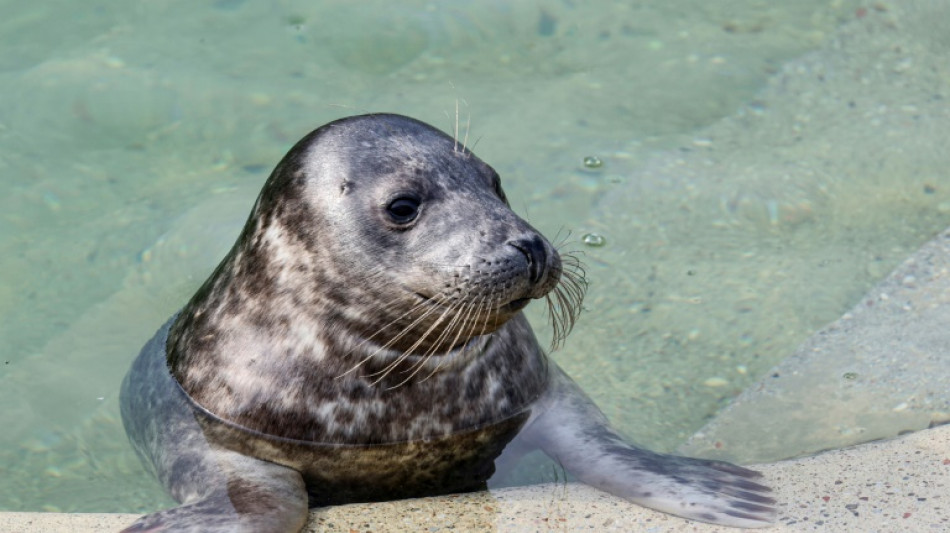
Lithuania bids to save Baltic seals as ice sheets recede / Photo: Petras Malukas - AFP

 Cornell suspends frat parties after alleged gang rape
 Man City deserve to keep titles, says PSG's Luis Enrique

 Regulator 'will resign' if any political interference in Man City case

 Microsoft's Brad Smith calls for 'real and effective' AI safety standards

 Anthropic warns of AI 'worms' spreading across smart gadgets

 Big US banks report strong earnings and stay bullish on AI

 Iraola backs Barcola, Wirtz to come good for Liverpool

 In a first, AI helps UK lawmaker find her voice in parliament
 Pope Leo in Rome hospital for lung operation

 EU watchdog says smart glasses must give 'clear warnings' when recording
 Houthis say Saudi Arabia strikes oil site in Yemen's capital

 France roiled by marches in support of protesting students

 Goldman Sachs profits jump as CEO says no plans to exit

 Apple unveils HomeView smart display in renewed home push
 Novelist Thelyson Orelien denies AI use, admits plagiarism 'mistakes'

 Trump asks Greece ambassador to resign amid bribery scandal: White House

 11 missing after ships struck off Bulgaria in latest Black Sea attack

 France budget debate faces rocky start as Socialists vow to fight

 AI could 'change the stakes' on bioweapons: UK spy chief

 Sweden centre-left leader fails to form government

 EU economy chief doubtful Russian diesel exports will affect prices

 Capital International Highlights Multilingual Access to Its Platform as European Economic Conditions Diverge

 Hazlewood takes six as Australia win first Test

 Pope Leo admitted to hospital for lung operation

 Hungary cuts anti-LGBTQ measures from Orban-era law

The grey seals slide out of their cages into the Baltic Sea near the Lithuanian coast, swimming off to new lives imperilled by climate change, pollution and shrinking fish stocks.
The seals have been nurtured at a rehabilitation centre in the Lithuanian port of Klaipeda.
Survival rates for cubs in the wild can be as low as five percent, according to local scientists.
The Baltic Sea, which is shared by the European Union and Russia, rarely freezes over now, depriving seals of sanctuaries to rear their cubs.
"Mothers are forced to breed on land in high concentration with other seals," said Vaida Surviliene, a scientist at Vilnius University.
"They are unable to recognise their cubs and often leave them because of it," she said.
Rearing cubs ashore also leaves them exposed to humans, other wild animals, rowdy males, as well as a higher risk of diseases, according to Arunas Grusas, a biologist at the centre.
- 'It was a sensation' -
Grusas began caring for seals in 1987 when he brought the first pup back to his office at the Klaipeda Sea Museum, which now oversees the new rehabilitation centre built in 2022.
"We taught them how to feed themselves, got them used to the water –- they had to get comfortable with the sea, which spat them out ashore practically dying," Grusas said.
The very first cubs were placed into makeshift baths set up in an office.
"It was a sensation for us, there were practically no seals left then," Grusas said.
The scientists had to learn how to nurse the cubs back to health.
First, the cubs were treated to liquid formula before moving onto solid food.
At the time in the late 1980s, the seals were close to extinction –- there were just around 4,000 to 5,000 left in the sea from a population of around 100,000 before the Second World War.
"The population began to decrease drastically in the 1950s due to hunting amid competition with fishers," said Surviliene.
- 'Nothing left to eat' -
The 1960s also saw the use of pesticides in agriculture that were "incredibly toxic for predators", the scientist said.
The seals at the top of the food chain in the Baltic Sea absorbed the pollution, leaving the females infertile and the entire population with a weak immune system, unable to ward off parasites and resist infections.
After a ban on toxic pesticide use, the population survived, with the current estimates putting the number of grey seals in the Baltic Sea at 50,000 to 60,000.
In a response to overfishing, the European Commission also finally banned commercial cod fishing in the eastern Baltic Sea in 2019.
"Over 80 percent of fish resources in the Baltic Sea have been destroyed, the seals have nothing left to eat," said Grusas.
The ban has yet to show a positive result.
"There has been no fishing of eastern Baltic cod for around five years, but it's not yet recovering -- and it's one of the main sources of food" for the seals, said Darius Daunys, a scientist at Klaipeda University.
Recently a growing number of adult seals have been washing up on Lithuanian beaches.
Scientists like Grusas point the finger at near-shore fishing nets, where seals desperate for food end up entangled and ultimately drown.
- 'Tired of the tension' -
Out in the Baltic Sea, the nine released seals took their first swim in the wild.
Previously, GPS trackers showed they favoured a route north toward the Swedish Gotland island in the middle of the Baltic Sea, where fish are more plentiful.
Others, however, needed a gentle push from the biologists.
In previous years, the released seals would even follow the boat back to shore, scared to venture off alone.
Eventually they all find their way in the wild.
Grusas is now preparing to retire after dedicating his life to saving animals.
He will leave at a time when the grey Baltic seal population has stabilised, but remains highly vulnerable.
"I've spent my whole life with seals," he said. "I'm tired of the tension –- you just don't know what can happen to them."
A.O.Scott--AT