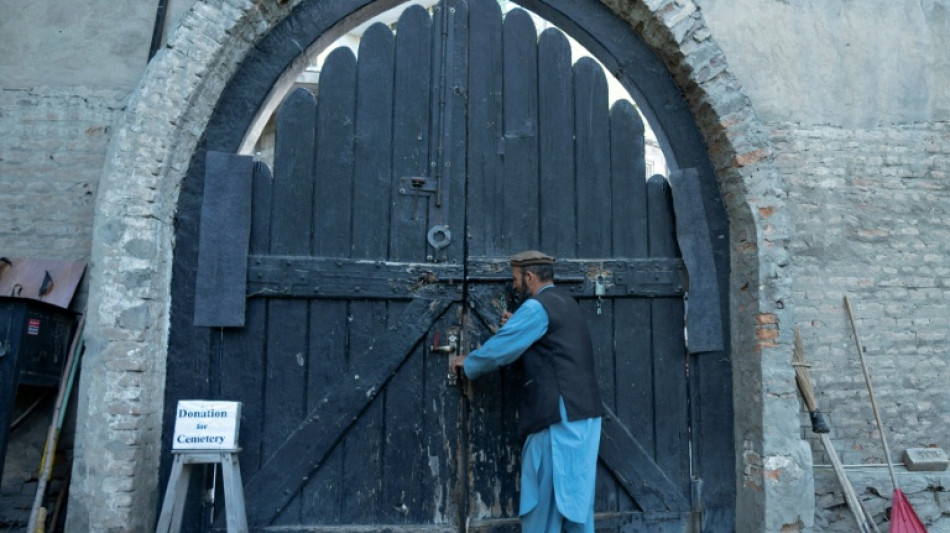
Nearly two centuries on, quiet settles on Afghanistan's British Cemetery / Photo: Wakil KOHSAR - AFP

 Trump, White House post video of UK man killed by tiger
 Saudi employee arrested for allegedly bugging OpenAI office
 Atletico sink Man Utd as Viking deny Bayern in Champions League
 Man United's Martinez blasts board's lack of investment

 Meet A7 International, an Innovative Global Platform Designed to Reinvent the International Payments Market
 Shakhtar hope London move a reminder of Ukraine conflict

 Tresoldi hat-trick fires Brugge past Inter Milan

 Rams axe kicker Mevis after misses cost victory over Bills: reports
 Yamal stays cool at boiling Galatasaray to lift Barcelona to victory

 Arsenal cruise past Lille into share of Champions League lead

 Trump ousts Greece ambassador over ethics scandal

 Reese Witherspoon, France's Mediawan to buy Hello Sunshine
 Bipartisan US senators urge Trump to scrap Russian diesel deal
 Ex-gang leader sentenced to minimum 40 years for Tupac murder
 Cornell suspends frat parties after alleged gang rape
 Man City deserve to keep titles, says PSG's Luis Enrique

 Regulator 'will resign' if any political interference in Man City case

 Microsoft's Brad Smith calls for 'real and effective' AI safety standards

 Anthropic warns of AI 'worms' spreading across smart gadgets

 Big US banks report strong earnings and stay bullish on AI
 Iraola backs Barcola, Wirtz to come good for Liverpool
 In a first, AI helps UK lawmaker find her voice in parliament
 Pope Leo in Rome hospital for lung operation

 EU watchdog says smart glasses must give 'clear warnings' when recording
 Houthis say Saudi Arabia strikes oil site in Yemen's capital

Aynullah Rahimi's family has for decades tended the old cemetery in Kabul reserved for non-Afghans, but since the country's latest war ended and foreigners left in droves, he says few now enter the oasis of quiet in the capital.
Dating back to the Anglo-Afghan wars of the 19th century, the small plot of land in the city centre has interred and memorialised foreign fighters, explorers and devotees of Afghanistan who have died in the country over some 180 years.
In the two decades of war between Western forces and the Taliban that ended in 2021 with the latter's victory, there were a handful of burials and memorials attended by ambassadors and dignitaries at the British Cemetery.
But these days, Rahimi quietly tends to the garden of roses and apricot trees, the calls of caged partridges louder than the rumbling traffic beyond the high stone wall that secludes the cemetery.
"Before the Taliban came to power, many foreigners used to come here to visit every week," he told AFP.
"No one visits here much now, only sometimes a few tourists," he said.
The paint on the walls -- hung with commemorative plaques for the dead of NATO countries who fought the Taliban, as well as journalists who covered the conflict -- has chipped and weathered since the Taliban takeover in 2021, when Western embassies emptied.
Where Kabul was once teeming with Western soldiers, diplomats, journalists and humanitarians, their presence has thinned dramatically.
Adventurers from around the world are increasingly travelling to the country, despite lingering security risks and Taliban-imposed restrictions primarily targeting Afghan women -- including a general ban on women entering Kabul's parks.
For those who know what's behind the wall marked only by a small sign reading "British Cemetery", they can pause in the shade in one of the few green spaces in the city fully open to foreign women.
"This is a historical place," Rahimi said, noting he hasn't had interference by the Taliban authorities.
Those whose countrymen are memorialised there are welcome, he added -- "it's their graveyard".
- The Ritchies -
The last time the cemetery was full of the living, Rahimi said, was the burial of the latest person to be interred there -- Winifred Zoe Ritchie, who died in 2019 at the age of 99.
Ritchie's family brought her body from the United States to Afghanistan to be laid to rest next to her husband, Dwight, who was killed in a car crash in southern Afghanistan 40 years earlier.
The Ritchies had worked and lived in Afghanistan, one of their sons later following in their footsteps -- cementing the family's ties to a country far from their homeland.
The couple's daughter, Joanna Ginter, has memories of her family wandering through markets, flying kites and raising pigeons in Kabul years before the city was engulfed by the first of many conflicts that wracked the country for 40 years.
Their mother's burial "was the first time (we visited) since we were there for my dad's funeral", Ginter told AFP, having travelled back to Kabul with relatives.
"I was very happy to get to go there, even though it was for a funeral."
Her mother's grave marker stands out in light marble among the headstones, wobbly letters next to a long cross -- a rare sight in Afghanistan.
Older gravestones of some of the more than 150 people buried there bear the scars of conflict, names pockmarked into near unrecognisability by weapon fire that breached the wall.
Other than thieves who broke through a fence where the cemetery backs onto a hill dotted with Muslim graves -- "our graveyard", Rahimi calls it -- the caretaker says he is left mostly alone to his watch.
The 56-year-old grew up helping his uncle who raised him tend to the cemetery, taking over its care from his cousin who fled to Britain during the chaotic withdrawal of foreign forces as the Taliban marched into Kabul.
He had in turn taken up the post from his father, who guarded the cemetery and dug some of its graves for around 30 years.
"They also told me to go to England with them, but I refused and said I would stay here, and I have been here ever since," Rahimi said, certain one of his sons would follow in his footsteps.
T.Wright--AT