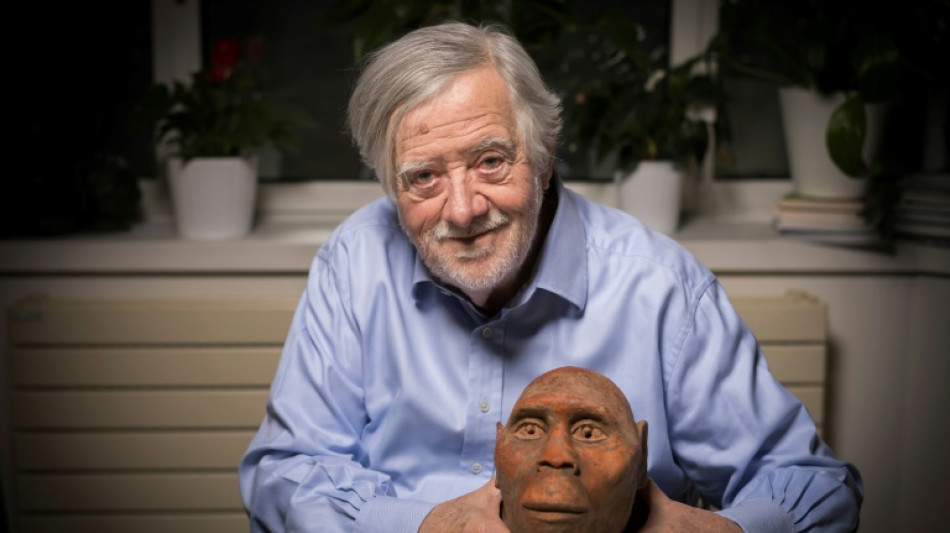
French co-discoverer of 'Lucy' dies at 87 / Photo: LIONEL BONAVENTURE, - - AFP/File

 Ready, set, snooze: Sleep-deprived Japanese compete for best-rested

 Falcons thump Saints 45-24 as New Orleans marks Katrina anniversary

 Tuvalu govt adviser says Australia overstepped in pre-COP visit

 Asian stocks mixed despite tech-led Wall St record
 Tens of thousands expected in Paris for high school protests

 AI borrowing binge rattles US markets

 Young Canadians sue government over alleged climate failures

 White Sox down Guardians to take 2-0 series lead

 Leaders visit Pacific atoll at frontline of climate change

 Yemen's Houthis claim striking Riyadh airport, other Saudi sites

 Best-selling British author Jeffrey Archer dies aged 86

 Military plane crash kills 32 in Nigeria

 Olise powers France to win over Belgium in Nations League

 High-flying Blazy turns to birdlife at Chanel

 Riyadh's allies pledge troops as Yemen, Saudi Arabia attack Houthis

 Clashes erupt outside Kosovo parliament over war crimes court

 Milan's Saelemaekers suffers ankle setback, faces lengthy spell out

 Rubio arrives in Iceland to push for greater US presence in Arctic

 Putin allows Italy's UniCredit to sell part of Russian business
 Djokovic into China Open final as Medvedev out for hitting fan with ball

 ICC unseals arrest warrants for Taliban education ministers

 Modric hopes fans back Croatia against Spain after England shame

 Bolsonaro rides right-wing surge into Brazil's election runoff

 Turkey blocks X account of British reporter

 Ukraine says using AI robot guns to shoot down new Russian drones

French palaeontologist Yves Coppens, credited with the co-discovery of the famous fossil find known as "Lucy", died on Wednesday aged 87 after a long illness, his publisher said.
"France has lost one of its great men," publisher Odile Jacob tweeted, adding that beyond his science skills, Coppens had also been "a talented writer, storyteller and non-fiction author".
He was, with Maurice Taieb and Donald Johanson, part of the team that found the most complete remnants of an Australopithecus afarensis ever discovered, in 1974 in Hadar, Ethiopia.
The team nicknamed the 3.2- million-year-old female hominid "Lucy" after the Beatles song "Lucy in the Sky with Diamonds" which they listened to while labelling the fossils.
Based on the large part of Lucy they found, 40 percent of her skeleton, the scientists were able to determine her height (one metre, 3.5 feet) and show that she was muscular and able to climb trees as well as walk upright.
Coppens, who was born in Britanny and was the son of a nuclear physicist father, co-signed six hominid discoveries over his career.
"At six or seven years old I already wanted to become an archaeologist," Coppens told AFP in 2016. "All my holiday time was spent at digs," he added.
Coppens was admitted to France's prestigious CNRS scientific centre in 1956 when he was still only 22.
He began travelling to Africa from the 1960s, starting with Algeria and Chad.
His first major discovery came in 1967, a 2.6-million-year-old fossil in the Omo valley in Ethiopia.
Then in 1974 came the international expedition in Ethiopia's Afar triangle that was to make Coppens, his friend and fellow Frenchman Taieb and Donald Johanson, an American, world famous for the discovery of Lucy.
Coppens often referred to himself as one of Lucy's "daddies" ("papas" in French).
For a long time after the find, which comprised 52 bone fragments, scientists believed that she was a direct ancestor of humanity.
But this claim is no longer widely believed, and Coppens as well as other palaeontologists came instead to view Lucy as a distant cousin of mankind.
Later Coppens ran digs in Mauritania, the Philippines, Indonesia, Siberia, China and Mongolia.
Back home, he became director of the Musee de l'Homme (Museum of Mankind) in Paris, was given the palaeontology chair in the prestigious College de France, and joined France's Academy of Science.
He also won several prizes, served as an advisor on environmental questions to the French government, and wrote several books and more than a million scientific articles.
Besides the discovery of Lucy, Coppens once told AFP, he was particularly proud to have "made an irrefutable link between the emergence of man and climate change".
As forests gave place to savannas, man stopped climbing trees, began to walk upright and needed to develop brain power to keep carnivores at bay, he said.
burs-jh/har
F.Ramirez--AT