Climate watchers fret over Trump's cut to sciences / Photo: Patrick T. Fallon - AFP

 PSG outgun embattled Man City in six-goal Champions League thriller

 In Chicago, pope's hometown, Catholics express shock and support

 Musk suggests US govt behind any slowdown in Ukraine's Starshield system

 Chiclayo prays for recovery and return of the 'Peruvian pope'
 Barcola scores hat-trick as Liverpool hit LASK for six

 Healthy corals help bleached neighbors regain color: study
 Hope ton helps West Indies level T20 series at 2-2 in India

 Ukraine war reaches shores of Bulgarian fishing village
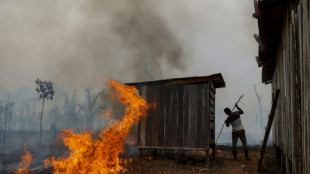 Brazil probing 'criminal' origin of forest fires: minister to AFP

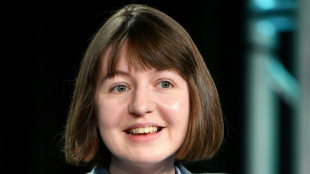 Sally Rooney books cannot be sold in UK amid Palestine Action ban: publisher

 Italian ski stars Goggia and Brignone to miss season opener

 Bournemouth boss Rose urges Cherries to bounce back from Chelsea 'slap'

 Top seed Sabalenka falls at first hurdle in Wuhan
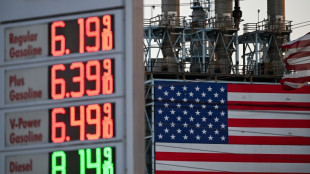
 FX Junction Brings Copy Trading to Everyone, While Their Money Never Leaves With Their Broker

 Brighton defender Struijk's red card overturned

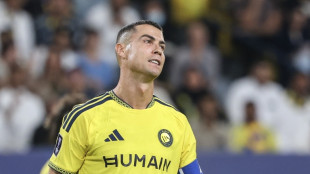 Saudi league postpones three matches after Houthi attacks

 US consumer inflation up more than expected as midterms loom

 Canadian publisher supports novelist Orelien after AI denial

 Medvedev sees off Tsitsipas to reach Shanghai Masters quarters
 Louvre boss warns of closure risk without major renovations

 Lawes and Genge urge England to end ban on overseas-based players

 Metrika Selected by OCC to Support Stablecoin Supervisory Framework Under the GENIUS Act
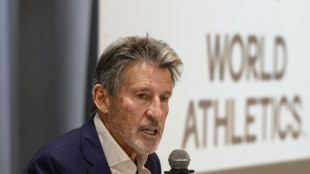 Kenya hosting 2029 World Championships will help doping fight, says Coe

 UK prosecutor tells jury Russell Brand a 'sexual predator'

 Fulham manager Arbeloa fined £25,000 after Man Utd outburst

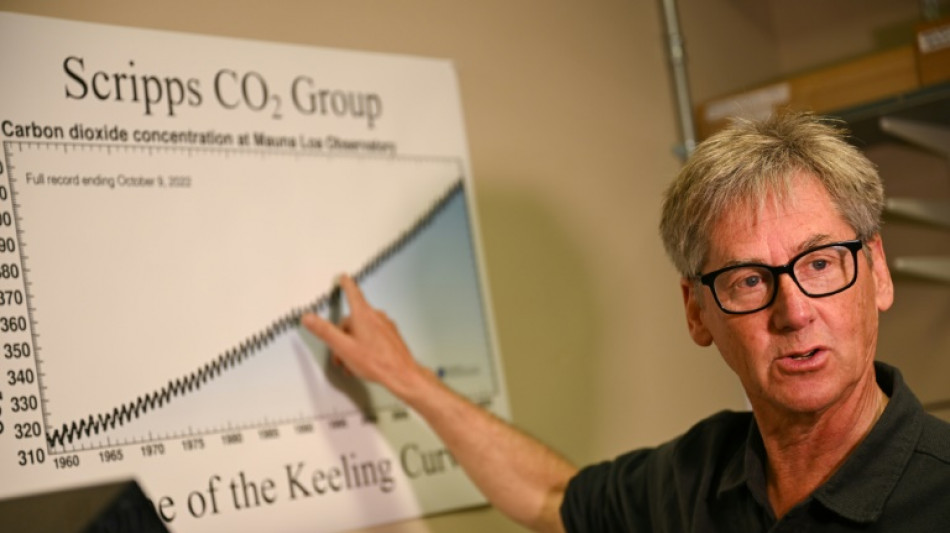
In his California laboratory, Ralph Keeling examines a graph created from data his father began collecting that keeps a record of the amount of carbon dioxide in the atmosphere.
After 67 years, the fate of this "major indicator of climate change" is uncertain under President Donald Trump's administration.
The United States "needs this information, there's no doubt about it," the geochemistry professor at the Scripps Institution of Oceanography in San Diego told AFP.
His father, Charles David Keeling, decided in 1958 to measure atmospheric CO2 concentrations at the summit of the Mauna Loa volcano in Hawaii.
This gave rise to the Keeling curve, which today represents the oldest continuous measurement of this greenhouse gas, which is produced by the burning of fossil fuels.
This graph "showed early on that humans were having an impact on the whole planet," even before the effects of climate change were palpable, Ralph Keeling said.
Even as science as evolved, the project remains an essential climate watchdog.
It provides a basis for thinking about how farmers can modify their crops in the face of a warming atmosphere, or how insurers can adapt their coverage to cope with increasingly fierce fires and more frequent flooding.
"This is very rock solid data, but the program that makes this is fragile," Keeling said.
- 'Concerning' -
Concerns arose in early March, when Elon Musk's so-called Department of Government Efficiency recommended canceling the lease on the National Oceanic and Atmospheric Administration (NOAA) office in Hawaii by the end of August.
This office, located in the town of Hilo, is responsible for maintaining the measurements at the summit of Mauna Loa.
But it's not just buildings. NOAA, a key agency for American climate research, has been targeted by hundreds of layoffs since the return to the White House of Trump, who has repeatedly called climate change a "hoax".
The administration also wants to cut the agency's budget by $1.6 billion, according to documents revealed in mid-April by The New York Times.
The plan also envisages eliminating the branch dedicated to oceanic and atmospheric research.
"It's concerning," said Keeling.
At the summit of Mauna Loa, an observatory houses machines from the Scripps Institute and NOAA, which simultaneously measure atmospheric CO2 concentrations at an altitude of 3,400 meters (11,000 feet).
To ensure they're working properly, local scientists also regularly collect air samples in glass carboys, following the method developed by Charles Keeling more than six decades ago in San Diego.
Since then, other countries have begun recording the amount of CO2 in the atmosphere, thanks to new methods sometimes involving satellites.
But these alone are not enough, according to Keeling.
"Although there's a bigger community now, and there's a constellation of methods being used, those additional efforts have assumed that this backbone from Scripps and NOAA is there," he said.
"A satellite measurement of CO2... gives you a lot of fine grained information, but it doesn't give you reliable long term trends, and it doesn't give you certain other measures that we can get from direct atmospheric measurements.
"You have to ground truth it, you need the calibration."
- Attack on climate science -
NOAA declined to comment on the potential impact of the proposed cuts on its program.
"We are not discussing internal management matters and we do not do speculative interviews," the agency told AFP.
"NOAA remains dedicated to its mission, providing timely information, research, and resources that serve the American public and ensure our nation's environmental and economic resilience."
For Tim Lueker, who spent his career with the atmospheric measurement program launched by the Scripps Institute, that is cold comfort.
The Trump administration "is not making these cuts to save money. It's so transparent what's going on," he said.
At 67, he is worried about a full-scale attack on climate science, with the government ordering the NOAA to identify funding for projects that mention the terms "climate crisis," "clean energy," "environmental quality," or "pollution."
"The idea of saving money... is kind of silly when you consider how much one fighter plane costs compared to the annual funding of NOAA Climate Research."
J.Gomez--AT