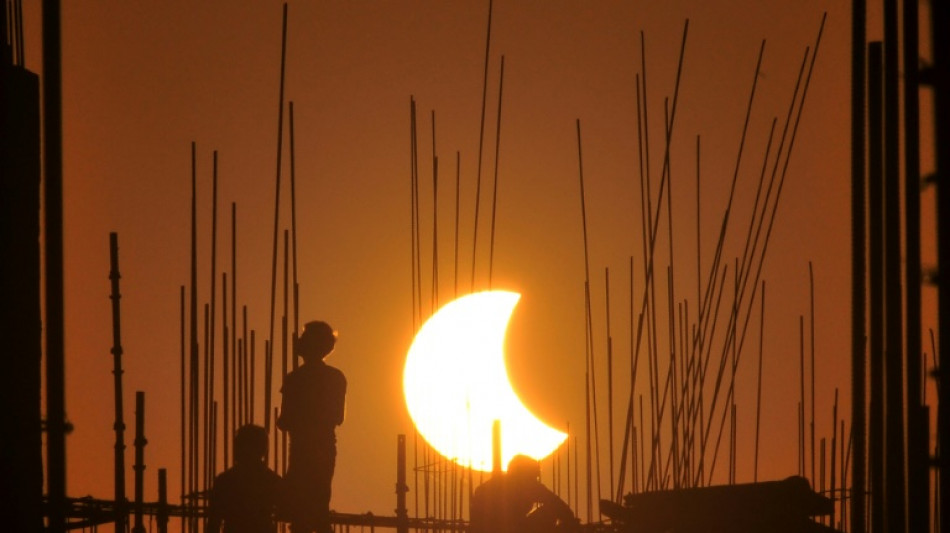
Partial solar eclipse in northern areas on Saturday / Photo: Vinay GUPTA - AFP/File

 New four-lane bridge opens between China, North Korea

 Tech stocks lead rout after US inflation fuels rate hike bets

 'No time to recover': UNDP chief sounds alarm on growing poverty after Iran war shock

 Australia says won't let big tech have 'unfettered' access to kids

 Mobile clinics battle Mongolia's childhood dental 'disaster'

 Wallabies back Meredith as playmaker for second New Zealand Test

 Messi's Inter Miami book playoffs with 2-0 win over New York City

 Oil-rich Alberta tests Canada's unity with secession vote

 EU leaders head for showdown over bloc budget

 All Blacks make three changes for second Wallabies Test

 Spider Labs: 75.0% of Bot-Classified Ad Clicks Lacked Basic Browser Automation Signs

 PSG 'got lucky' to win Man City thriller, says Luis Enrique

 Real Madrid comeback stuns Roma as Mourinho enjoys happy reunion
 Shakhtar make winning start at new Champions League 'home'

 Hat-trick hero Barcola primed to shine for Liverpool: Iraola

 Villa put six past Fenerbahce in record rout

 US stocks fall after hot inflation report as leading AI shares tumble

 Government buildings torched in violent Albanian protests

 Wall Street grills Bank of America over money laundering fine

 Mekies extends contract as Red Bull team principal until 2031

 Indonesia rescues starved orangutan from fires: officials

 Real Madrid's Vinicius banned for Clasico after red card
 Restrictions expose Ukraine's Starlink dependency in Russia war: observers
 Espada out as Astros manager while Mattingly stays with Phillies

 Houthis say targeted Saudi oil giant Aramco, vow more attacks

The moon will cross in front of the Sun for around four hours on Saturday, creating a partial solar eclipse that careful skygazers will able to see in parts of the Northern Hemisphere.
The eclipse will stretch from eastern Canada to northern Russia, and potentially be visible in most of Europe and some areas of northeastern North America and northwest Africa, according to France's Paris Observatory.
The eclipse will begin at 0850 GMT on Saturday and end at 1243 GMT.
The relatively rare celestial event occurs when the Sun, Moon and Earth all line up. A total solar eclipse is when the moon totally blots out the Sun, creating an eerie twilight.
But this time, the Moon will cover at most 90 percent of the Sun in some northern latitudes, turning the Sun's rays into "cold light", Paris Observatory astronomer Florent Deleflie told AFP.
The maximum amount of eclipse will be visible in northeastern Canada and Greenland at 1047 GMT.
It will be less spectacular in other areas. In France, for example, between 10 to 30 percent of the Sun's disc will be obscured, depending on the region.
"The naked eye will not be able to see any difference," Deleflie said.
- Be careful -
People wanting to see the moon apparently take a bite out of the Sun will need to take precautions.
Looking straight at the Sun -- during an eclipse or otherwise -- can lead to irreversible vision loss.
"Using special glasses is one solution," Deleflie said.
However if the glasses are not new, even a slight defect or "microscopic hole" can cause eye damage, he warned, advising people to try observing an eclipse at a local astronomy observation centre.
There, "you can safely verify the precision of celestial mechanics and marvel at interesting details on the Sun's surface, such as sunspots", he said.
The partial eclipse will not turn up on a smartphone camera without a suitable filter, Deleflie added.
"The light is so intense that the obscured part won't appear."
The latest celestial show will come two weeks after skygazers across much of the world marvelled at a rare total lunar eclipse, dubbed a "Blood Moon".
Saturday's partial solar eclipse will be the first of the year, and the 17th of this century.
A bigger one is coming -- On August 12, 2026 a total solar eclipse will be visible in Iceland, northern Spain and a parts of Portugal.
More than 90 percent of the Sun will also be obscured in parts of Europe including Britain, France and Italy.
It will be the first total solar eclipse since one swept across North America in April 2024.
R.Garcia--AT