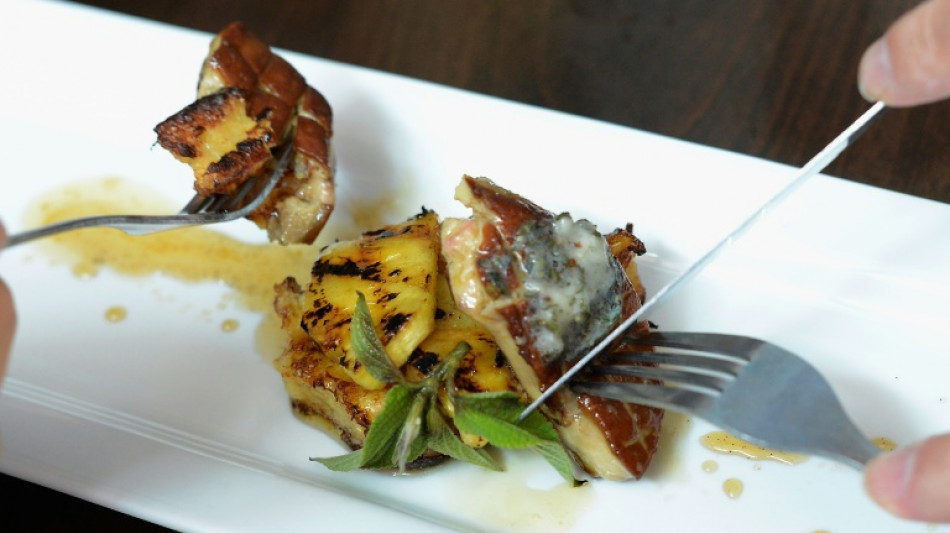
Faux gras? Scientists craft 'more ethical' version of French delicacy / Photo: KEVORK DJANSEZIAN - GETTY IMAGES NORTH AMERICA/AFP/File

 New four-lane bridge opens between China, North Korea

 Tech stocks lead rout after US inflation fuels rate hike bets

 'No time to recover': UNDP chief sounds alarm on growing poverty after Iran war shock
 Australia says won't let big tech have 'unfettered' access to kids

 Mobile clinics battle Mongolia's childhood dental 'disaster'

 Wallabies back Meredith as playmaker for second New Zealand Test
 Messi's Inter Miami book playoffs with 2-0 win over New York City
 Oil-rich Alberta tests Canada's unity with secession vote
 EU leaders head for showdown over bloc budget

 All Blacks make three changes for second Wallabies Test

 Spider Labs: 75.0% of Bot-Classified Ad Clicks Lacked Basic Browser Automation Signs

 PSG 'got lucky' to win Man City thriller, says Luis Enrique

 Real Madrid comeback stuns Roma as Mourinho enjoys happy reunion

 Shakhtar make winning start at new Champions League 'home'

 Hat-trick hero Barcola primed to shine for Liverpool: Iraola

 Villa put six past Fenerbahce in record rout
 US stocks fall after hot inflation report as leading AI shares tumble
 Government buildings torched in violent Albanian protests
 Wall Street grills Bank of America over money laundering fine

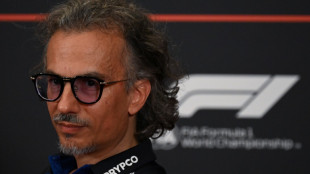 Mekies extends contract as Red Bull team principal until 2031
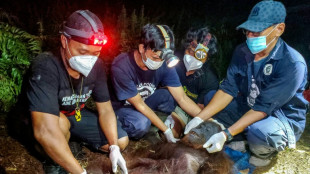 Indonesia rescues starved orangutan from fires: officials

 Real Madrid's Vinicius banned for Clasico after red card
 Restrictions expose Ukraine's Starlink dependency in Russia war: observers
 Espada out as Astros manager while Mattingly stays with Phillies
 Houthis say targeted Saudi oil giant Aramco, vow more attacks
Foie gras — the fattened liver of ducks or geese — is a French delicacy prized for its rich, buttery flavor. But its production, which involves force-feeding the animals, has led to bans in several countries.
Now, a team of scientists says they've developed a more ethical alternative: one that mimics the taste and texture of the dish, minus the controversy.
The results were published Tuesday in the journal Physics of Fluids.
"It was always a dream to make foie gras more accessible and better for animal welfare," said lead author Thomas Vilgis, a professor of food science at the Max Planck Institute for Polymer Research in Mainz, Germany. "It's good to stop these force-feeding practices —- or at least reduce them."
Vilgis and his colleagues from his own institute and the University of Southern Denmark were adamant about one thing: no outside additives.
They initially tried cooking collagen from the birds' skin and bones into the liver-fat emulsion, but the result lacked the signature silky texture.
Then came the breakthrough: treating the fat with the bird's own lipases: enzymes the body naturally uses to break down fats. This tweak replicated a key part of the foie gras formation process, without resorting to force-feeding.
"At the end of the process, it allows the fat to recrystallize into the large crystals which form aggregates like the ones we see in the original foie gras," Vilgis said.
According to the authors, the elegance of the method lies in its simplicity: harvest the liver and fat, treat the fat with lipases, mix, sterilize — and voila.
Laser microscopy gave the new product a thumbs-up: the emulsion structure, fat droplet size, and shape closely matched traditional foie gras. Even the aroma passed the test.
To test texture, the team turned to industrial compression devices -— machines that gently press on food samples to measure firmness. The new foie gras held up well, offering a mouthfeel strikingly close to the original.
"We could really see the influence of these large fat particles, which we call in the paper 'percolating clusters,'" Vilgis said.
"At the beginning of the 'bite,' these large clusters have a high resistance, creating a similar mouthfeel of elasticity -— without being too rubbery like after the collagen or gelatin addition."
Vilgis has filed a patent for the process and now hopes to partner with companies to bring this kinder foie gras to market.
Y.Baker--AT