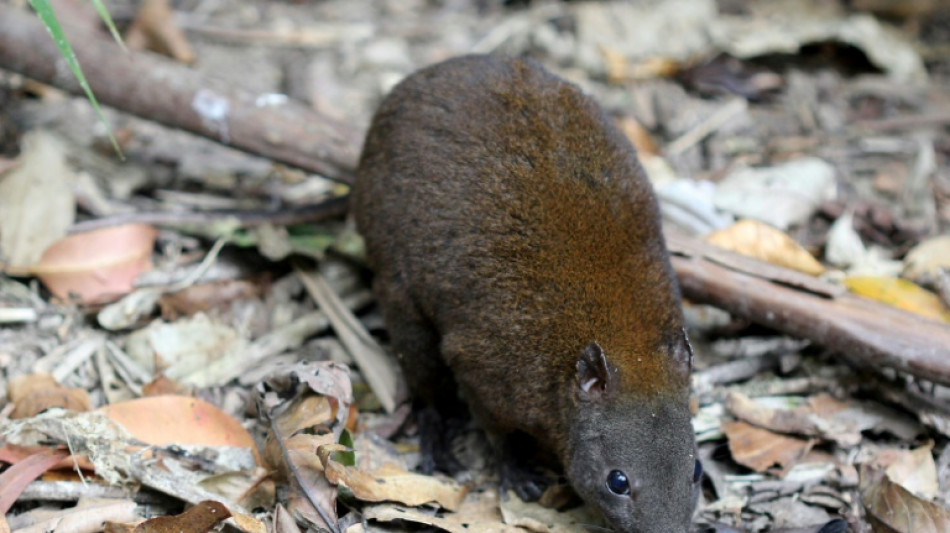
'Musky' marsupial could solve hopping kangaroo mystery / Photo: Handout - FLINDERS UNIVERSITY/AFP

 Asian Cup in Saudi Arabia could be postponed but 'no hurry' to decide: AFC

 Conrad wields axe after South Africa loss to Australia

 School roof collapse kills teacher, 27 children in NW Pakistan

 Haze turns Indonesia skies orange, shuts schools in East Timor

 California puts first US billionaire tax to the vote

 School headscarf ban meets resistance in Austria

 World's top cocoa producer aims for a climate-tough bean

 Why is Shell facing lawsuits over climate disasters in Brazil and the Philippines?

 New four-lane bridge opens between China, North Korea

 Tech stocks lead rout after US inflation fuels rate hike bets

 'No time to recover': UNDP chief sounds alarm on growing poverty after Iran war shock

 Australia says won't let big tech have 'unfettered' access to kids

 Mobile clinics battle Mongolia's childhood dental 'disaster'

 Wallabies back Meredith as playmaker for second New Zealand Test

 Messi's Inter Miami book playoffs with 2-0 win over New York City

 Oil-rich Alberta tests Canada's unity with secession vote

 EU leaders head for showdown over bloc budget

 All Blacks make three changes for second Wallabies Test

 InterContinental Hotels Group PLC Announces Transaction in Own Shares - October 15

 Spider Labs: 75.0% of Bot-Classified Ad Clicks Lacked Basic Browser Automation Signs

 PSG 'got lucky' to win Man City thriller, says Luis Enrique

 Real Madrid comeback stuns Roma as Mourinho enjoys happy reunion

 Shakhtar make winning start at new Champions League 'home'

 Hat-trick hero Barcola primed to shine for Liverpool: Iraola

 Villa put six past Fenerbahce in record rout

Scientists stalking a small marsupial through a remote Australian rainforest say they may have found a clue to the mystery of why its bigger kangaroo cousins hop instead of walk.
Kangaroos and closely related wallabies are the only large animals to hop upright on two legs, researchers from Australia's Flinders University said Thursday, but why remains a mystery.
They believe the answer may lie with the small musky rat-kangaroo, a bush-dwelling marsupial weighing about the same as a loaf of bread.
Musky rat-kangaroos are a distant ancestor of the larger kangaroo species that famously roam the country's outback.
Researcher Amy Tschirn said musky rat-kangaroos -- named for their pungent scent -- were the only member of the "macropodoid" family that did not hop.
"As the only living macropodoid that doesn't hop, the musky rat-kangaroo provides a crucial insight into how and when the iconic hopping form of locomotion evolved in Australia."
Scientists tracked the creatures, also known as "muskies", through the tropical rainforests of far-northern Queensland state.
They observed the creatures moving in a "bounding" motion -- hopping with their back legs while their front paws remained on the ground.
It suggested a kind of mid-point in the evolutionary journey from walking on all fours to hopping on two, the researchers said.
"These results signal a potential pathway to how bipedal hopping evolved in kangaroos," said Harvard University biologist Peter Bishop, who was involved in the work.
"Perhaps it started with an ancestor that moved about on all fours like other marsupials, then an animal that bounded like the muskies, and finally evolved into the iconic hopping kangaroos we see in Australia today."
Kangaroos and wallabies are the only hopping species heavier than five kilogrammes (11 pounds), the researchers said.
Some smaller species of rodent also hop.
The researchers said they hoped to find fossils of ancient marsupials to better understand the evolution of modern-day kangaroos.
Their findings were published Thursday in peer-reviewed journal Australian Mammalogy.
N.Mitchell--AT