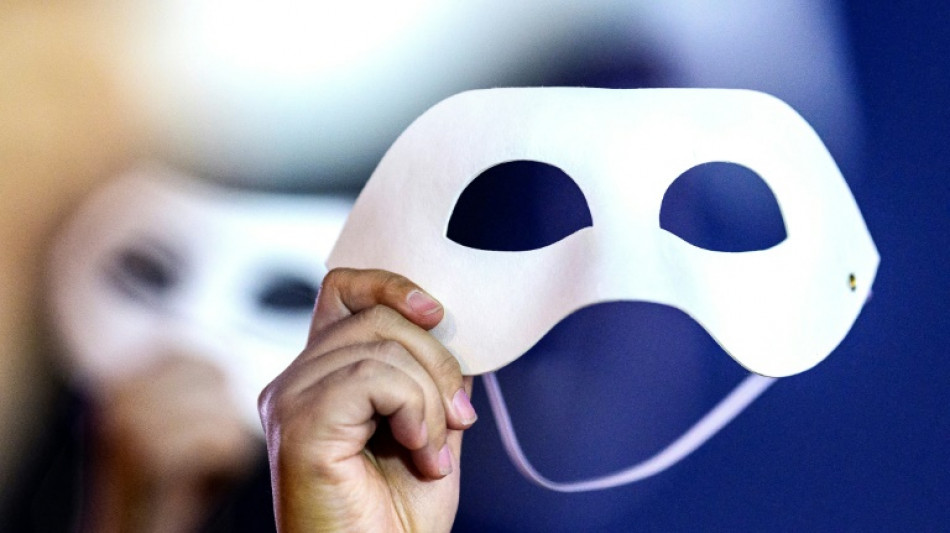
Tech firms fight to stem deepfake deluge / Photo: Anthony WALLACE - AFP

 Asian Cup in Saudi Arabia could be postponed but 'no hurry' to decide: AFC

 Conrad wields axe after South Africa loss to Australia

 School roof collapse kills teacher, 27 children in NW Pakistan

 Haze turns Indonesia skies orange, shuts schools in East Timor

 California puts first US billionaire tax to the vote

 School headscarf ban meets resistance in Austria

 World's top cocoa producer aims for a climate-tough bean

 Why is Shell facing lawsuits over climate disasters in Brazil and the Philippines?

 New four-lane bridge opens between China, North Korea

 Tech stocks lead rout after US inflation fuels rate hike bets

 'No time to recover': UNDP chief sounds alarm on growing poverty after Iran war shock

 Australia says won't let big tech have 'unfettered' access to kids
 Mobile clinics battle Mongolia's childhood dental 'disaster'

 Wallabies back Meredith as playmaker for second New Zealand Test
 Messi's Inter Miami book playoffs with 2-0 win over New York City

 Oil-rich Alberta tests Canada's unity with secession vote

 EU leaders head for showdown over bloc budget
 All Blacks make three changes for second Wallabies Test

 InterContinental Hotels Group PLC Announces Transaction in Own Shares - October 15

 Spider Labs: 75.0% of Bot-Classified Ad Clicks Lacked Basic Browser Automation Signs

 PSG 'got lucky' to win Man City thriller, says Luis Enrique

 Real Madrid comeback stuns Roma as Mourinho enjoys happy reunion
 Shakhtar make winning start at new Champions League 'home'

 Hat-trick hero Barcola primed to shine for Liverpool: Iraola

 Villa put six past Fenerbahce in record rout

Tech firms are fighting the scourge of deepfakes, those deceptively realistic voices or videos used by scammers that are more available than ever thanks to artificial intelligence.
Ever-improving generative artificial intelligence (GenAI) tools have become weapons in the hands of bad actors intent on tricking people out of their money or even their identities.
Debby Bodkin tells of her 93-year-old mother receiving a telephone call, a cloned voice claiming, "It's me, mom... I've had an accident."
When asked where they were, the machine-made impersonator named a hospital.
Fortunately, it was a granddaughter who answered the phone, opting to hang up and call Bodkin at work where she was safe and well.
"It's not the first time scammers have called grandma," Bodkin told AFP. "It's daily."
Such deepfake phone scams typically go on to coax victims into paying for medical care or other made-up emergencies.
Used on social networks to hijack the notoriety of celebrities or other high-profile figures, sometimes for disinformation, deepfakes are also being exploited by criminal gangs.
Hong Kong police earlier this year revealed that a multinational firm employee was tricked into wiring HK$200 million (around US$26 million) to crooks who staged a videoconference with AI avatars of his colleagues.
A recent study by identification start-up iBoom found that a scant tenth of one percent of Americans and Britons were able to correctly tell when a picture or video was a deepfake.
A decade ago, there was a single AI tool for generating synthetic voices -- now there are hundreds of them, according to voice authentication specialist Vijay Balasubramaniyan, CEO of Pindrop Security.
GenAI has changed the game, he said.
"Before, it took 20 hours (of voice recording) to recreate your voice," the executive told AFP.
"Now, it's five seconds."
Firms such as Intel have stepped up with tools to detect GenAI-made audio or video in real-time.
Intel "FakeCatcher" detects color changes in facial blood vessels to distinguish genuine from bogus imagery.
Pindrop breaks down every second of audio and compares it with characteristics of a human voice.
"You have to keep up with the times," says Nicos Vekiarides, chief of Attestiv platform which specializes in authenticating digital creations.
"In the beginning, we saw people with six fingers on one hand, but progress has made it harder and harder to tell (deepfakes) with the naked eye."
- 'Global cybersecurity threat' -
Balasubramaniyan believes that software for spotting AI content will become standard at companies of all kinds.
While GenAI has blurred the boundary between human and machine, companies that re-establish that divide could soar in a market that will be worth billions of dollars, he said.
Vekiarides warned that the issue "is becoming a global cybersecurity threat."
"Any company can have its reputation tarnished by a deepfake or be targeted by these sophisticated attacks," Vekiarides said.
Balasubramaniyan added that the shift to telework provides more opportunity for bad actors to impersonate their way into companies.
Beyond the corporate world, many expect consumers to look for ways to fight off deepfake scams endangering their personal lives.
In January, China-based Honor unveiled a Magic7 smartphone with a built-in deepfake detector powered by AI.
British start-up Surf Security late last year launched a web browser that can flag synthetic voice or video, aiming it at businesses.
Siwei Lyu, a professor of computer science at the State University of New York at Buffalo, believes "deepfakes will become like spam," an internet nightmare that people eventually get under control.
"Those detection algorithms will be like spam filters in our email software," Lyu predicted.
"We're not there yet."
M.White--AT