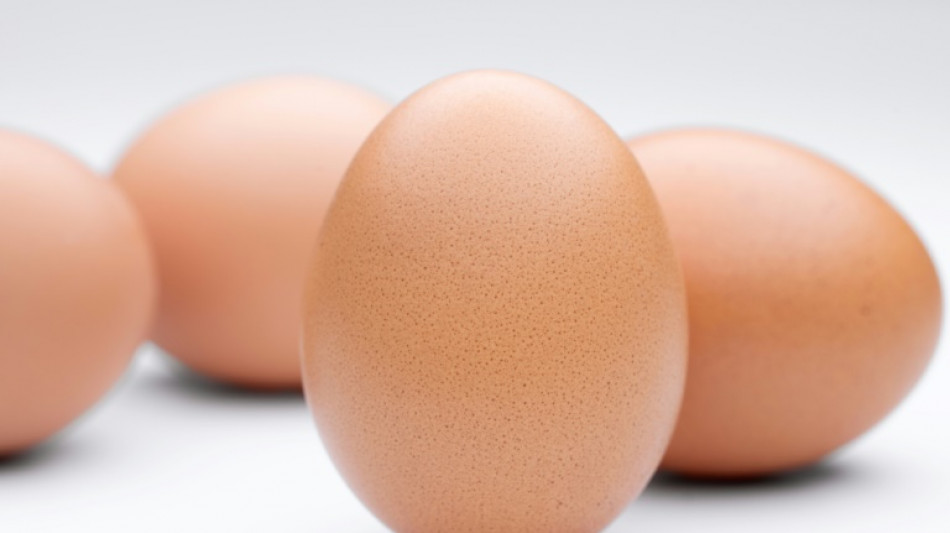
Scientists claim to have cracked how to cook the perfect egg / Photo: JOEL SAGET - AFP/File

 'Multiple victims' in Oregon elementary school shooting: police

 ChangeNOW Announces NOW AI After Resolving Website Integration Vulnerability

 Argentine demonstration over education cuts ends in clashes

 Argentine protesters, police clash at demo over university funding

 US stocks end higher as AI shares stabilize

 School roof collapse kills 32 children, teacher in Pakistan

 Lyon down Palace in Europa League, Sunderland leave it late

 UniCredit says receives ECB green light for Commerzbank takeover

 New York City pension fund asks Anthropic to delay IPO

 Venezuela's Maduro denies US torture charges as 'false accusations'

 Somalia sets May presidential election despite insecurity

 Chelsea's Caicedo eager to be more of a leader

 Rahm reaches separation deal with LIV in bankruptcy court

 UN chief urges nations to end 'war on nature'

 Newcastle boss Jaissle says Fernandez-Pardo just needs a goal

 Infantino offers apology but 'no answers' at FIFA meeting over World Cup plan

 Don't exclude Turkey from 'Made in Europe' plan: minister to AFP

 French duo Justice to score 'GTA VI': game maker

 El Nino a 'terrifying' threat to coral reefs: UN biodiversity expert

 Barcola must get used to Liverpool highs and lows, says Iraola

 Versus Trade Wins Best ECN/STP Broker APAC 2026, Marking Third UF Awards Recognition

 Three dead as Istanbul sees heaviest rainfall in 80 years

 US producer prices see biggest jump since 2022 in added challenge to Trump

 Swiatek avoids seed exodus to breeze into Wuhan last eight

 PM condemns 'chaos' as violent protests grip Albania

Hard-boiled, soft-boiled or poached. Scientists have studied how to cook the perfect egg and have come up with a new recipe that they say optimises its taste and nutritional quality.
Cooking an egg is a delicate art because the yolk and the white do not cook at the same temperature.
The yolk begins to solidify at 65 degrees Celsius (149 degrees Fahrenheit) and the white at 85C.
To avoid ending up with a soft-boiled egg, chefs have to choose a "compromise temperature", said the authors of a study published on Thursday in the journal Communications Engineering.
In the case of a hard-boiled egg -- cooked for 12 minutes at 100C -- all parts of the egg have a final temperature of 100C, well above the ideal cooking temperature, particularly for the yolk.
In the case of egg sous vide, which is cooked between 60 and 70C, the final egg is at a temperature of 65C.
But while this is the ideal temperature for the yolk, it is much too low for the proteins in the egg white to stick together.
As for the soft-boiled egg, cooked for six minutes at 100C, the authors say the egg yolk is undercooked.
The Italian polymer specialists approached the problem by simulating the process with the help of computational fluid dynamics software, which was used to simulate and analyse the flow of fluids and their interactions with solid surfaces.
- Recyclable materials -
The solution, they suggest, is to use a saucepan of boiling water at 100C and a saucepan of water at 30C and to transfer the egg from one to the other every two minutes for exactly 32 minutes in total.
"It is found that a stationary state at the centre of the yolk is reached at a constant temperature of 67C," namely the mean value between the temperatures of the saucepan of boiling water and the saucepan of lukewarm water, Pellegrino Musto, one of the study's authors, told AFP.
"Conversely, the albumen alternatively sees temperatures in the range 100–87C and 30–55C during the hot and cold cycles respectively," which allows all the layers of the egg white to reach cooking temperature, added Musto, research director at the National Research Council of Italy's Institute for Polymers, Composites and Biomaterials.
The authors then tested this method of "cooking in cycles" and found that the result was "more similar to the soft boiled when analysing the texture of its albumen, while it is very similar to the sous videsample when considering its yolk," the study says.
Cooking in cycles also has a "better advantage over conventional cooking methods in terms of nutritional content", the authors said.
The chemical analysis showed that the yolks of eggs cooked in cycles contained more polyphenols -- healthy micronutrients -- than hard-boiled eggs, soft-boiled eggs or sous videeggs.
Musto said in an email that the result was "(partially) unexpected" and proposed that "temperature degradation of bioactive molecules" at higher temperatures could be a possible cause.
The study has also found practical application, with one of the study's authors, Ernesto Di Maio, using the cyclic cooking method "regularly for his family and friends, who appreciate it a lot".
However, Musto pointed out that the study would have applications beyond the kitchen, especially with regard to recyclability, which he said was the main theme of the research group.
"A well designed thermal profile may allow the development of layered structures within an object made from a single material" that is entirely recyclable, Musto said.
"The resulting object will have layered properties as if it were a multi-material object," Musto said, adding that these are "very difficult to recycle" except in rare circumstances.
H.Gonzales--AT